

The Foundation Is Set. Now We Build.
Lighthouse Macro Phase 2 · Positioning Update #3 · Beam #1

April 14, 2026
If you’ve been here since January, you already know. We took our time.
Twelve pillars. Three engines. Months of work before we ever asked anyone to pay for a subscription. That was deliberate.
Most newsletters launch with a hot take and a paywall. We launched with a framework. A full diagnostic system, macro dynamics, monetary mechanics, market structure, built from the ground up, published for free, one pillar at a time. We knew that might cost us some early subscribers. We knew people might lose patience, or wonder when the “real” content was coming.
But here’s the thing: that was the real content.
Nobody in this space is publishing a 12-part analytical framework and handing it to you before asking for a dime. Because if you don’t understand how the system works, how labor flows lead stocks, how plumbing stress shows up before headlines do, how sentiment extremes become positioning signals, then a weekly market call is just noise. And there’s plenty of noise out there already.
So we built the foundation first. Every pillar, every indicator, every threshold, documented, explained, and published. Not behind a paywall. Not gated. Just out there for anyone willing to do the reading.
That phase is done.
Why we built it this way.
Before Lighthouse, I spent more than six years with the equity team at Bank of America Private Bank, progressing from intern to Associate Portfolio Manager. The strategy delivered a 2.35 Sortino, 103% upside capture, and 76% downside capture against the S&P 500. That performance is what convinced me the institutional diagnostic process I was using daily could exist outside a private bank.
Along the way, I’ve taken stops on the sell-side at a macro research provider, on the buy-side at a discretionary macro hedge fund, and at one of the largest trading data providers in the world, where I ran data and analytics for the buy-side research product. That’s where I authored published work on short interest signals and built proprietary market indices. Buy-side, sell-side, and data infrastructure. Every seat taught me something different about how institutional-grade macro work actually gets built and consumed.
Lighthouse Macro is all of that, productized, for allocators and hedge funds and family offices who don’t have a 20-person research team but still need the same systematic framework.
What’s been happening behind the scenes
While the pillars were going out, we weren’t sitting still.
PiTrade portfolio partnership. We’ve onboarded PiTrade as our portfolio tracking partner. The account is set up, the bank is verified, funding moves this week. Once funded, the model portfolio becomes continuously auditable in real time. Every position, every mark, every rebalance, timestamped and visible to subscribers. That is the infrastructure upgrade that makes the next phase possible.
Theo Advisors MOU. We signed a formal partnership with Theo Advisors, complete with IP protections and a structured referral framework. This opens a channel between our macro research and advisory-level client work.
We’re also actively exploring new data infrastructure partnerships and distribution channels. The Diagnostic Dozen wasn’t the destination. It was the launchpad.
What to expect starting now
Here’s what your subscription looks like going forward.
The Beacon comes every Sunday morning. 3,000-4,000 words of cross-pillar macro analysis. This is the flagship. Where the framework meets the current market. What changed across all twelve pillars, where the engines agree, where they diverge, and what that means for the week ahead. Every Beacon is anchored by an executive summary up top and explicit invalidation criteria at the bottom. Free for all subscribers, permanently.
Beams start today. Twice a week, roughly 750 words plus five charts. Targeted, timely, one thesis per post. Every Beam follows the same six-question structure: what just happened, what the data says, why the mechanism matters, where consensus is wrong, what would change our mind, and the positioning takeaway. Same shape every time. Variable insight, fixed frame. Because when the structure is consistent, the takeaways stand out.
Notes go out three times a week. Quick hits, 150 words and a chart. Free tier gets these too. The daily pulse.
The Chartbook drops every two weeks. 50-75 charts. No commentary, just the data. For those of you who want to see the full dashboard and draw your own conclusions.
The Horizon publishes monthly. Longer-form thematic work. 90-day forward outlook with scenario analysis, probability weights, and positioning implications across equities, rates, credit, commodities, and crypto. Where we zoom out and think about the big structural questions.
The cadence is about to pick up significantly. That’s the whole point. We front-loaded the framework so that everything from here has context.
This week is on us
Everything through Sunday is open to all subscribers. Beams, Notes, all of it. Consider it a proof of concept. We’ll have two Beams, daily Notes, and the first full Beacon this Sunday before anything moves behind the paywall.
Starting Tuesday, April 21 at 9:30am ET, Beams, Chartbook, and Horizon move to paid subscribers only. The Beacon stays free, permanently.
Positioning Update #3
First positioning mark since February 22. Honest accounting, including what we got wrong.
Inception was January 16, 2026. Starting capital: $100,000. The defensive posture set at inception has not been rebalanced. Here is the full accounting through last Friday’s close.
Jan 16 → Feb 23 (PU#2 published): Portfolio +5.11%, SPY -1.34%, alpha +6.45 pp. The defensive sleeve worked. XLU delivered, XLP held, GLD ran to $481. Five weeks of what the framework is supposed to do.
Feb 23 → Apr 10 (since PU#2): Portfolio -3.38%, SPY -0.43%, alpha -2.95 pp. We gave it back. GLD round-tripped from $481 down to $437. XLV underperformed against our own published expectations. The defensive sleeve had a rough seven weeks.
Jan 16 → Apr 10 (full inception): Portfolio +1.55%, SPY -1.76%, alpha +3.32 pp over 12 weeks. That is the honest number. Positive absolute return in a slightly down SPY tape, from a defensive posture, with one unforced error.
What we got wrong
In the February 22 Positioning Update, we flagged XLV with an explicit clause: “Trim if no relative strength improvement in 4 weeks.” Four weeks later was March 20. On that date, XLV’s relative strength versus SPY had deteriorated 3.55% from Feb 23. The trigger was met.
We did not act. The PiTrade onboarding consumed the bandwidth that should have gone to execution. As it happened, XLV recovered modestly from $145.33 on March 20 to $147.31 on April 10, so the financial cost of the missed trim was approximately 10 basis points. The discipline cost was higher. That is exactly the gap continuous tracking is built to close, and exactly why we are moving to PiTrade now instead of staying on discretionary monitoring.
Gold is the other conversation worth having. GLD peaked at $481.28 on February 23 and fell back to $437.13 by April 10. We explicitly said in “Bullion Brilliance” in March 2025 that new all-time highs should not trigger profit-taking on the structural thesis. We held to that discipline. The drawdown is the cost. The thesis (fiscal dominance, central bank buying, dollar weakness, de-dollarization) is intact. GLD is still up 3.76% from the January 16 entry, and we are still overweight.
Where we stand now
MRI has softened from High Risk at the February update to Neutral as of April 13 (reading +0.03). Market Structure Index is back in Strong Uptrend at +1.01. HY OAS is at 294 bps, complacent by our framework but below the 300 threshold that would force a reassessment. Labor is unchanged at the quits threshold. The composition of risk has shifted, but the defensive posture is still the right starting point. The April 14 signal dashboard is in the model portfolio file.
With PiTrade funded, every position is visible in real time. Marks are live, not scheduled.
The Diagnostic Dozen Discount
12 Pillars. 3 Engines. 1 Framework.
$500 $320. 36% off annual, first year only. Through April 21 at 9:30am ET.
Subscribe at the launch rate → Why 36? Twelve pillars across three engines. Math is fun.
This is a one-time launch offer. It won’t be extended, repeated, or stacked with anything else. When the window closes at market open on Tuesday the 21st, it’s gone. Monthly subscriptions are available at $50/month for those who want to start there. No discount on monthly, ever. The annual launch rate is the best deal we’ll offer.
If you just got here
Welcome. We’ve had a wave of new subscribers in the last 24 hours, and we’re glad you’re here.
One ask: go back and read the pillars. All twelve are linked at the bottom of this post. They’re free, they’re not going anywhere, and they’re the operating manual for everything we publish from here. You don’t need to read them all in one sitting. But the more of the framework you internalize, the more value you’ll get out of everything that follows.
Your first Beam
Enough about what we’re building. Let’s show you.
Below is the first Beam. Five charts, one thesis, following the fixed six-section structure. This is what the framework looks like in real time.
The Consumer Is the Canary. Gasoline Just Lit the Fuse.
Beam #1 · April 14, 2026
The Setup
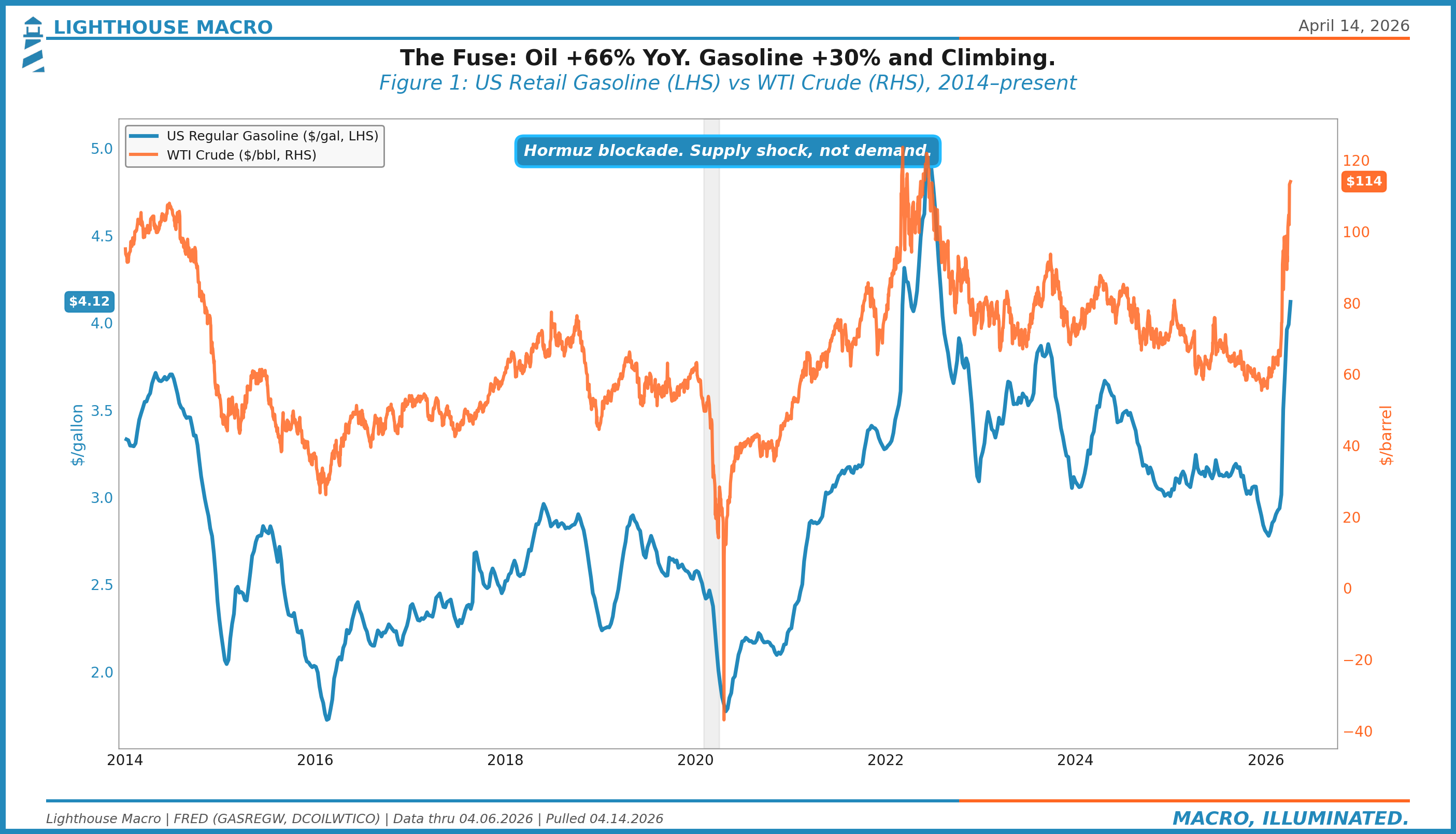
Oil is up 66% in the last year. Gasoline jumped 21% in a single month. Real disposable income is growing at 1.06%.
Do the math.
The March CPI print landed at 3.3% headline, 2.7% core. The consensus read wrote itself: transitory energy shock, core is fine, Fed stays patient, rally continues. Every trading desk in New York has posted some version of this take by now. It is the wrong read.
The Data
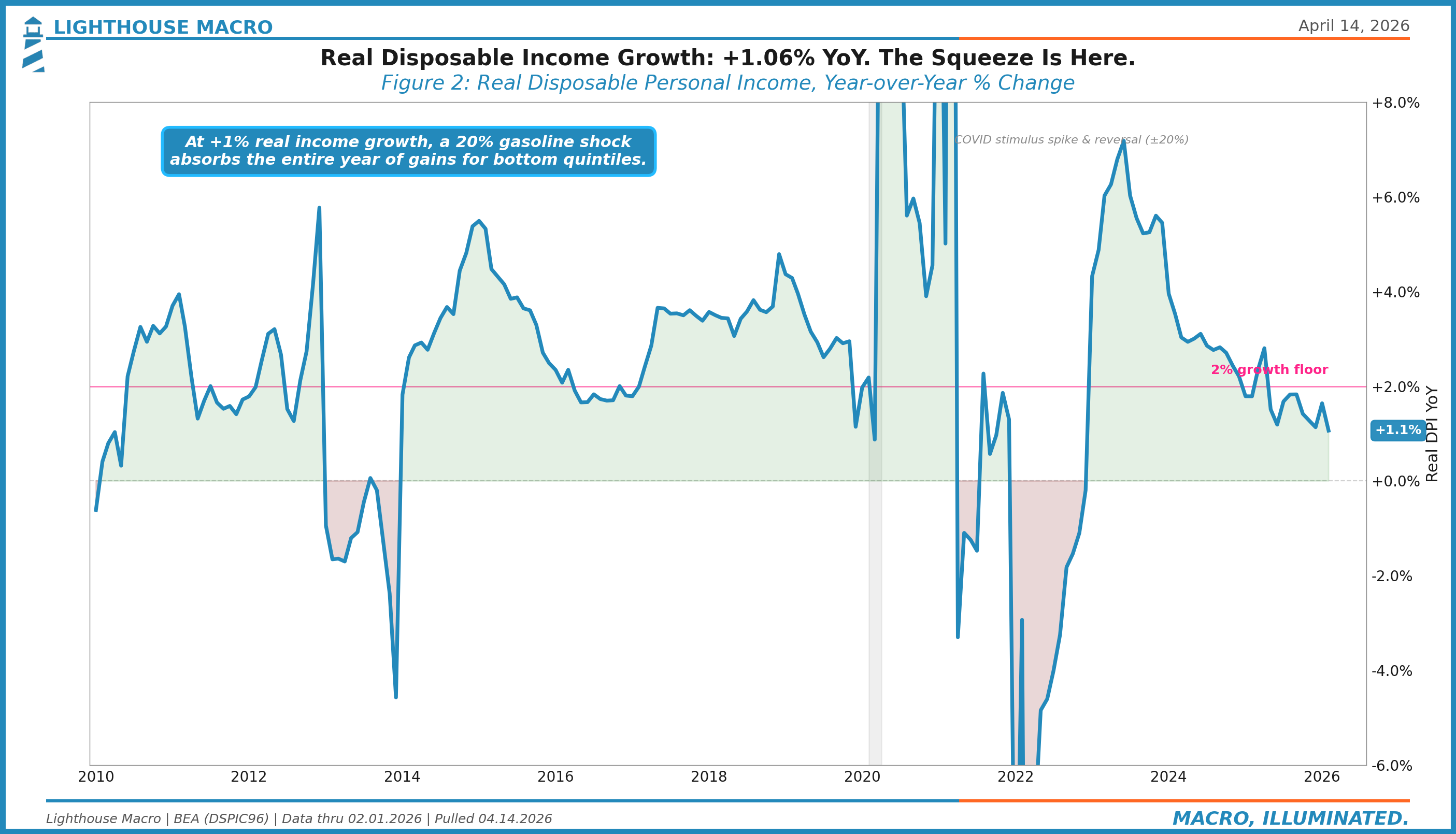
Real disposable income is growing at 1.06% year over year. That is the closest to zero we’ve seen outside a recession in two decades. It means the average household, in real terms, has almost no margin. And “average” is generous here: the top quintile is carrying the growth. The bottom half is already underwater before the gasoline bill arrives.
A 20% gasoline shock on a flat-income household isn’t a rounding error. It’s the entire year of real gains.
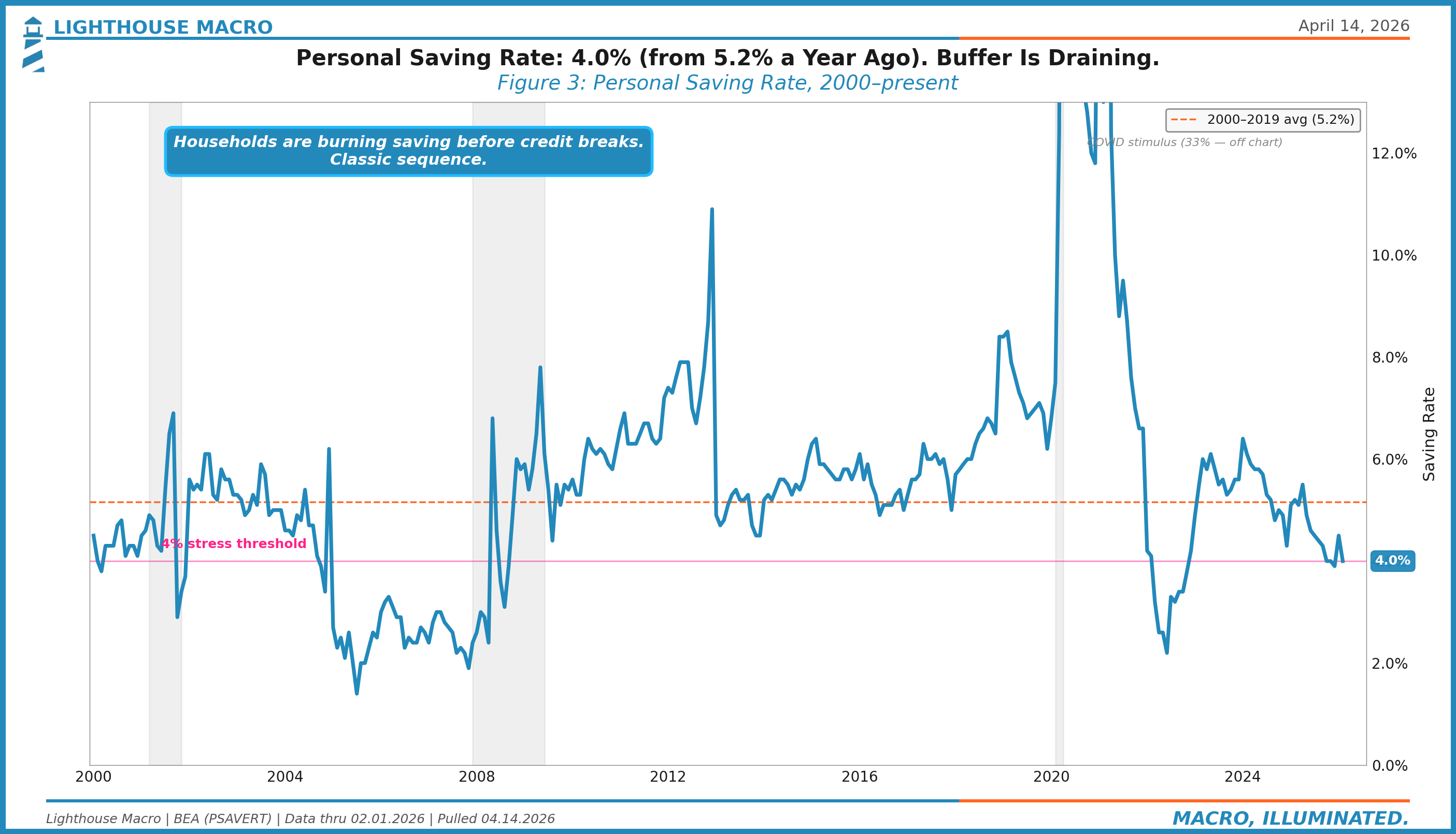
The saving rate tells the same story from the other side. It sits at 4.0%. A year ago it was 5.2%. The 2000-2019 baseline was 6.5%. We are below every regime we have clean data for outside of 2022’s inflation spike, and we are there before the oil shock has fully transmitted to retail prices.
The Mechanism
This is Pillar 5, live. The Consumer Conditions framework we published in February calls consumer spending “The Last Domino” for a reason. The transmission runs in a specific sequence: saving rate compresses first, discretionary spending contracts second, services employment weakens third, credit stress fourth.
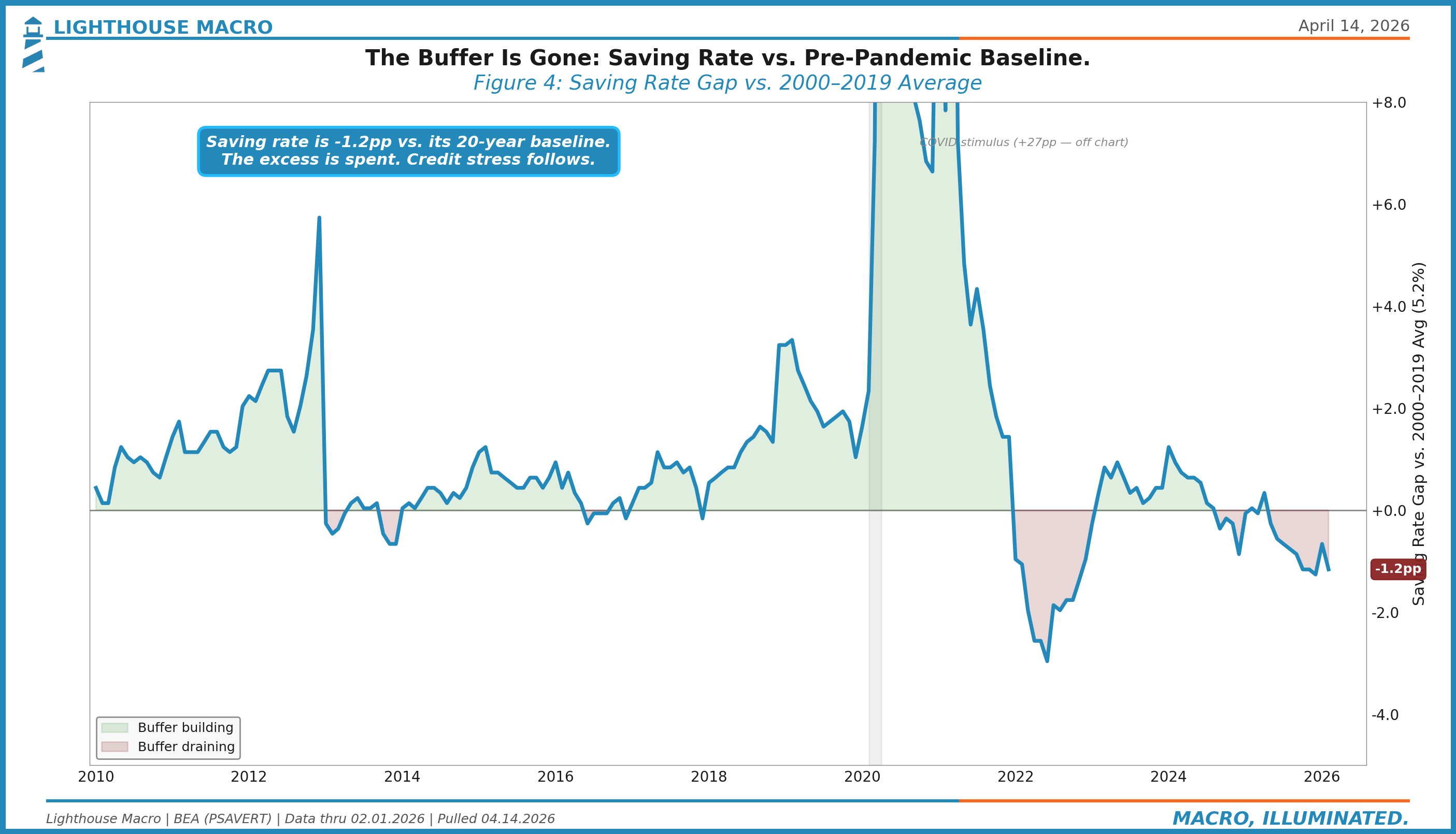
Look at the gap chart. Negative territory since 2022. The pandemic excess was spent, then the normal buffer was spent, and now we sit 1.2 percentage points below the 20-year baseline. Households have been financing consumption by drawing down saving for nearly three years. That can continue until it can’t.
Credit card delinquencies? Still low at 2.94%, actually down year over year. That’s not a contradiction, that’s the sequence. Households burn saving first. They cut discretionary next. Credit breaks last. We are in the middle of stage two. The oil shock is about to accelerate it.
What Consensus Is Missing
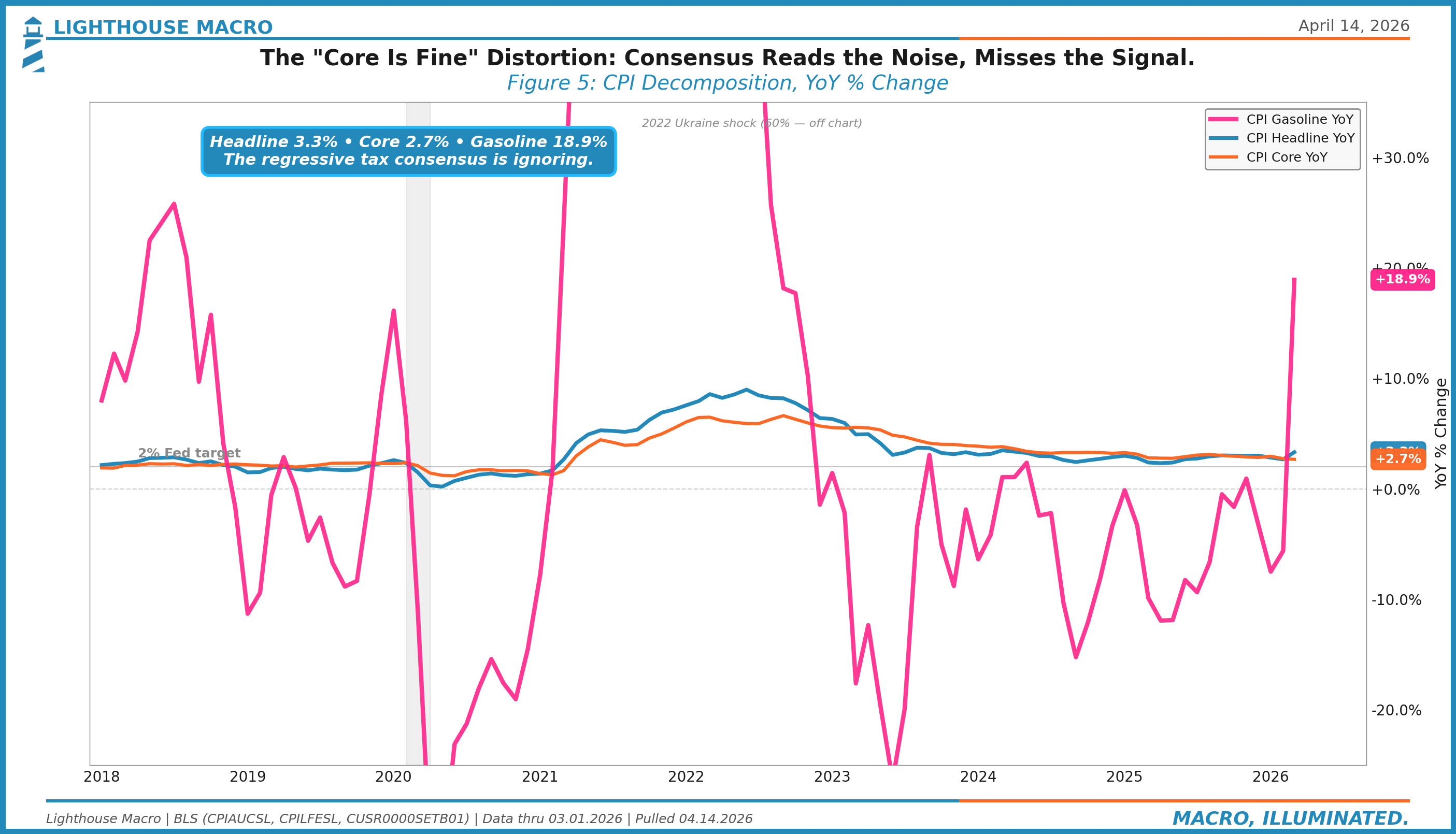
Consensus reads the 2.7% core CPI print and calls it a win. We read the 18.9% gasoline print and see a regressive transfer happening in real time. Both numbers are true. Only one matters for where the consumer is headed.
The “look through energy” reflex made sense when oil was a cyclical swing factor around a stable trend. It doesn’t make sense when oil is responding to a structural supply shock (Hormuz blockade, ceasefire collapse) on top of a consumer that already has no buffer. The pass-through math works in only one direction from here.
What Would Change Our Mind
Two things break this thesis. First, Hormuz de-escalates and WTI drops below $85 within 30 days, pulling retail gasoline back toward $3.50 and reversing the income squeeze before second-round effects land. Second, real DPI growth re-accelerates meaningfully on the April or May prints, which would mean wage growth is absorbing the fuel tax faster than we expect.
Neither is impossible. Neither is what we are seeing right now.
The So-What
The Consumer Conditions framework exists exactly for moments like this one. Headline resilience on top, fragility underneath. The “Last Domino” sequence, live. We are watching stage two of three.
Services employment is the tell for stage three. Restaurants and retail first, then the broader job flows. That’s the part the labor data hasn’t caught up to yet. It will.
Thursday’s Beam: the Credit-Labor Gap is back.
The bottom line
We built slow on purpose. The Diagnostic Dozen is a foundation nobody else has. Now the cadence ramps, the partnerships activate, and the real-time application begins.
This isn’t a newsletter that tells you what to think. It’s a system that teaches you how to see.
The Diagnostic Dozen: Your Complete Framework
Pillar 1: Labor·Pillar 2: Prices·Pillar 3: Growth·Pillar 4: Housing·Pillar 5: Consumer·Pillar 6: Business·Pillar 7: Trade·Pillar 8: Government·Pillar 9: Financial·Pillar 10: Plumbing·Pillar 11: Market Structure·Pillar 12: Sentiment & Positioning
That’s our view from the Watch. We’ll be sure to keep the light on....
Bob Sheehan, CFA, CMT | Founder & Chief Investment Officer