

The Splitting Cycle
Two cycles, one tape, and the anchor that’s moving.


The Horizon · May 2026
The full Horizon normally sits behind the paywall. This one runs free as the launch piece for the stack we’re building around the framework.
Executive Summary
Q1 2026 real GDP grew 2.0% annualized. Roughly 1.1 percentage points of that, more than half of the entire print, came from computer and software investment. Inside the consumer line, healthcare alone accounted for 47% of the spending growth. Strip those two layers and the underlying private-sector economy ran closer to flat than to two percent. The headline reads resilience. The composition reads fragmentation.
This Horizon documents that fragmentation across six pillars and connects it to the rates regime that is repricing alongside it. Term premium on the 10-year sits at roughly 70bps, the floor of the pre-QE distribution. The framework’s honest level is 150. The Federal Open Market Committee printed four dissents at its April 29 meeting, the most at any single FOMC meeting since October 1992. Powell exits the chair on May 15. Kevin Warsh’s confirmation vote is this week. The institutional anchor is moving in five days, into a committee that has already begun fracturing in both directions.
We call this regime The Splitting Cycle. Two parallel cycles overlapping at the seam, held together by a tape that is still pricing one of them and ignoring the other. The framework’s job in 2026 is to read the composition.
We are not calling for an imminent recession. We are documenting a structural divergence between the headline economy and the composition underneath. The investment side is being underwritten by four companies pointing at $625 billion in 2026 capex. The consumer side is being held up by healthcare and government. The credit market is pricing the surface. Labor flows are giving mixed signals after the May 5 JOLTS print. The Fed is fracturing. The plumbing is running closer to capacity into the May 11 to May 13 auction window. The 30-year cracked 5% on May 4 and partially retraced on Iran headlines.
All of those are happening at once. None of them are noise.
Part I: The Splitter
The Q1 GDP advance landed at 2.0% annualized on April 30. Below the 2.3% consensus, above the Atlanta Fed’s 1.2% running estimate, and almost exactly where the St. Louis Fed’s tracker put it. The headline was a soft beat. The composition is the news.
Inside the print, non-residential investment grew at a 10.4% annualized rate, contributing 1.39 percentage points to the 2.0% headline. Consumer spending grew 1.6%, contributing 1.08 points. Government spending grew 4.4%, adding 0.73. Imports rose, subtracting from the total. Exports added back. The contribution shares tell the story the headline buries.
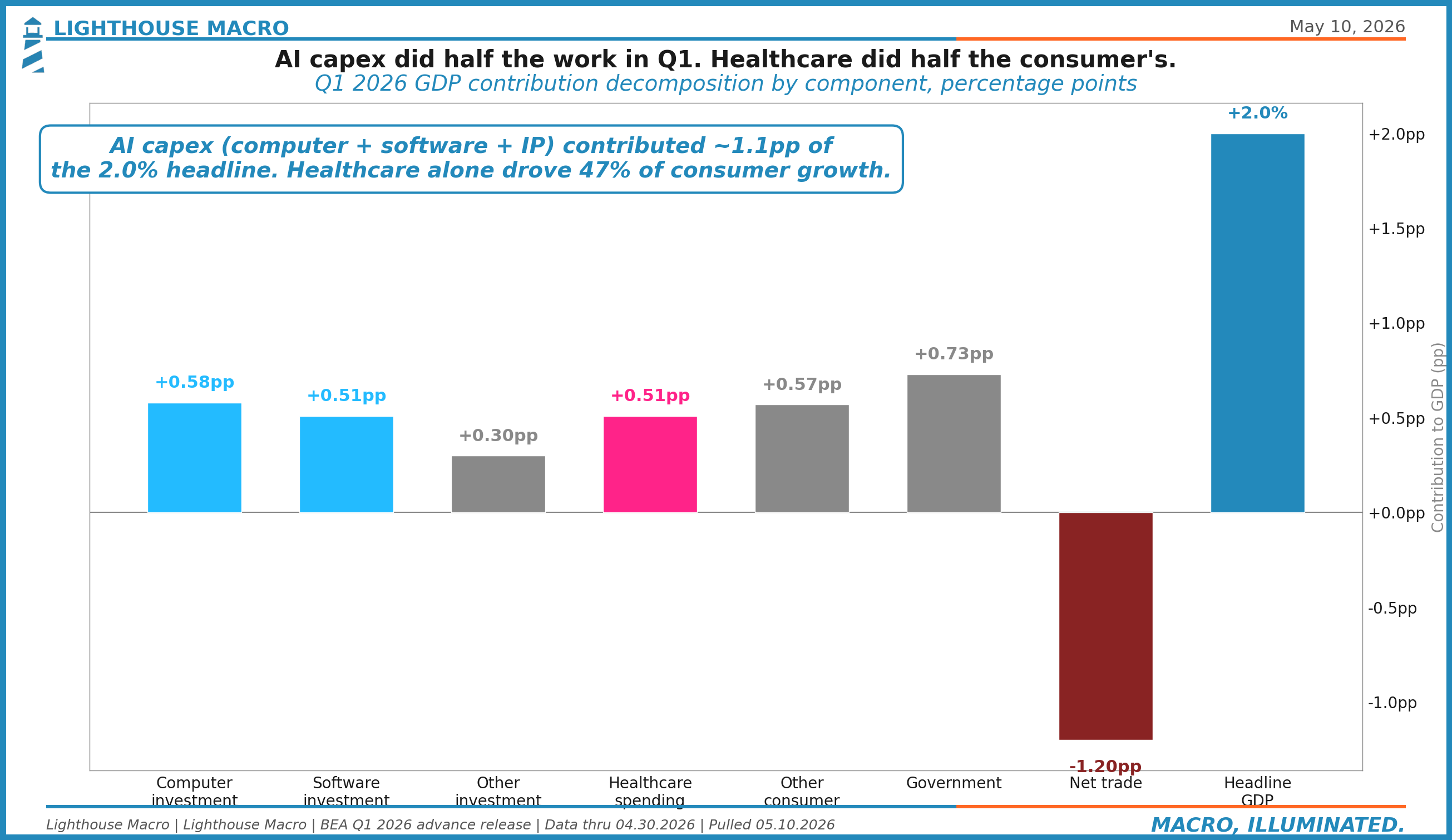
Look inside the investment line. Computer investment grew at a 67.4% annualized rate. Software grew 22.6%. Together, those two line items contributed roughly 1.09 points to GDP, more than half of the entire 2.0% headline. Equipment, intellectual property products, and private inventory all rose. Residential and nonresidential structures both fell. The investment cycle is concentrated by category, sitting in the hardware and software stack that runs the AI buildout.
Now look inside the consumer line. Real PCE grew 1.6%, of which 47.2% came from spending on health care alone. Durable goods consumption was flat. Non-durables fell at a 0.2% rate. The consumer is not weak in aggregate. The consumer is being held up by health care, which is the least discretionary category in the basket and the one most sensitive to demographics rather than business cycle.
The cycle is not lifting. The cycle is splitting.
The capital cycle running through that investment line has a name we have used before. It is the AI capex super-cycle, and the Q1 2026 reporting season just extended it without flinching. The four largest hyperscalers, Microsoft, Meta, Alphabet, and Amazon, collectively guided to roughly $625 to $640 billion in 2026 capital expenditures. Including Oracle and the broader top-five hyperscaler universe, the analyst consensus has now moved to roughly $700 to $750 billion. That is up from the January estimate of $620 billion. Big Tech raised the spending guide aggregating 2026 by $80 to $130 billion in a single quarter.
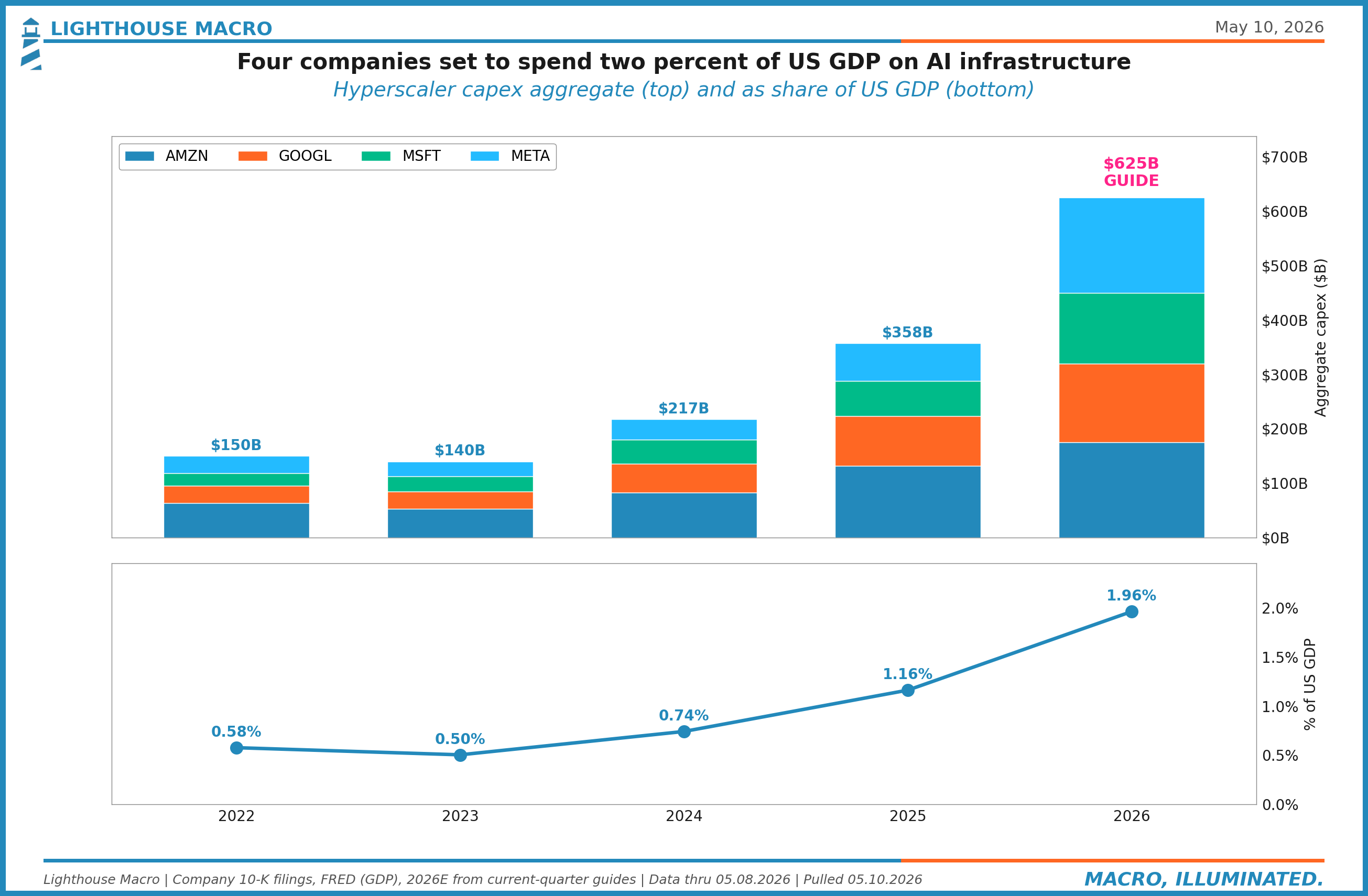
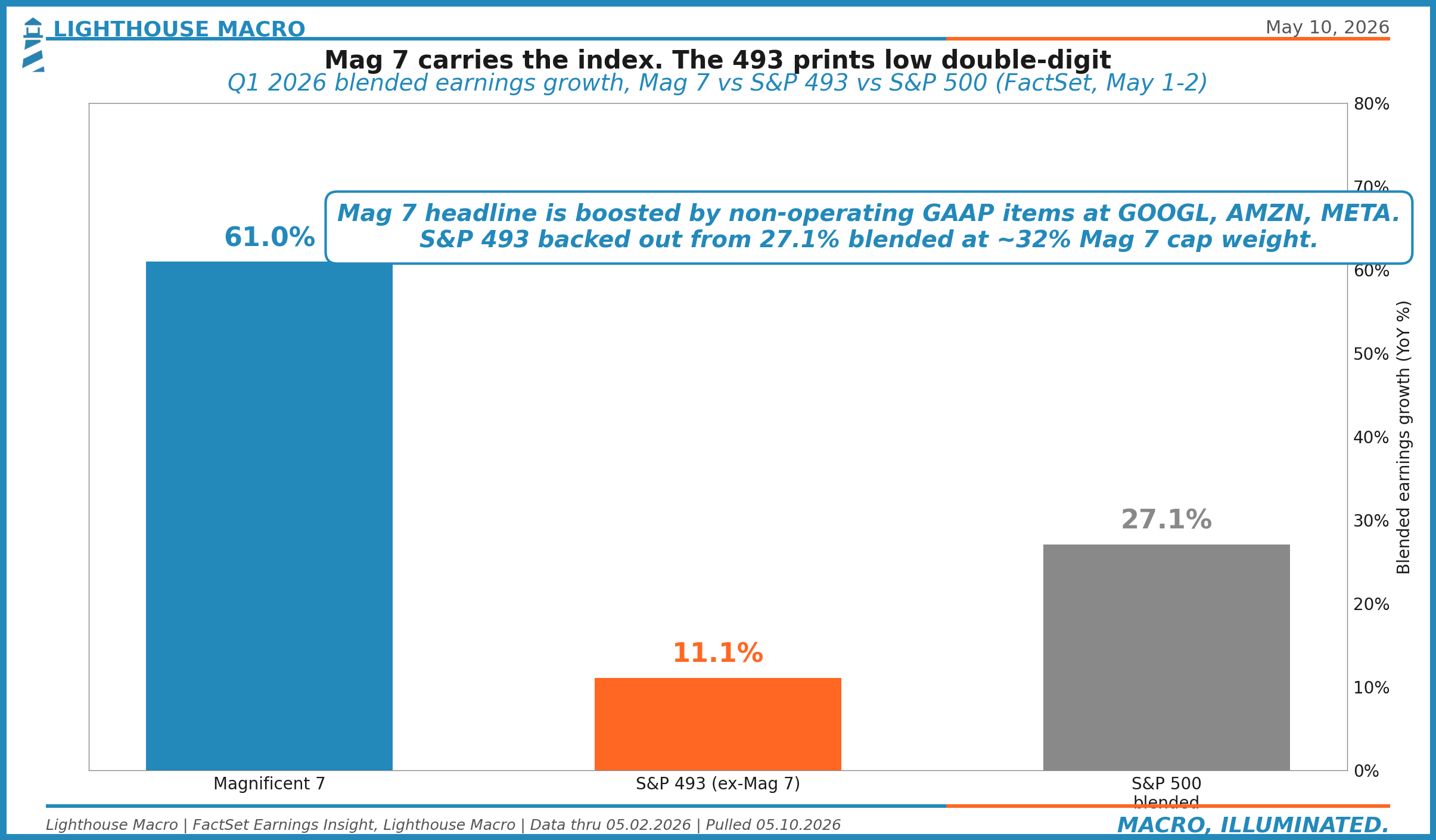
The dollar magnitudes are easy to gloss past. The macro magnitude is not. Four companies pointing at $625 billion in 2026 capex represent roughly 2% of US GDP being directed at AI infrastructure. There is no peacetime precedent at this concentration outside the late-1990s telecom and dotcom buildout, and the AI cycle is now running hotter on capex/revenue ratios than that one did at its peak. Per FactSet, blended S&P 500 earnings growth this quarter sits at 27.1%. The Magnificent Seven blended at 61.0%. The S&P 493, even with the Mag 7 cap weight stripped out, prints at 11.1%. One side of the capital cycle is producing the entire earnings tape on its own.
The pricing evidence inside the buildout is the part that surprises us most. Semiconductor industrial production minus broader manufacturing IP runs at +7.1 percentage points wide, persistent through every quarter of the last three years. Production of the things AI demands has been growing materially faster than production of everything else. Yet semiconductor PPI is flat. Core goods CPI is barely above 1%. The buildout is showing up as quantity expansion, not as price pressure.
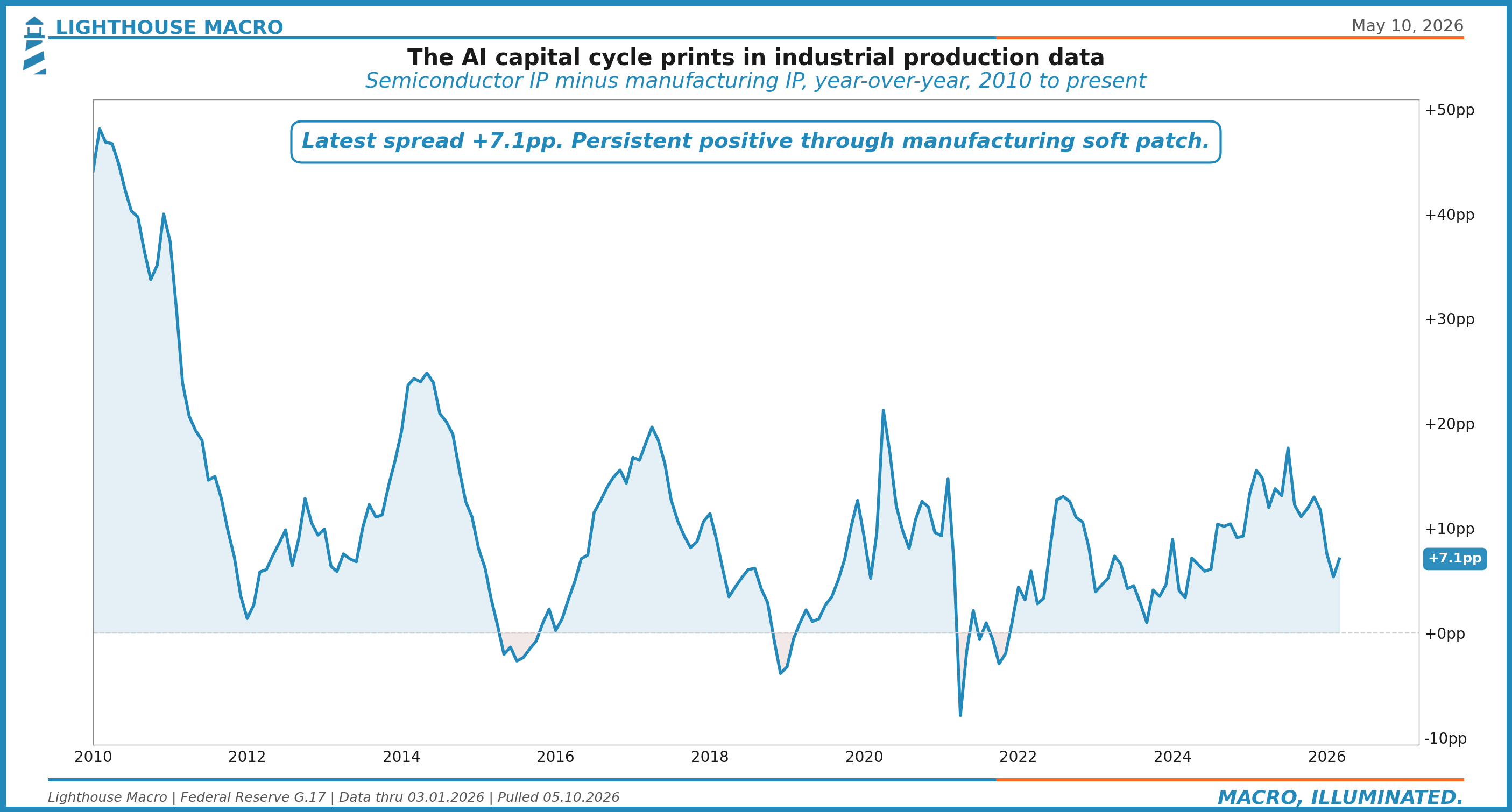
Quantity without price is the signature of a cycle the Fed has no obvious reason to lean against. The 2021 goods cycle showed up as both more units and higher prices, which forced a hawkish response. The 2025-26 AI cycle shows up as more units at flat or falling prices, with the relative price story pointing the wrong way for inflation hawks. That changes the macro implication. Real yields, credit duration, and the equity multiple paying for back-loaded monetization are where the bill comes due, not headline CPI.
The capital intensity ratios make the dependency concrete. Capex as a share of revenue runs 86% at Oracle, 54% at Meta, 47% at Microsoft, 46% at Alphabet, and 25% at Amazon. Bank of America’s credit team estimates AI-related capex consumes roughly 94 cents of every dollar these companies generate after dividends and buybacks across 2025-26, up from 76 cents in 2024. Barclays models Meta’s free cash flow falling roughly 90% in 2026. The cycle is being financed by the residual after capital returns to shareholders, and the residual is shrinking.
That dependency is the thing the headline tape is not pricing. The S&P 500 makes new highs because the AI sleeve carries the index and the multiple compounds. The 493 is growing earnings at 11%, which is mid-cycle, not late-cycle. The 7 is growing at 61%, of which Nvidia alone does most of the lifting. Take Nvidia out of the Mag 7 group entirely and the remaining six grow earnings at roughly 6%. That is below the 493. The breadth of the earnings beat is narrower than the index print suggests. The dispersion of capex commitments across the same companies is widening.
The macro thesis we wrote in late April still holds. AI is fragmenting the cycle. The Q1 GDP print made that quantitative. The hyperscaler capex guides extended it. The earnings concentration confirmed it. The investment side accelerates. The consumer side eases. The engine creating the divergence is sustained and unhedged.
What would change our mind on the splitter thesis. Computer-electronic products inventory-to-shipments rises sharply, telling us supply has caught demand. Semiconductor IP rolls over relative to manufacturing IP. Real yields rise meaningfully and high-yield spreads widen while capex expectations stay aggressive, forcing the buildout to slow on financing constraint. Or one of the four hyperscalers cuts its 2026 guide on the next print. None of those have happened.
Part II: The Anchor Moves
The Adrian-Crump-Moench decomposition puts the 10-year Treasury term premium at roughly 70bps as of late April 2026. A year ago it sat at 40. Five years ago it ran negative. The framework’s honest level, the median reading from 1970 to 2007, sits at 150bps. We are halfway home.
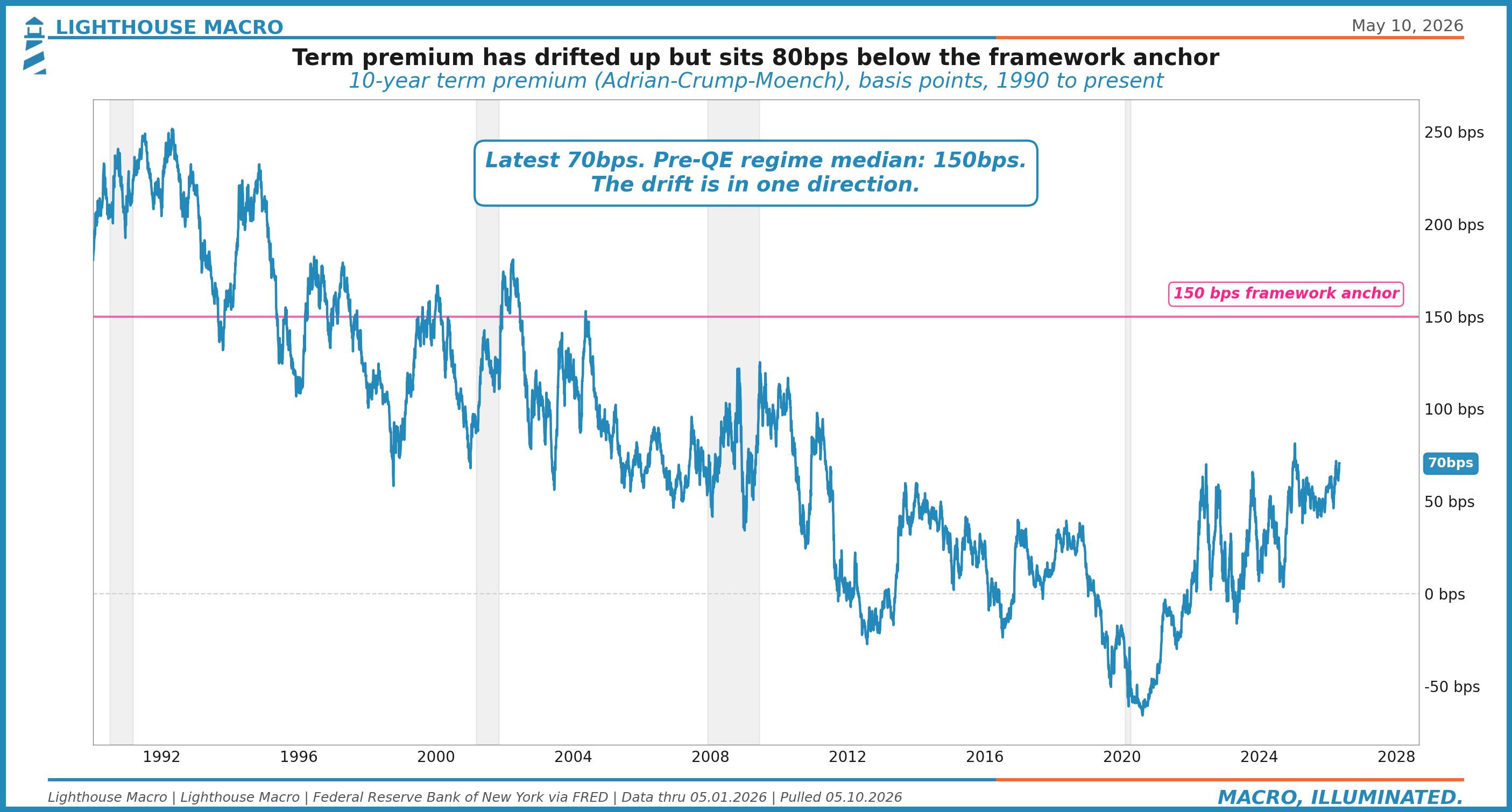
The conditions facing the bond market today look meaningfully more like the pre-2008 regime than the 2014-21 stretch when term premium ran below zero. Structural deficits at full employment. Treasury funding short and deferring duration. The Fed out of the buyer seat. Inflation re-anchored at target with materially wider variance than the 2010s carried. None of those features were present during the QE-era anomaly. All of them characterized the regime where term premium averaged 150 to 250 for forty years. We anchor at 150 because that is the median across that distribution, and 70 is the floor of it.
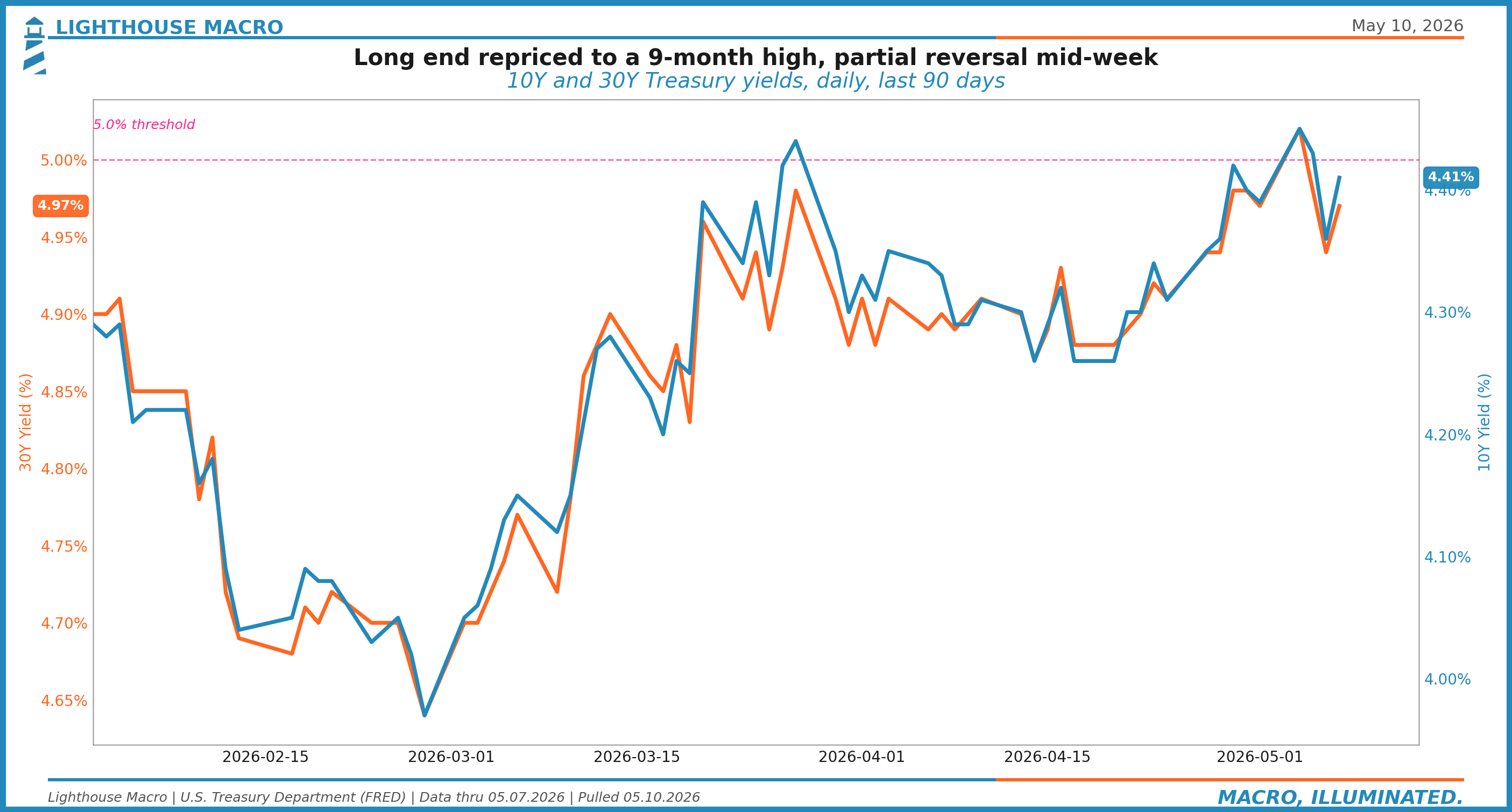
The May 6 Quarterly Refunding Announcement was the structural test on the long end. We wrote the May 4 Beacon (”The Honest Level”) arguing that May 6 sets the pace. The market priced the worry into May 4. The 30-year yield briefly cracked 5%, the highest level since November 2023. The 10-year hit 4.45%, a nine-month high. Treasury supply concerns drove the move. Then the announcement landed. Treasury’s Q2 2026 net marketable borrowing announced at $189 billion, $79 billion above the $110 billion estimate Treasury published in February, a 72% overshoot inside a single quarter. Coupon sizes unchanged for the ninth straight quarter. The “at least the next several quarters” forward guidance language stayed. Net new cash from refunding $41.7 billion. Auction sizes set for $58 billion three-year, $42 billion ten-year, $25 billion thirty-year over the May 11 to May 13 auction window.
The market reaction was a partial retrace. The 30-year closed May 7 at 4.97%. The 10-year at 4.41%. The QRA was the non-event the announcement language signaled. The supply path was the catalyst the market priced two days early.
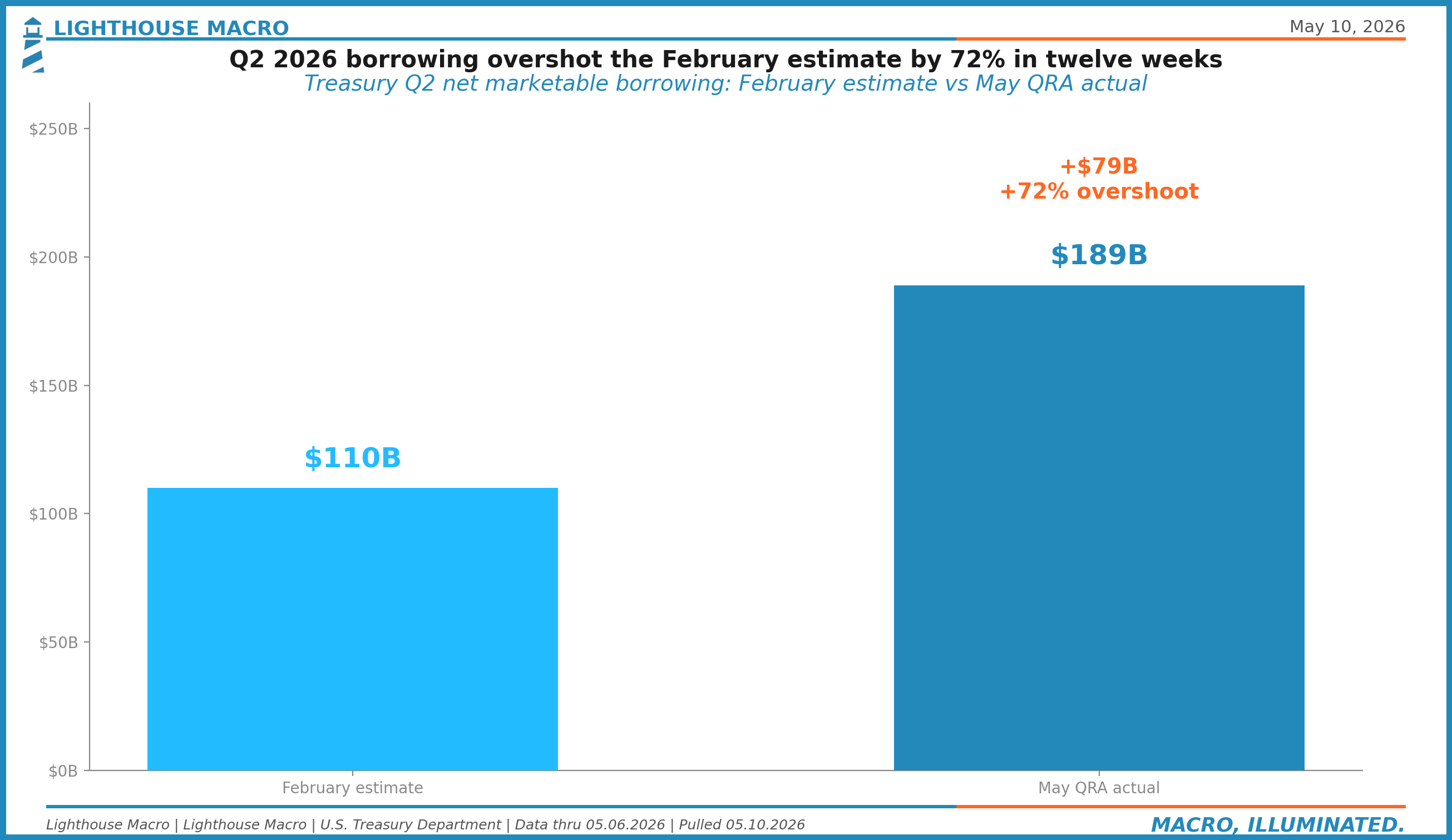
The destination did not move on May 6. The pace did. Treasury continues to fund through the front of the curve, leaning on bills, deferring duration. Each quarter that passes with stable coupon sizes is another quarter that adds to the eventual coupon issuance trajectory. Analyst expectations have shifted to 2027 as the year coupon increases begin. The framework reads that as a deferral, not a solution. The term premium reset is the price of that deferral, paid in basis points by buyers who require compensation that QE-era buyers did not.
The Federal Reserve is the second pillar of the rates regime, and the institutional anchor is moving in a way the dot-plot does not yet reflect.
The April 29 FOMC kept the target range at 3.50% to 3.75% for the third straight meeting. The vote was 8-4. Four dissents. The most a single FOMC meeting has produced since October 1992. Cleveland’s Beth Hammack, Minneapolis’s Neel Kashkari, and Dallas’s Lorie Logan dissented over the inclusion of easing-bias language in the statement. Governor Stephen Miran dissented in the opposite direction, calling for a quarter-point cut. Three hawks pushed back against the language. One dove pushed for action. The committee is fracturing in both directions.
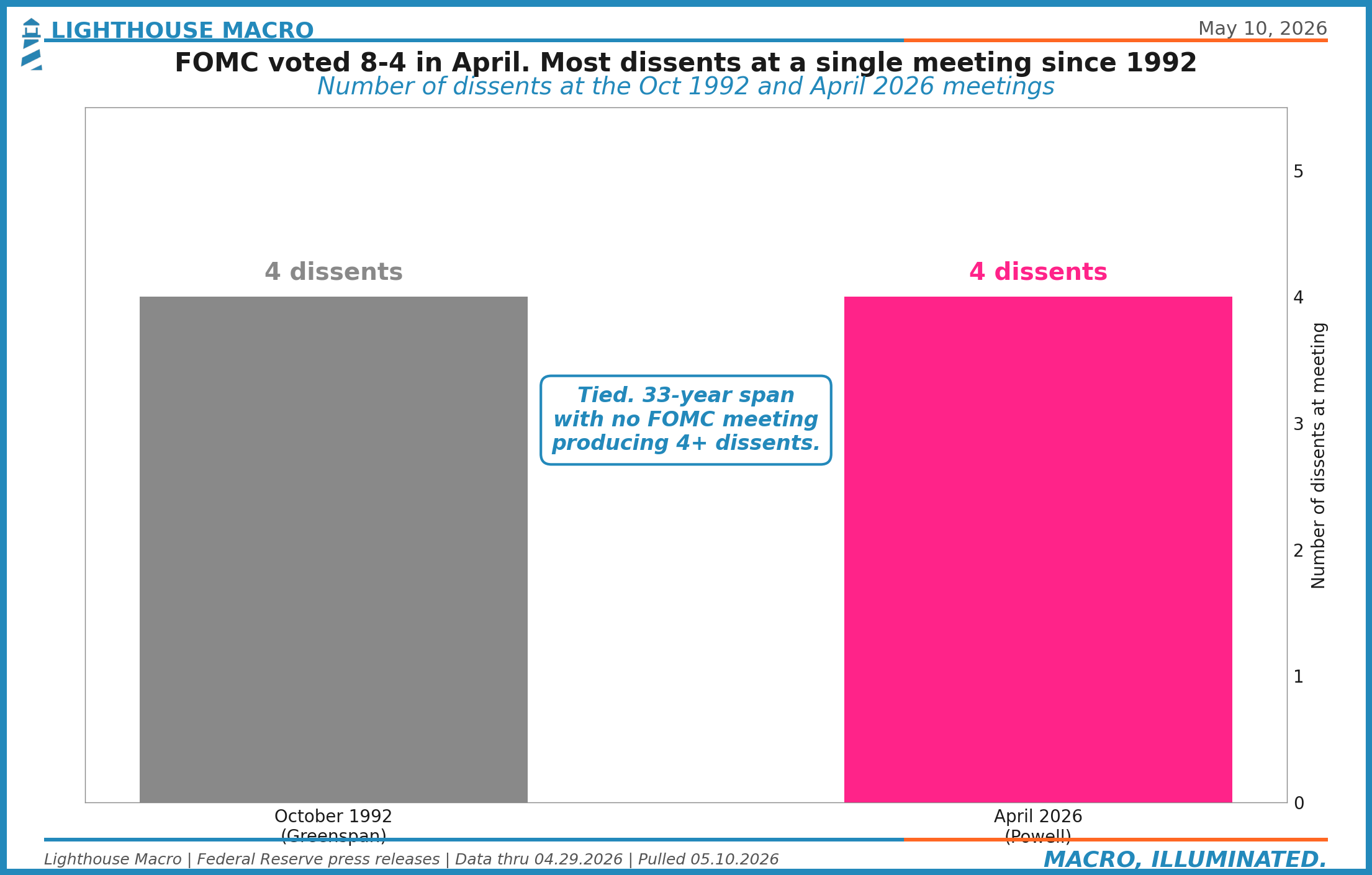
A 33-year span without four dissents at a single meeting is not a number we cite for color. It is the institutional read on a committee that has lost the procedural consensus that has typically governed Fed decisions through every cycle of the last three decades. That fracturing matters now because the chair changes in five days. Powell’s term as Chair ends May 15. Kevin Warsh has been nominated, and the Senate confirmation vote is expected this week.
Warsh’s confirmation hearing on April 21 went fine on the substance. He committed publicly to Fed independence, declined to fix any future rate decision in advance of Senate questioning, and signaled what one analyst called a “regime change” plan for the institution. The procedural risk is concentrated in committee. Sen. Tillis is blocking the nomination over an investigation into Powell, and the Senate Banking Committee runs a 12-10 Republican advantage. One Republican defection in committee blocks the floor vote. As of this writing, the path to confirmation by mid-May is intact but contingent.
The forward question is not whether Warsh hikes. It is whether the dot-plot trajectory bends meaningfully more hawkish at the margin under a chair whose historical voting record sits to the right of the recent FOMC center. We expect it does. The committee that just produced four dissents on easing-bias language will not absorb a Warsh chair without the dot plot moving. The path of short rates that anchors the front end stays anchored. The supply path that anchors the long end keeps grinding. The curve steepens through the back, not through the front.
That is the Fed-side mechanism for term premium repricing. The fiscal-side mechanism still sits underneath, and the two operate in the same direction. The destination is 150bps. The path is grind, occasionally gap, partially retrace, repeat. May 4 was a single session of that pattern. The next one comes when the next catalyst arrives.
What would change our mind on the term premium thread. Term premium compresses sustainably below 50bps for three consecutive weeks. Or 10-year trades back below 4.10% with no growth shock to explain it. Or Warsh signals continuity at his confirmation hearing in a way that the market reads as Powell-trajectory preservation. Or Treasury executes a meaningful weighted-average maturity extension over the next two quarters that pulls the duration absorption forward and compresses the back-loaded supply story.
Part III: K-shape With a Caveat
The labor data took a turn on May 5 that the framework has to handle honestly.
The March JOLTS print, released that day, showed the hire rate jumping to 3.5% from 3.2% in the prior month. Hires rose by 655,000 to 5.6 million, the biggest single-month rise in over a year. The quits rate ticked up to 2.0% from 1.9%, just at the framework’s pre-recession threshold rather than below it. Job openings sat at 6.9 million, unchanged. Layoffs and discharges held at 1.2%. The print partially reversed the labor-flow weakening narrative we and others have been writing.
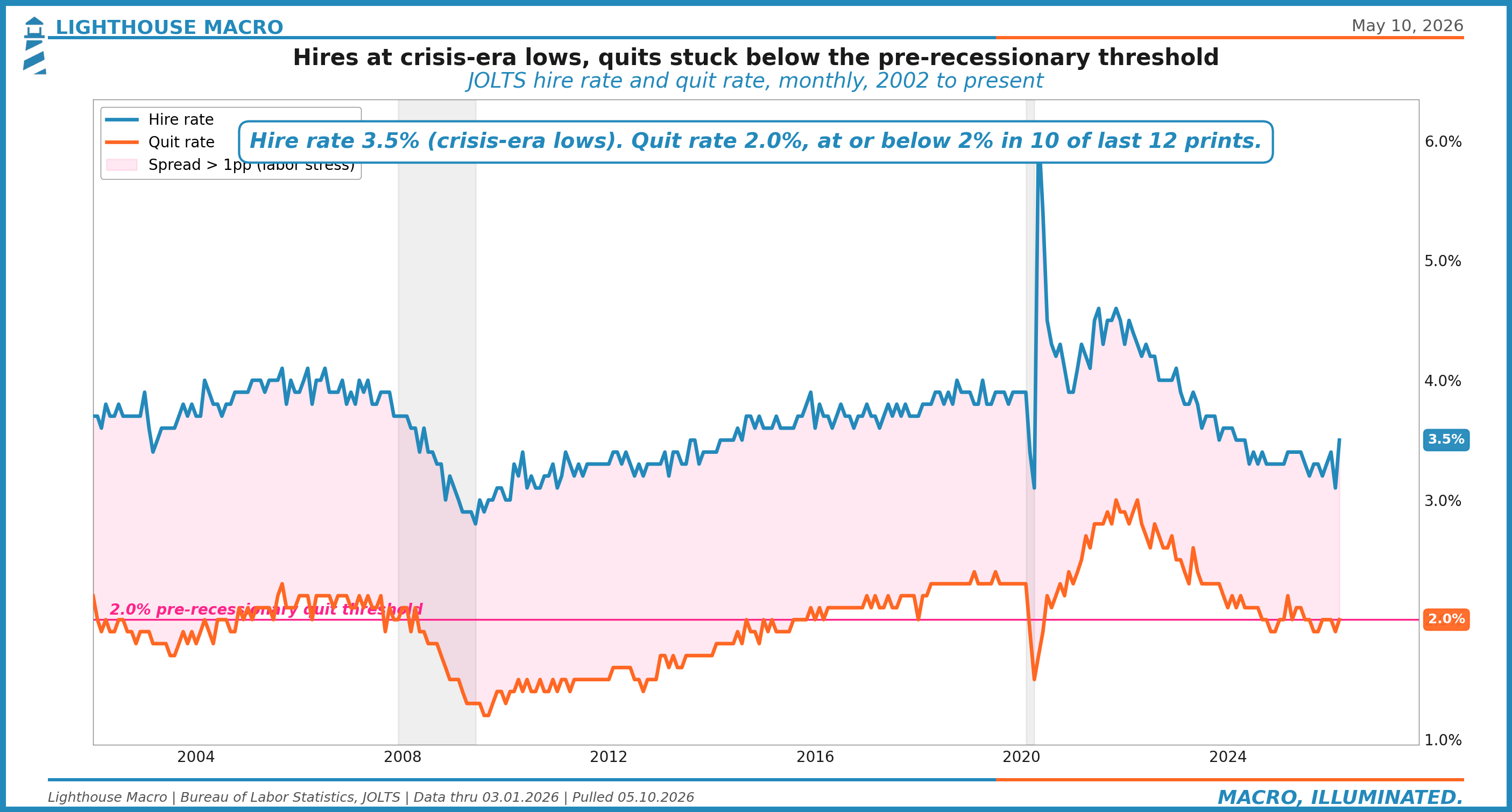
We have to read this two ways at once. The first read is straightforward. The flow data softened the late-cycle thesis at the margin. Hires accelerating off a crisis-era low is not consistent with a labor market about to break. Quits stopping their slide and re-anchoring at the threshold instead of below it removes one trigger we had named in earlier pieces. The Credit-Labor Gap, which we computed at -1.68 from the March data when it was the latest reading, will compress mechanically as the May print updates. Some of the framework’s spread-widening triggers fade.
The second read is the one we sit with longer. The March print is one data point. It is the first JOLTS release in six months that has pointed in the direction of recovery rather than continuation. The composition story underneath the headline did not change. Tech-sector layoffs continued through April. Microsoft, Meta, and Oracle cumulative announced reductions ran in the tens of thousands. Healthcare and transportation continued to carry net job creation. Bottom-half employment expanded. Top-half employment in tech, professional services, and finance contracted. The headline payroll has been firm because the bottom-half is still hiring. The K-shape composition has not closed.
Real wages tell the same story. The Q1 Employment Cost Index showed wages and salaries rising 0.8% quarter-over-quarter and 3.3% year-over-year, decelerating modestly from the prior trend. Inflation-adjusted wages and salaries grew 0.1% over the year. Effectively zero. Workers’ real spending power is being held flat by a CPI print that has run sticky on the goods side and re-accelerated on energy through the back half of Q1. The aggregate labor income that funds consumption is barely growing in real terms. Healthcare drove half of consumer spending growth in Q1. The other half came from trade-down, government transfers, and savings drawdown.
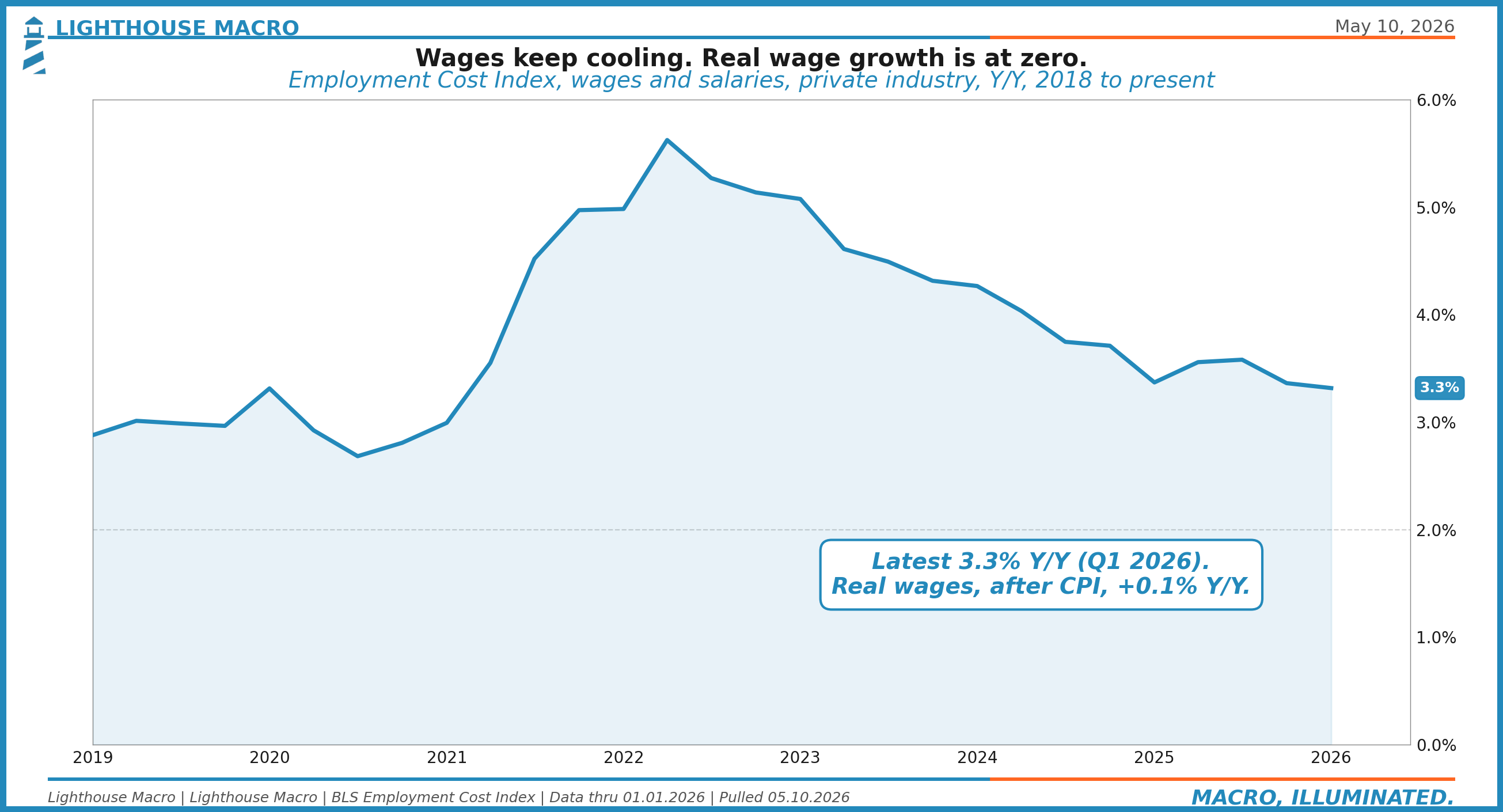
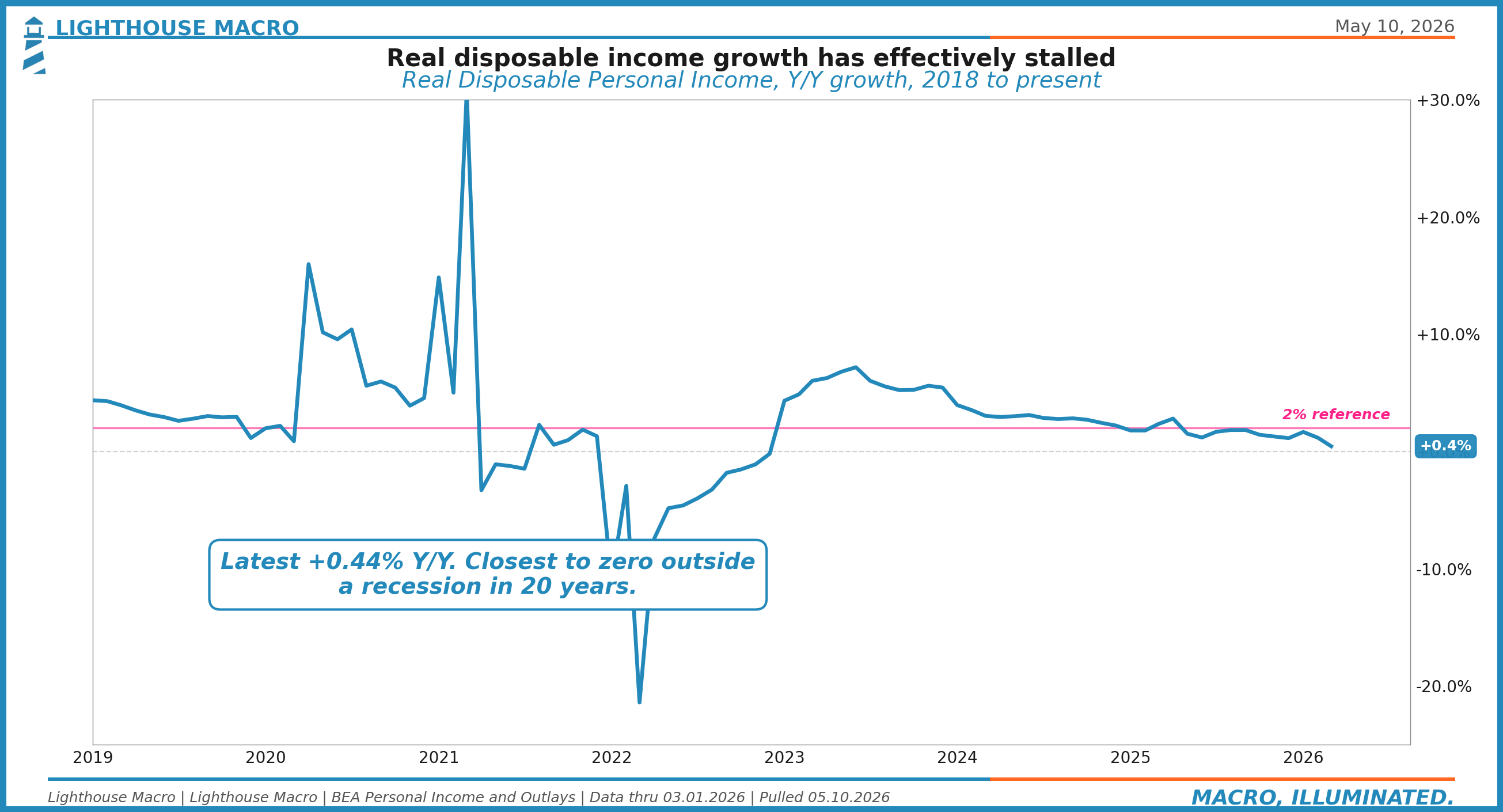
This is the part the headline labor and consumer data hide together. The hire rate jumped back, which is real. The quit rate stopped falling, which is real. Composition is still K-shaped, which is also real. Real wages are at zero, which is the hardest fact to argue with. The labor market is holding without enough force to fund a consumer currently spending out of an aggregate saving rate near 4%, with the bottom 60% running well below that.
The next labor surprise can come from either direction and both paths are consistent with the framework’s read. Top-half cuts continue and eventually compress the headline payroll. Or bottom-half hiring continues and the headline holds while real income growth stays flat. Either way, the K-shape composition holds. Either way, the consumer remains the lagging variable in the cycle.
What would change our mind on the labor thread. Real disposable personal income re-accelerates above 2% for two consecutive prints. The quit rate moves back above 2.2% on the next two JOLTS releases. Tech-sector layoffs reverse with hiring announcements at the same firms. ECI wages re-accelerate to 4% year-over-year while inflation cools, restoring real wage growth.
Part IV: Credit Looks the Other Way
The high-yield option-adjusted spread closed May 7 at 279bps. Below the 300bps complacency line we use as a regime marker. Roughly 200bps below the long-run average. The spread has tightened straight through the late-March SPX correction, the Iran supply shock, the FOMC dissents, and the GDP composition surprise. Credit has not flinched.
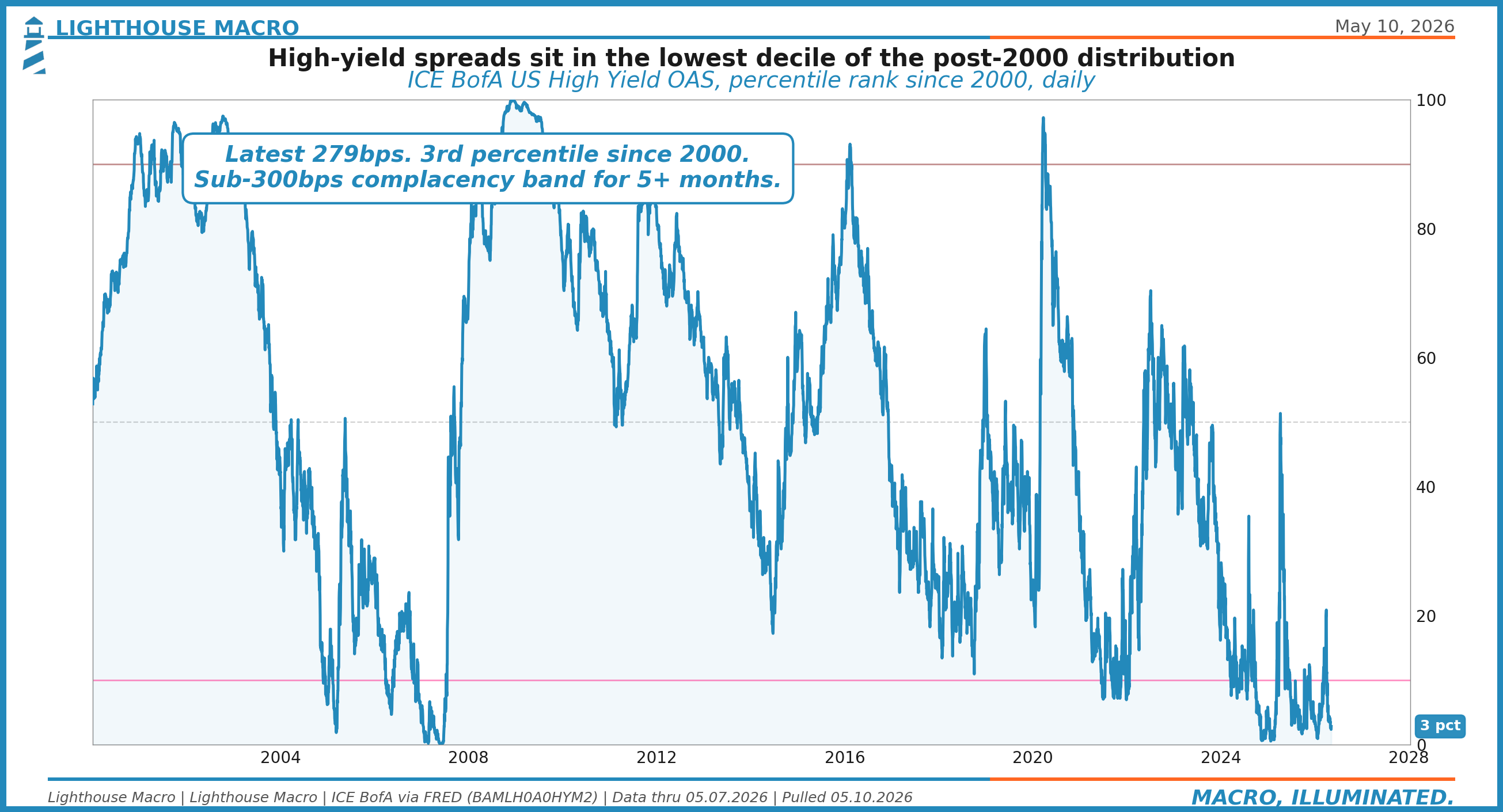
Investment-grade spreads tell the same story from the other side of the credit curve. IG sits near 80bps, the tightest in roughly three decades, in the bottom-decile of its post-2000 distribution. Both segments are pricing perfection. The relevant question is what they are pricing it against.
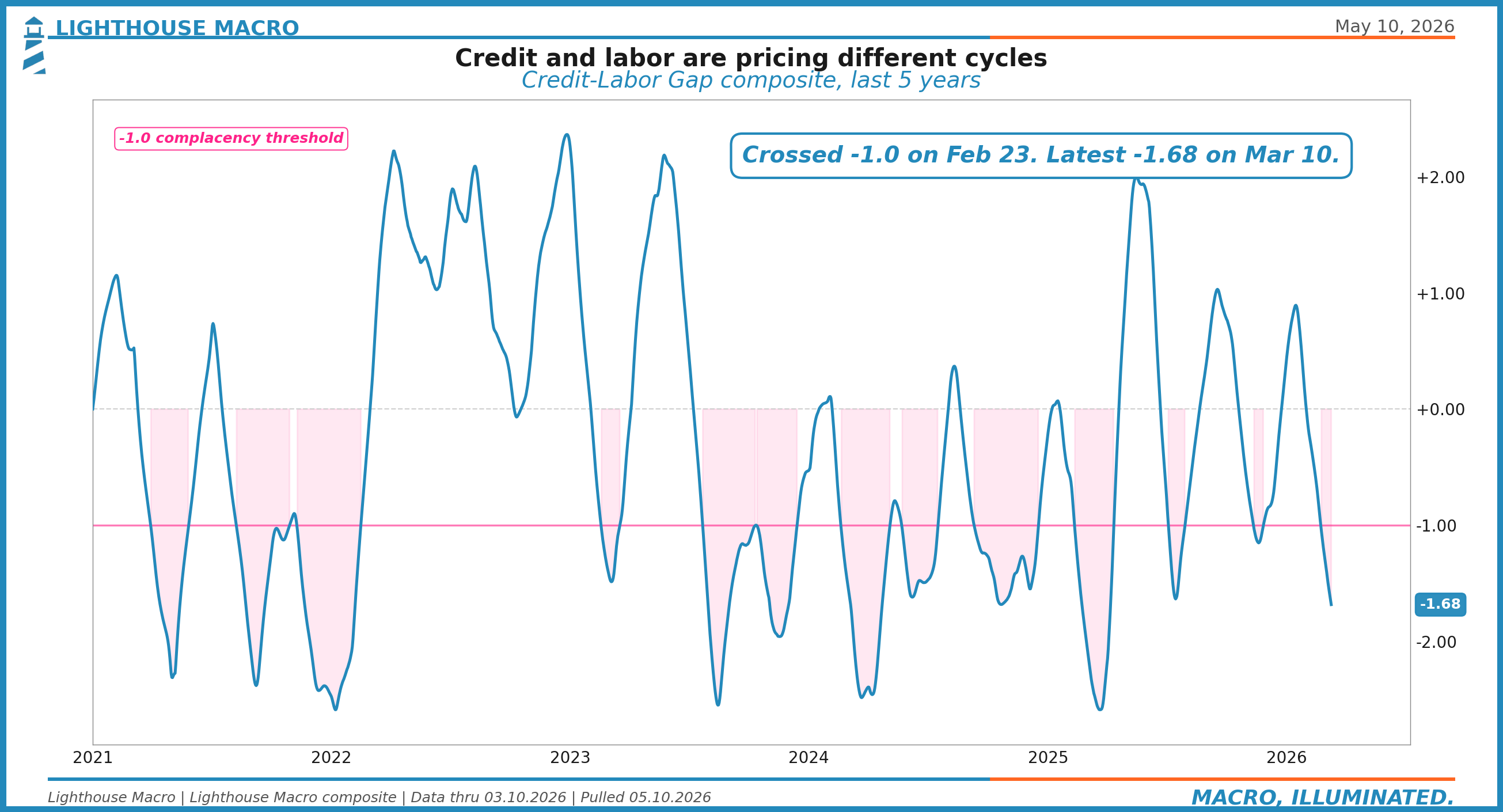
The Credit-Labor Gap, which compares high-yield spread positioning against labor fragility, was at -1.68 on the March composite refresh. Deeply through the -1.0 complacency threshold. The math on that gap will compress with the May 5 JOLTS print, because the labor side moved in the direction of recovery. The gap may not compress all the way. Quits at the threshold is not quits above it. Real wages at 0.1% is the consumer-income condition that prevents the labor signal from closing the credit-spread divergence on its own.
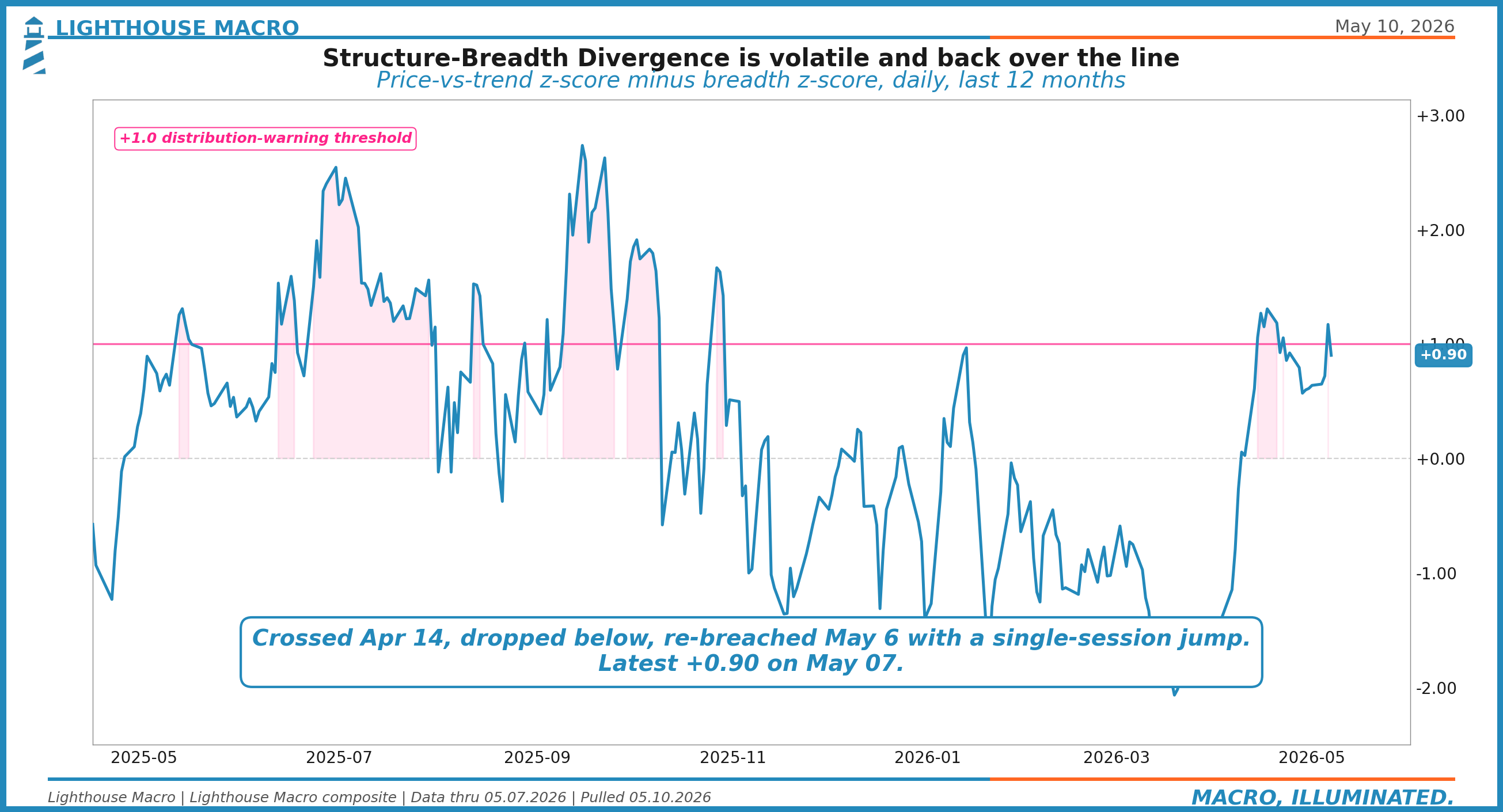
The market structure side is the second cross-check. The Structure-Breadth Divergence (SBD), which measures the gap between price-vs-trend and breadth-vs-trend on the S&P 500, breached its +1.0 distribution-warning threshold on April 14, traded above it for a week, dropped back into the +0.6 range, and re-breached on May 6 with a single-session jump from +0.72 to +1.17. The breach was real and volatile. By May 7 it had retraced to +0.90, just below the threshold.
The Market Structure Index (MSI) sits at +1.05 as of May 8, after a 3.1 z-score swing in the prior month. Structure is back. Breadth is participating. But the participation is shallow. The percent of S&P 500 members above their 50-day moving average sits at 52% with the index near all-time highs. Comparable record-tape episodes typically run 70%+. The 50-day rule is the cleanest read on rank-and-file participation, and the rank-and-file is barely participating at the index level.
The cross-asset composition tells a fourth story. Equities at all-time highs. The 10-year at 4.41% with the 30-year nearly at 5%. The dollar testing support. Gold near $4,800. Bitcoin consolidating. None of those are the cross-asset signature of a clean risk-on tape. The equity index is doing something the rest of the asset complex is not buying.
What would change our mind on the credit-and-structure thread. HY OAS compresses below 240bps and stays there for two months while quits stabilize back above 2.1% for two consecutive JOLTS releases. Or breadth thrust higher: percent above 50d crosses 60% with confirming percent above 20d above 70% on the same five-day window. Or the May 6 SBD breach stays retraced for two weeks of consecutive closes below +0.5. Any of those would mean the warning is wrong and the rally has earned the next leg on actual broadening.
Part V: The System Runs Closer to Capacity
The plumbing signal that matters is in the funding spreads. The SOFR-IORB spread, the cleanest read on whether reserves are doing the work they need to do, sits roughly 5bps negative on most days. By the level alone, reserves are still ample. The pattern around the level tells a different story.
Episodes through late 2024 and 2025 saw SOFR-IORB widen on quarter-ends and tax dates, the largest single-day spike being 32bps on October 31, 2025, the highest reading in five years. Those episodes are no longer isolated. They cluster around predictable cash-management dates, growing in magnitude. The April 2026 tax season passed without an acute incident, in part because the Fed had already halted QT on December 1, 2025, and begun reserve management purchases of approximately $40 billion per month in Treasury bills. Those purchases are technical management of seasonal flows. They do not rebuild the buffer. The Fed exiting the seller role does not put the Fed back in the buyer role.
A single quarter-end blip is noise. Repeated blips at predictable dates, growing in amplitude, are the system telling us that the buffer between abundant and scarce reserves is thinner than the level alone implies. We treat SOFR-IORB as a regime indicator rather than a level indicator for that reason. The level says ample. The frequency and amplitude of dislocations say closer to the threshold than ample suggests.
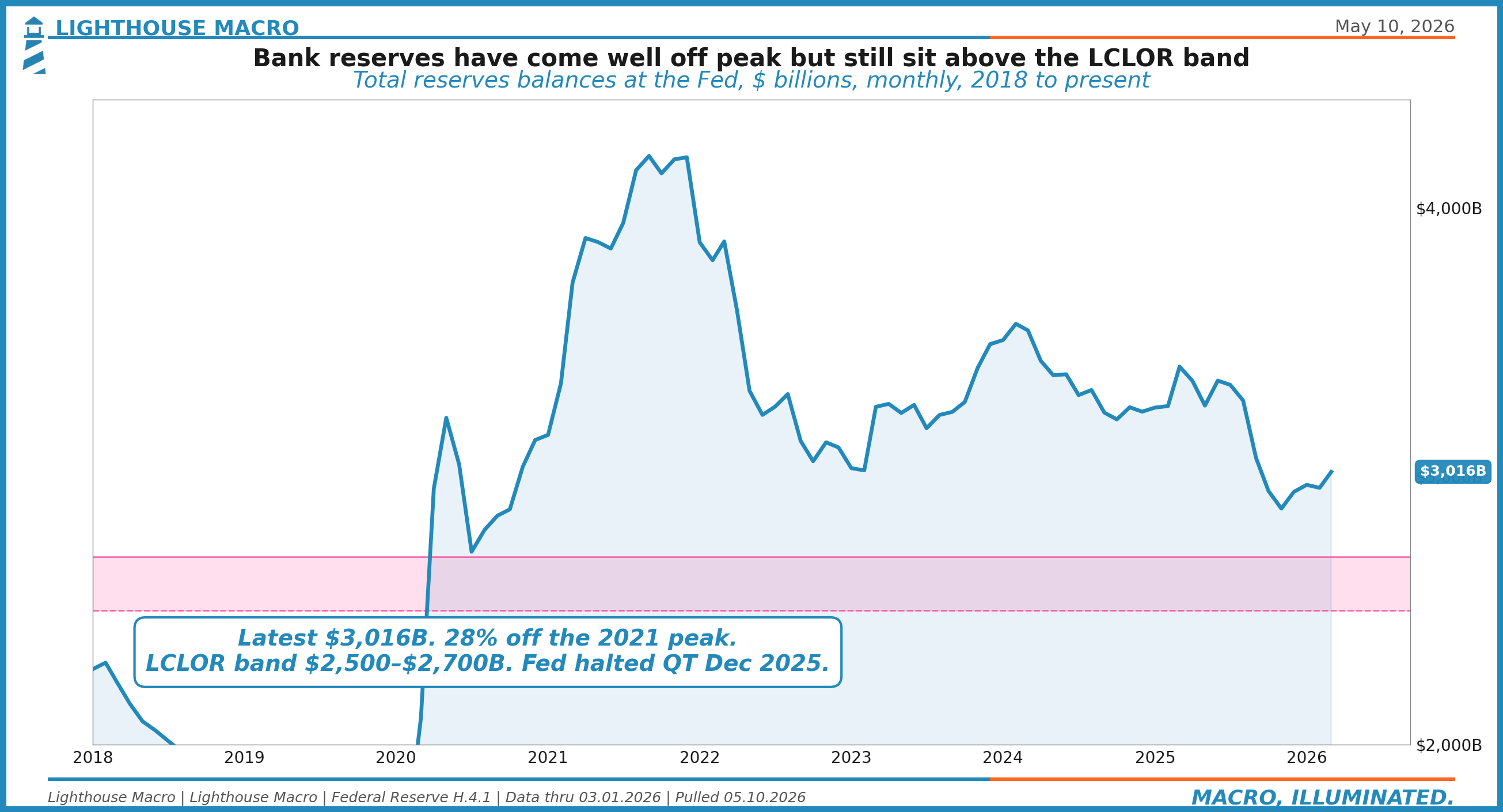
Reserves themselves sit at roughly $3.0 trillion as of early May, modestly above the $2.5 to $2.7 trillion Lowest Comfortable Level of Reserves (LCLOR) band Fed officials describe as the threshold below which funding stress historically emerges. The trajectory matters more than the level. RRP exhaustion, which carried the system through 2022 to 2024, was the first stage of buffer compression and finished long before the auction window we are about to walk into. The relevant pressure point now is the absorption capacity of the system that has to take down the supply.
The May 6 QRA confirmed the pace. Coupon sizes unchanged for the ninth straight quarter. Forward guidance language preserved. Net new cash from refunding $41.7 billion. The May 11 to May 13 auction window prices that confirmation. $58 billion three-year on Tuesday, $42 billion ten-year on Wednesday, $25 billion thirty-year on Thursday. The questions that matter run through the auction stat sheet. Tail or stop-through. Bid-to-cover. Indirect bidder share, which proxies foreign demand. Direct bidder share, which proxies real-money domestic. Primary dealer takedown, which is what is left over when the indirects and directs are out.
That last category is where the constraint binds. Primary dealers absorb whatever the rest of the auction does not, and dealer balance sheet capacity is regulated by the Supplementary Leverage Ratio. SLR treats Treasuries the same as risk assets for capital purposes. Each dealer’s ability to warehouse a heavy auction without flinching is a function of capital headroom against that ratio. The 2025 SLR exemption rollback that was floated and shelved would have given dealers more room to absorb supply. It did not happen. Dealers run closer to their internal warehouse limits today than they did a year ago, and the back-loaded coupon trajectory the QRA preserved compounds against that constraint quarter after quarter.
The Fed’s response to the next bind is the question Treasury is implicitly running through every QRA. Buyer-of-last-resort interventions during episodes like September 2019 happened on a 24- to 48-hour timeline. The system today is not at that point. It is closer to that point than the headline reserve level implies, and the auction calendar between now and the August refunding compounds the test.
What would change our mind on the plumbing thread. The May 11 to May 13 auctions all clear without tails, with indirect bidder share above 70% and primary dealer takedown below 18% on the thirty-year. Reserves expand back above $3.2 trillion through a sustained Fed bill-purchase program scaled larger than current pace. SOFR-IORB averages below zero through two consecutive quarter-ends without any single-day spike above 10bps. Any of those would mean the system has either absorbed the supply cleanly or rebuilt enough cushion that the next acute event recedes from the calendar.
Part VI: What Comes Next
Three calendar items shape the next thirty days, and each one is a fork.
The Iran path opened on May 6. The White House announced a 14-point memorandum of understanding intended to end the war. The framework calls for a 30-day window of nuclear talks, an Iranian moratorium on enrichment, US sanctions relief, and the release of frozen Iranian funds. Trump halted Project Freedom, the US escort effort in the Strait of Hormuz, citing progress in negotiations. Brent crude fell 8% to close at $101 on the announcement. WTI fell 7% to $95. By May 7 Brent was at $100, WTI at $94.81. The IEA had estimated the conflict was disrupting roughly 14 million barrels per day of crude transit through the Strait of Hormuz at peak.
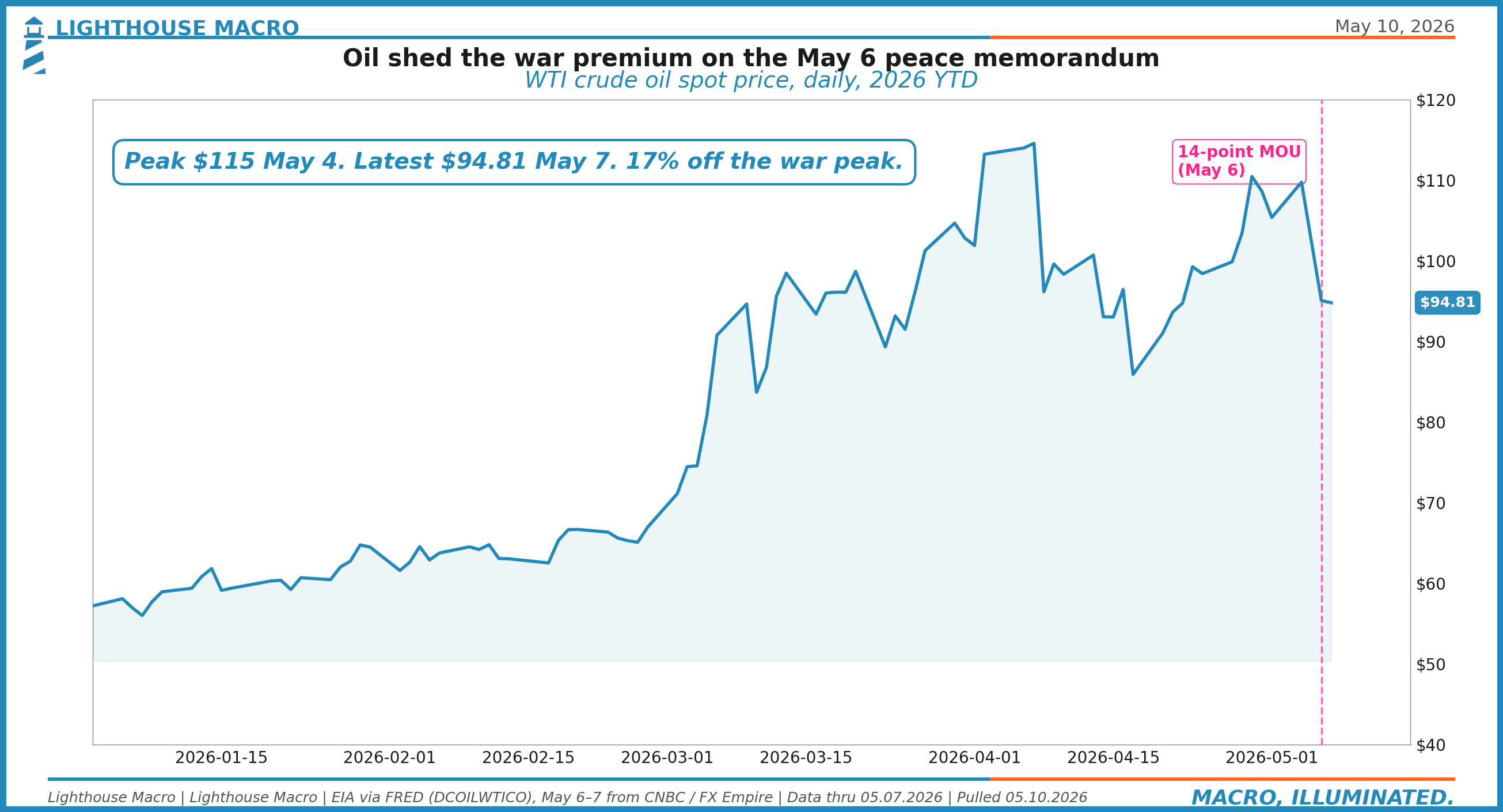
The Iran fork has three branches. Branch one: the deal completes within 30 days. Oil moves toward $75. Energy equities rotate, the inflation tailwind compounds, the Fed’s “look through the supply shock” framing was right. Branch two: talks break down inside the window. Strait re-closes. Oil moves toward $115. Headline CPI re-accelerates, services inflation lags but pulls higher, the Fed has no cover to ease. Branch three: the talks drag through the 30 days without resolution. Oil stays in the $90 to $100 range. Premium stays priced. The macro outlook absorbs uncertainty as a variance, not a level.
The Warsh confirmation this week is the second fork. The committee vote is the binding constraint, not the floor vote. A clean confirmation puts Warsh in the chair on May 15 and shifts the dot-plot trajectory hawkish at the margin. A blocked nomination forces a renomination process that could leave Powell as a holdover or push to an interim chair, an institutional event the Treasury market has not had to price in 30 years.
The CPI print on May 13 is the third fork. Headline already running 3.3% with energy on a downward path post-Iran announcement. Core has been holding around 2.7%. The supercore reading, which strips housing, is what the Fed actually targets, and it has been the variable that determined the path of cuts in every prior cycle. A supercore print at or below 0.2% monthly buys the Fed time. A print at or above 0.4% removes the cover Powell has been using to look through the energy spike, and the FOMC dissent dynamic gets louder before Warsh even arrives.
Each fork resolves, in some form, before June 5. The framework’s job between now and then is to be patient with which branch fires and which threshold breaches. The book is mostly cash for a reason.
Bottom Line
The headline economy reads 2% growth, 3.3% inflation, 4-something unemployment, all-time-high equity prices, and tight credit spreads. By any single line, the picture is fine.
The composition reads differently. AI capex is doing more than half the GDP heavy lifting. Healthcare is doing half the consumer’s. The Fed is fracturing into its largest dissent count in 33 years. Term premium sits at the floor of a regime it doesn’t belong in. Real wages are at zero. The 30-year cracked 5% on a Monday and partially retraced by Wednesday on geopolitical headlines. The plumbing is running closer to capacity than the headline reserve level implies. The structural-breadth divergence breached and re-breached inside two weeks. The credit-labor gap was at the deepest reading since 2018 going into a labor print that partially relieved it.
None of that is new this week. Most of it has been visible for a quarter or longer. What changed in the last 30 days is the aggregate compression. The catalyst window we framed in the April 27 Beacon was supposed to test the framework. The framework reads strained, not broken. Strained is information.
The cycle is splitting. The anchor is moving. The book waits for the gates to align. The framework waits for the composition to either hold the surface up, or pull it down. We don’t know which way that resolves. We do know which way the composition is leaning.
The framework reads the tape. We trade the reads. The launch goes anyway.
Behind the Watch: the stack expands
The framework is what we have built over the last decade and a half across institutions. Twelve pillars, three engines, one master composite, a public model, and an active book. The Substack has been the primary surface for the framework since the publication launched. As of this Horizon, the surface starts to widen.
Three new surfaces alongside the Substack, one anchor that ties them together, and a rollout sequence that runs as the build queue clears.
The portfolio, public
The Lighthouse Macro portfolio is going public on PiTrade. Advisory through Pioneer Advisory LLC. Brokerage and clearing through Interactive Brokers LLC. The platform’s creator program lets us publish positions in real time, with subscribers able to follow and copy at $10 one-time per portfolio per the platform’s terms.
The portfolio is the framework, expressed within the platform’s available order types. Eight target positions plus an SGOV cash floor. Active versus staged separated by trigger. SPY as the public benchmark, because that is the lingua franca of the platform and because the position-level RS gates for equities all bench against it.
Subscribers will see the full position book by ticker and weight, updated in real time. Performance versus SPY. Trades as they happen, with timestamps. Strategy description and methodology. What subscribers do not see is the dollar amount of capital committed; that is private by platform design.
A note on the structure. The portfolio runs on PiTrade as a publicly tracked tactical macro book, with brokerage and clearing through Interactive Brokers and advisory through Pioneer Advisory LLC. Different vehicle from a hedge fund or a separately managed account, different regulatory architecture, different fee structure. The discipline is documented in writing every Sunday in The Horizon. The trades land on the platform with timestamps. The framework and the book live in the same room.
The portfolio launches with what the framework actually allows on day one. The first thirty days will look like patience, because the framework requires patience right now. The patience is the position.
The research surface, opened
We have been building the Lighthouse Macro research dashboard against the OpenBB Workspace. The first pillar-level apps ship to paid subscribers as they clear the build queue.
The mechanic. Lighthouse_Master.db, the SQLite warehouse that backs every chart and every composite we publish, is exposed to OpenBB Workspace through a FastAPI bridge running on Lighthouse Macro infrastructure. Subscribers point OpenBB at the bridge and read the full database directly. Roughly 2,100 series. Roughly 4 million observations. Refresh cadence matching the underlying source pipelines, daily on the composites.
What that means in practice. Every chart we publish in a Beam or a Beacon or a Horizon will be reproducible on the dashboard inside two clicks. Every pillar composite queryable as a live time series. Every threshold, every regime classification, every divergence flag we cite auditable against the source data.
The roadmap is dozens of pillar-level apps in the build queue. Labor flows. Credit-Labor Gap. MRI regime. Plumbing dashboard. Sentiment composite. Each pillar gets its own app surface as the architecture rounds out. We will publish each one as it ships, with a one-paragraph explainer in the Substack Note that week.
This is the layer of the stack that most directly answers the question we hear most often from institutional readers. “Where does the data come from, and can I see it?” Soon, you can.
The channel, and the bot
The Lighthouse Macro Telegram channel is shipping, paired with a framework-aware bot that paid subscribers can query directly.
The channel handles the cadence the Substack cannot. Live macro briefings during the New York session. Threshold-breach alerts the moment a pillar reading crosses. Auction post-mortems within an hour of the print. Real-time read-throughs on economic releases. Anything that benefits from being delivered in minutes rather than days lives on Telegram.
The bot is the more interesting piece. Trained on the full Lighthouse Macro framework documentation, the pillar specifications, the published Beacons, Beams, and Horizons, and the live data layer through the OpenBB bridge. Subscribers ask it framework-aware questions and get framework-aware answers in real time. “What is the current MRI regime, and which pillars are driving it?” gets a current-data answer. “Which composites have moved most over the last week?” gets a live ranked list. “Walk me through the Credit-Labor Gap calculation as of today’s print” gets the formula, the inputs, and the current reading.
The Substack remains where the framework gets articulated and where positions get explained. The bot is the layer that lets subscribers interact with the framework in between publications, on their own questions, on their own data.
Access to the channel and the bot is included in the standard paid subscription. Pairing instructions and onboarding ship to subscribers in the Substack Note when each goes live.
The grandfather, and the floor
This is the most important paragraph in the Horizon, for subscribers and for prospects.
Every paying Substack subscriber on the books before the launches above is grandfathered into the full Lighthouse Macro stack as it expands. That includes PiTrade portfolio access at the subscriber rate, the OpenBB dashboard, the Telegram channel, and the LHM bot. The Substack subscription is the anchor. Existing subscribers carry forward at their current rate, with permanent rate preservation against the full-stack pricing that goes live when the surface area is complete.
Founding members lock for life at their original rate. Subscribers on the books at the current $500/yr ($50/mo) rate carry forward at that rate as long as the subscription stays continuous through the public-pricing transition. The price you pay today does not move on you because we shipped four more products around it.
What that means for prospects considering today’s rate. The next move is up. We have not set a date, and we are not setting one in this Horizon, but the direction is determined. The full Lighthouse Macro stack at the current rate is what you get for subscribing before the next pricing move. After that, the rate moves and the grandfather rule above is what makes the prior rate stick for the cohort that got in.
The path forward
We are honest about what this means.
What stays the same. The framework we publish on Substack today, the Beam cadence, the weekly Beacon, the monthly Horizon, the Note rhythm, all of it continues at the current cadence under the current pricing. The free tier remains free. The paid tier remains paid at the current rate for current subscribers.
What changes. The surface area expanding. Hundreds of charts a month across Beams, Beacons, Chartbooks, and Horizons. Dozens of OpenBB apps surfacing the same data infrastructure that backs the publication. A live Telegram channel during the trading day. A framework-aware bot answering subscriber questions in real time. A public portfolio with timestamped trades. All of it sitting behind one credential.
The line between free and paid moves as the paid surface grows. The early-cycle macro framework explainers stay free, because they belong to the educational mission and the brand. The real-time readings, the live data access, the bot, the portfolio, and the deep-dive composite work move further into the paid tier. Some pieces that currently live above the fold will move below it as the stack rounds out.
The next public pricing move will reflect the stack as it exists at that moment, not as it exists today. The grandfather rule above is how we make that move without penalizing the cohort that got in early. Subscribe today and you are in that cohort.
If the framework, the book, and the stack we’re building are the kind of work you want in your inbox at the current rate, the math is straightforward enough.
The remainder of this Horizon is for paid subscribers.
The Book at Launch Readiness
Eight framework positions plus a strategic cash floor. The framework requires patience right now, and the book reads patient. The active sleeve at 10am Monday sits at 13% on the tape; everything else stages behind named triggers, with the cash floor paid roughly 4% to wait. The cash floor is the framework operating as designed.
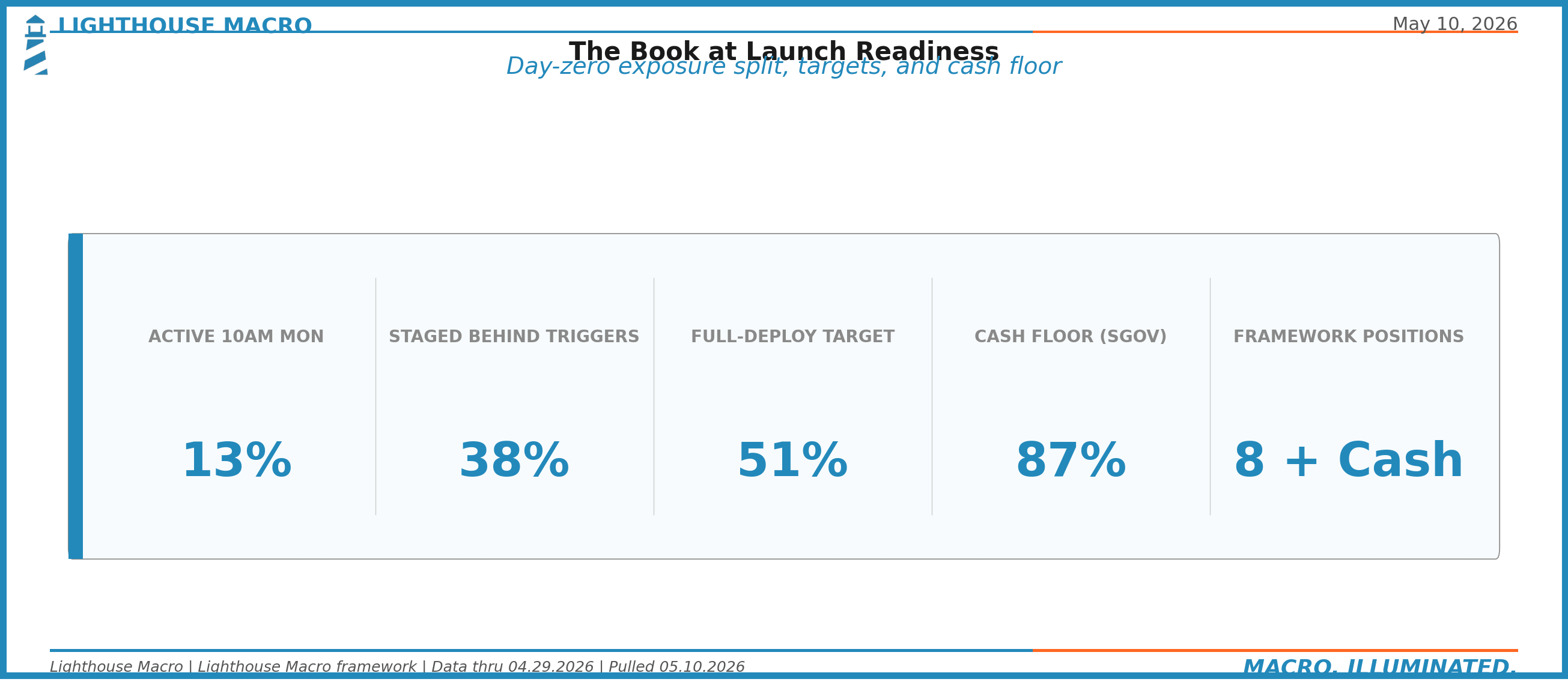
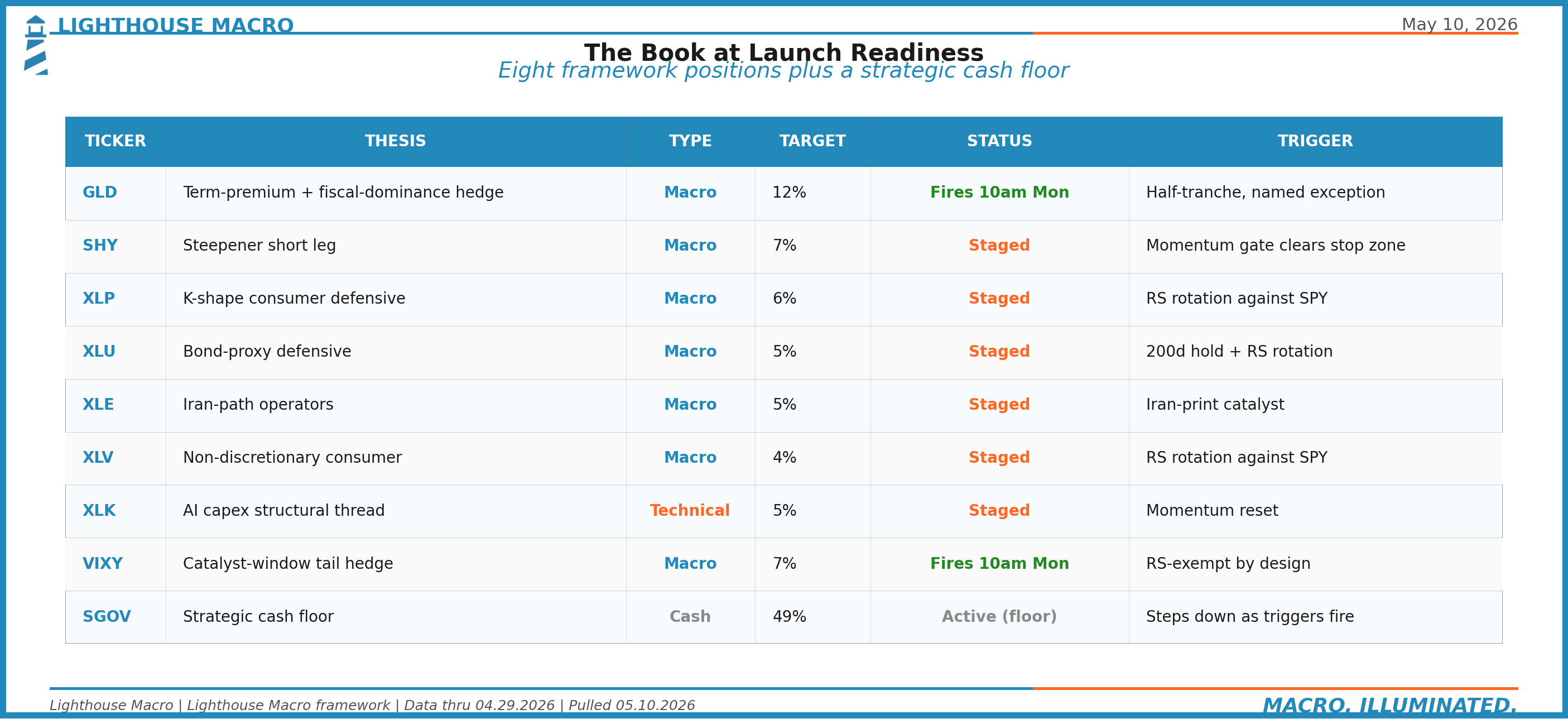
Framework readings as of 2026-04-29 close. Bench-corrected RS regimes; rate-of-change and distance-from-MA z-scores computed against 252-day rolling distribution.
The book by exposure
Long the term-premium and fiscal-dominance thread, expressed through gold at a structural pullback inside a multi-year breakout that is still intact on weekly timeframes. Long the short-end leg of the steepener trade, staged behind the price gate clearing the stop zone. Long defensive equity through staples, utilities, and healthcare, each staged behind relative-strength rotation against SPY. Long energy operators, staged on the next Iran-print catalyst. A small AI-infrastructure expression on the systematic screen, staged behind a momentum reset. Tail hedge via volatility through the catalyst window. Strategic cash floor parking the residual at roughly 4% carry while triggers wait.
Every line carries named triggers in writing. Relative-strength against the corrected benchmark; rate-of-change at two windows; distance-from-MA at two windows. The full position book, the per-line sizing, and the live state of each gate publish in real time on the PiTrade feed when it launches, and inside the trading day on the Telegram channel as triggers fire.
The active sleeve at 10am Monday
Two positions clear the framework’s day-one gates and fire at 10am Monday. The gold half-tranche, under a named exception against the multi-year breakout that is still intact on weekly timeframes. The volatility hedge, RS-exempt by design, full size against the four-fork catalyst window. Both are documented in the standing trade log with the named exception on the gold price gate cited.
Every other line waits. The patience is the position.
Today’s read on the systematic screen
The LHM systematic screen reads risk-on at the technical level. The cleanest cluster sits in broad equity and growth, concentrated in tech and AI-infrastructure exposure. The defensive sleeve the macro thesis prefers reads Red or Mixed on relative strength, technically short of clearing the gate today.
The framework’s response is the staged-versus-active split above. The macro view says lean defensive. The technical screen says the defensives are still pending. The book holds the targets and lets the gates fire.
Risk Matrix
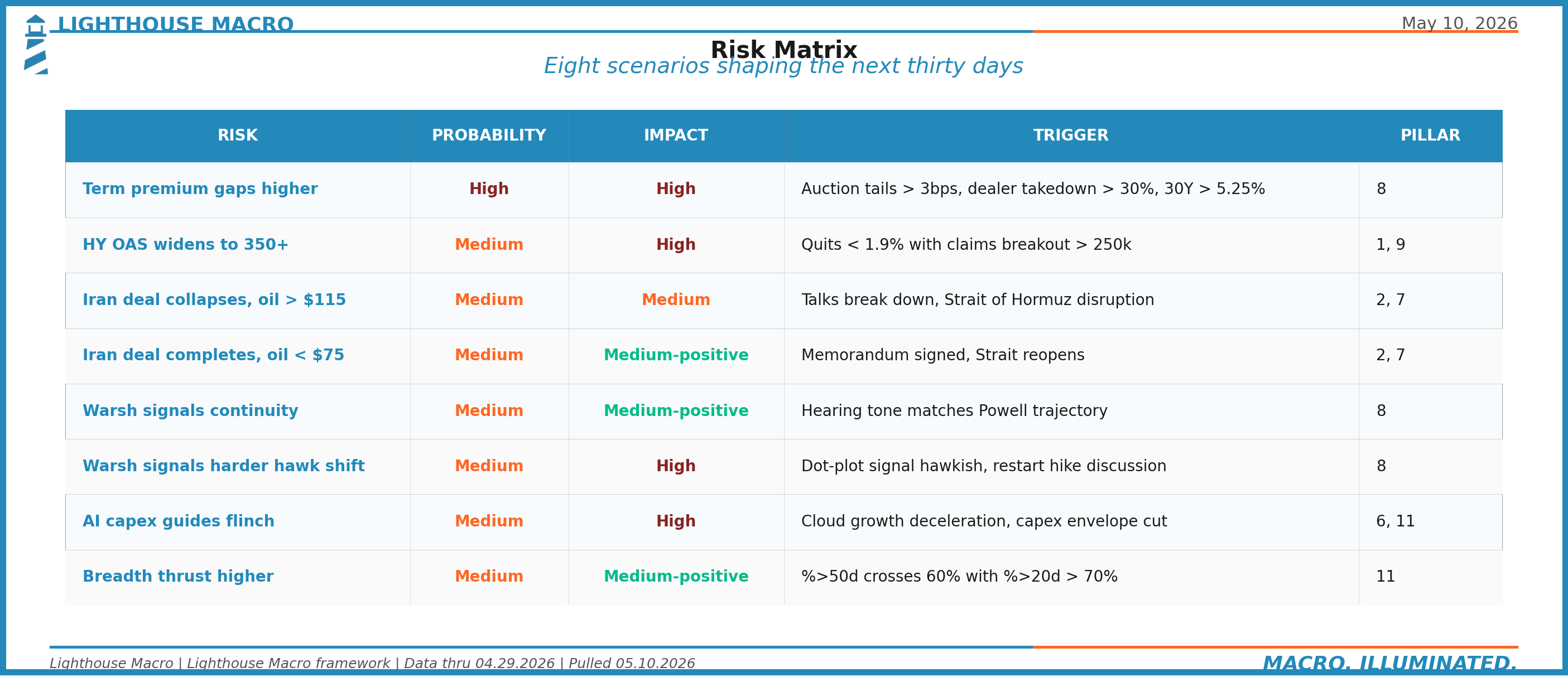
Eight scenarios shaping the next thirty days, with probability, impact, trigger levels, and the pillars each touches. Portfolio reasoning updated weekly. Triggers fire intra-week in the Telegram channel.
Watchlist
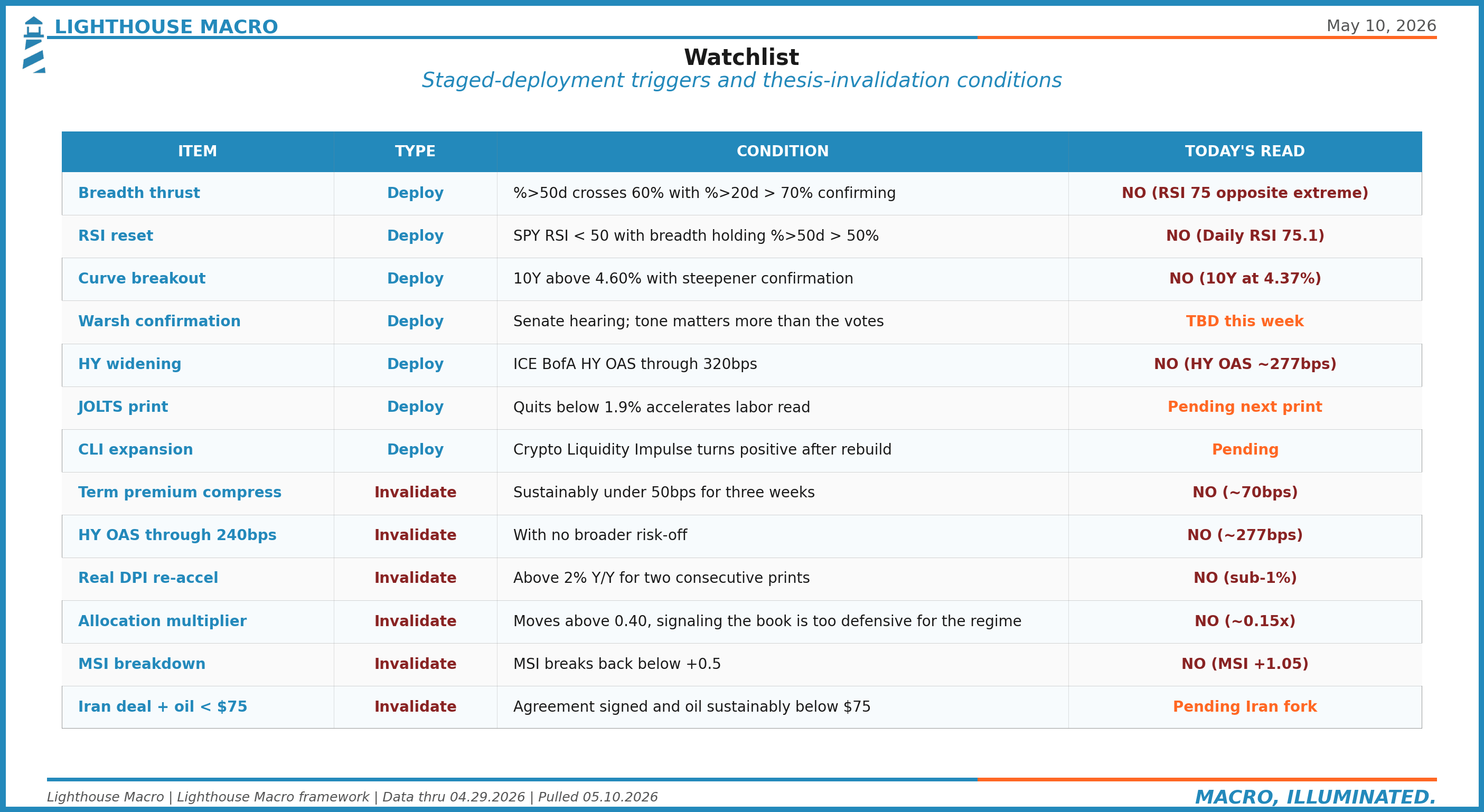
What we are watching for staged deployment, and what would invalidate the current book. Live readings update in the Telegram channel as triggers fire.
Bottom Line
The catalyst window is open. The Fed anchor moves in five days. The plumbing runs closer to capacity each quarter. The composition of the cycle is splitting between an investment thread that has its own gravity and a consumer thread that does not.
The book runs the framework through a second gate. The portfolio’s first day on PiTrade starts patient. Most of the target weights sit behind triggers. The discipline is the published edge.
The stack runs the framework through a third gate. PiTrade puts the book on a public timestamped feed. OpenBB puts the data and the composites on a live workspace. Telegram puts the cadence inside the trading day. The bot puts the framework inside the subscriber’s own question. Four surfaces, one credential, rolling out as the build queue clears.
What we built over the last decade and a half was the framework. What we are launching now is the surface for it. The Substack stays the anchor. The current rate stays available through the rollout window. The grandfather rule stays permanent for the cohort that locks before the next pricing move.
The framework reads the tape. We trade the reads. The launch goes anyway.
That’s our view from the Watch. We’ll keep the light on...
Bob Sheehan, CFA, CMT
Founder & Chief Investment Officer
Lighthouse Macro | Research | @LHMacro
