

The Records Don't Agree With the Tape. The Fed Just Changed Hands.
THE BEAM | May 18, 2026

Lighthouse Macro is not a market newsletter. It is a twelve-pillar diagnostic system. We built the whole thing and published all twelve pillars free, the mechanics and the thresholds, one at a time. The framework is open. That build is done. Now it runs live.
The portfolio is Crosscurrents, funded and live on PiTrade under @LighthouseMacro. About a week in, three positions on: SHY, GLD, and XLP. Every position, every mark, every rebalance, timestamped and auditable as it happens, the misses included. Early marks went out against SPY. A macro book that holds short-duration Treasuries, gold, and defensives should not be measured against a long-only equity index, so we benchmark Crosscurrents against QAI, the liquid multi-strategy comp. The benchmark should say what the strategy is. The framework is not a worldview we narrate at you. It is infrastructure you can watch work, with a real book attached to it. Watch it move in real time: https://app.pitrade.com/user/lighthousemacro
The work is built for two readers. Market participants who trade the macro, and operators whose decisions ride on it without ever placing a trade. The same framework serves both.
What follows is a Beam in three parts. Part 1 is free. Parts 2 and 3, the plumbing under the long end and the institution that just changed hands, are for subscribers, with ten more charts and the full positioning read.
The price is $500 a year. For a limited time, the first year is $400. After that, standard pricing.
PART 1: The Tape Doesn’t Agree With Itself
Free preview · Parts 2 and 3 are for subscribers
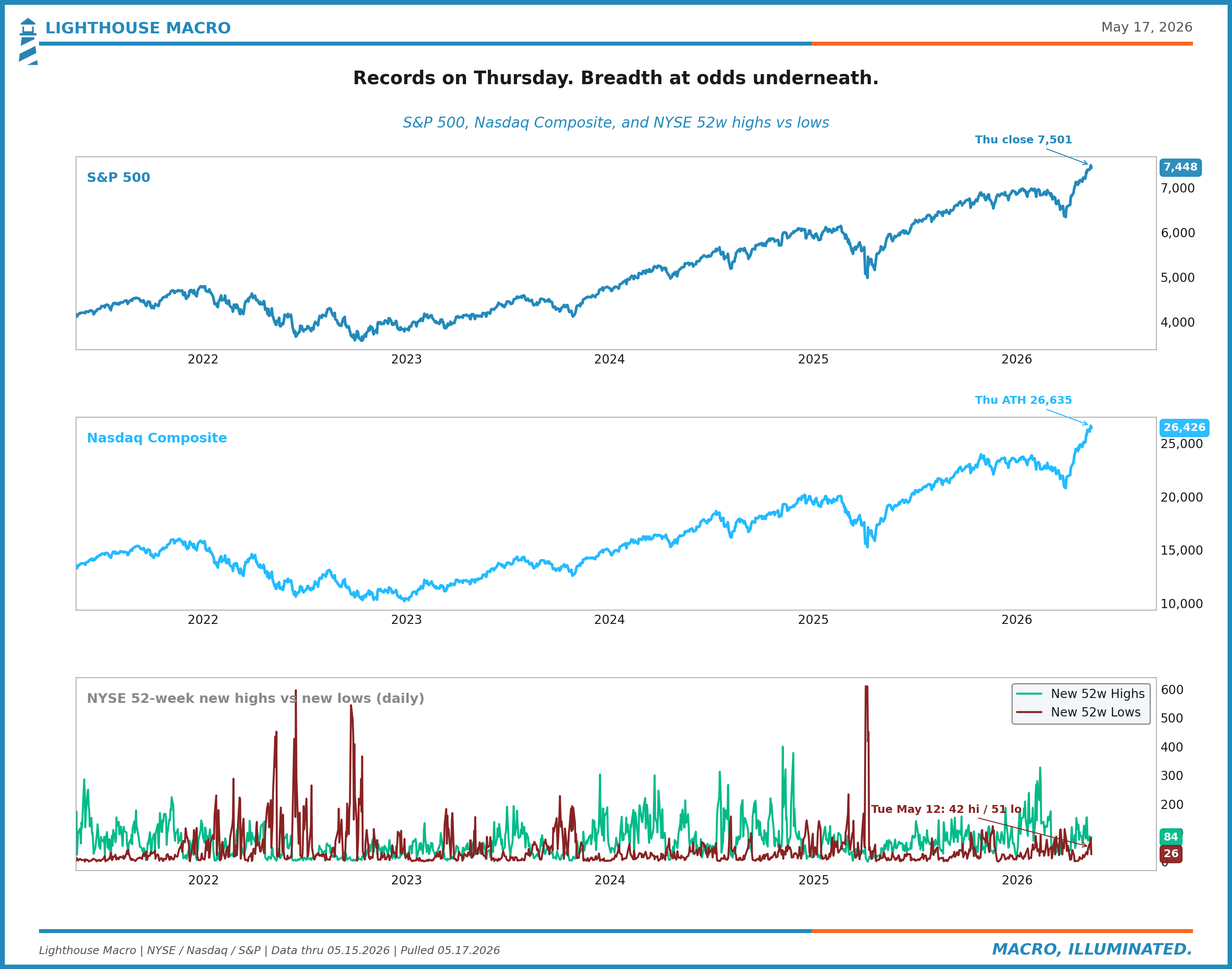
Three things happened over the last week that we should sit with before we say anything else about them. On Tuesday, with the indices grinding toward records, the NYSE common-stock tape still printed more new 52-week lows than new 52-week highs, 51 against 42. On Thursday the S&P 500 closed above 7,500 for the first time, at 7,501. The Nasdaq Composite printed an all-time high at 26,635. The Dow crossed 50,000 for the first time since February. Then Friday took most of it back. The S&P closed Friday at 7,408, down 1.2% on the week’s high and roughly back where the week started. Jerome Powell’s last day as chair of the Federal Reserve was Friday. Kevin Warsh, confirmed by the full Senate on May 13, took the chair this morning and chairs his first FOMC on June 16 and 17.
Two of those are facts about the tape. One is a fact about the institution. All of them are unfolding inside the same five-day window, and that window also holds an inflation print at 3.8% year over year, the largest one-month jump since May 2023, a Treasury refunding running 70% above its quarterly projection, and oil that will not stay below $100 because the Strait of Hormuz is still on the table.
It is a lot. The market is treating it like a normal week.
We are not. Our composite read of sentiment against structure, what we call the Sentiment-Structure Divergence, sits in FEAR plus WEAK alignment. Sentiment is not euphoric and structure is deteriorating at the same time. That is the patient regime, the one where the data keeps printing and the eventual move comes from a single thread breaking rather than from the headline. The reading is the spine of this piece. Part 1 is the tape. The plumbing underneath it, and the institution sitting on top of it, are Parts 2 and 3.
The Setup
Start where the disagreement is loudest. The cap-weighted indices are at fresh records. The common-stock tape underneath them printed more new lows than new highs the same week. That is not a rounding error in the data. It is the data telling two stories at once, and the gap between them is the entire subject of this piece.
The records are real. The Mag 7 carried the index there, and inside the Mag 7, Nvidia carried the Mag 7. The “everything is great” narrative, read closely, is an “AI infrastructure is great, and also Nvidia” narrative. The index is doing what a cap-weighted index does when leadership narrows. It obscures what the median name is doing.
The Data
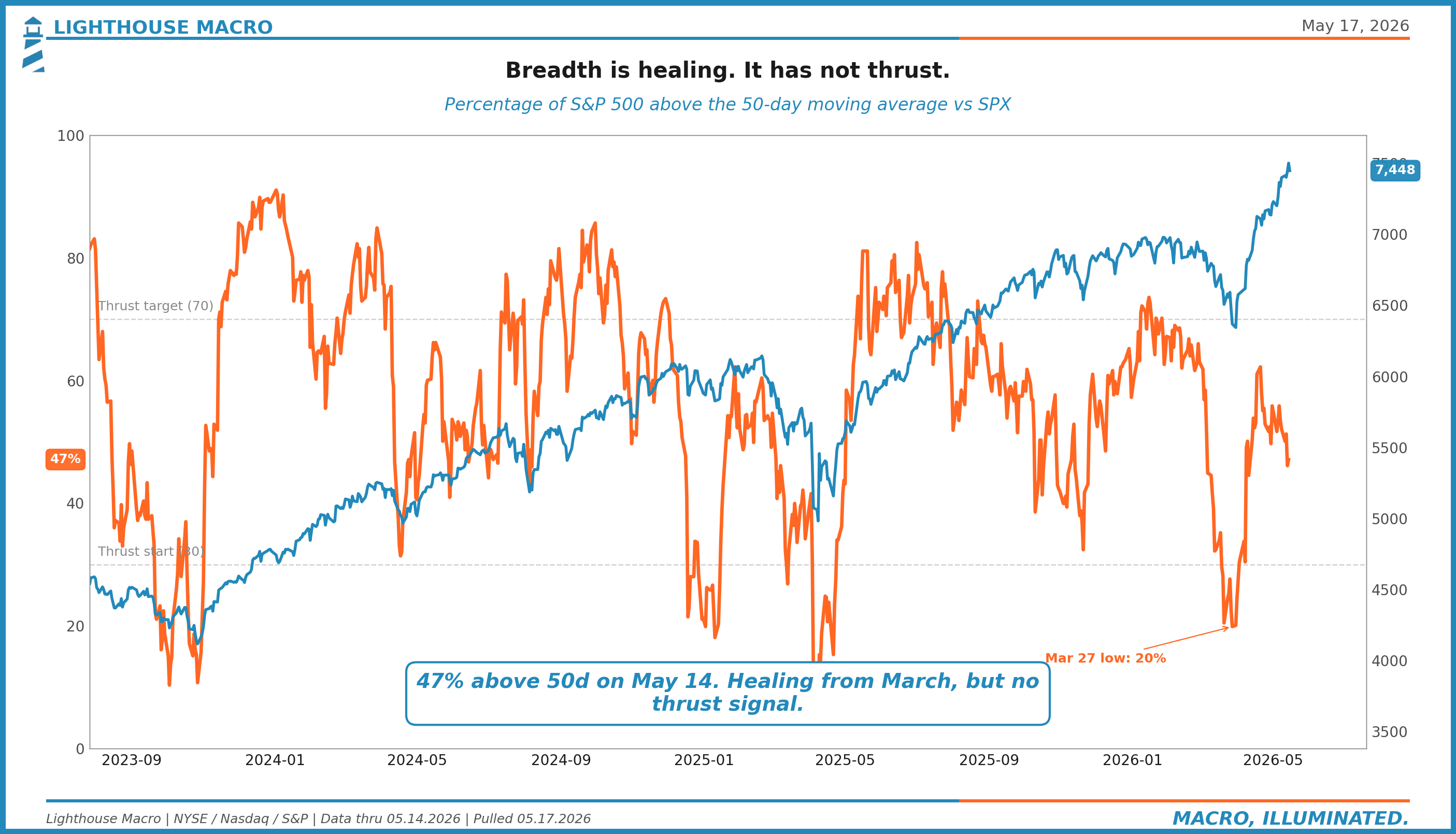
The percentage of S&P 500 stocks above the 50-day moving average sits at 47% as of May 14. That number is fine for the middle of a normal cycle. What matters at this index level is whether the breadth thrust has fired, the move from below 30 to above 70 within ten sessions, which is the marker that confirms participation broadening into a durable regime. We have not seen one of those since the spring of 2023. The path from the March 27 low at 20% up to 47% now is healing. Healing is a recovery off a washout. Thrust is a regime change. They are not the same event, and only one of them confirms a record.
Healing with the index at record highs is the configuration we have run back through 2007, 2014, 2018, 2020, and 2022. It does not always resolve into a top. It always shows up before one.
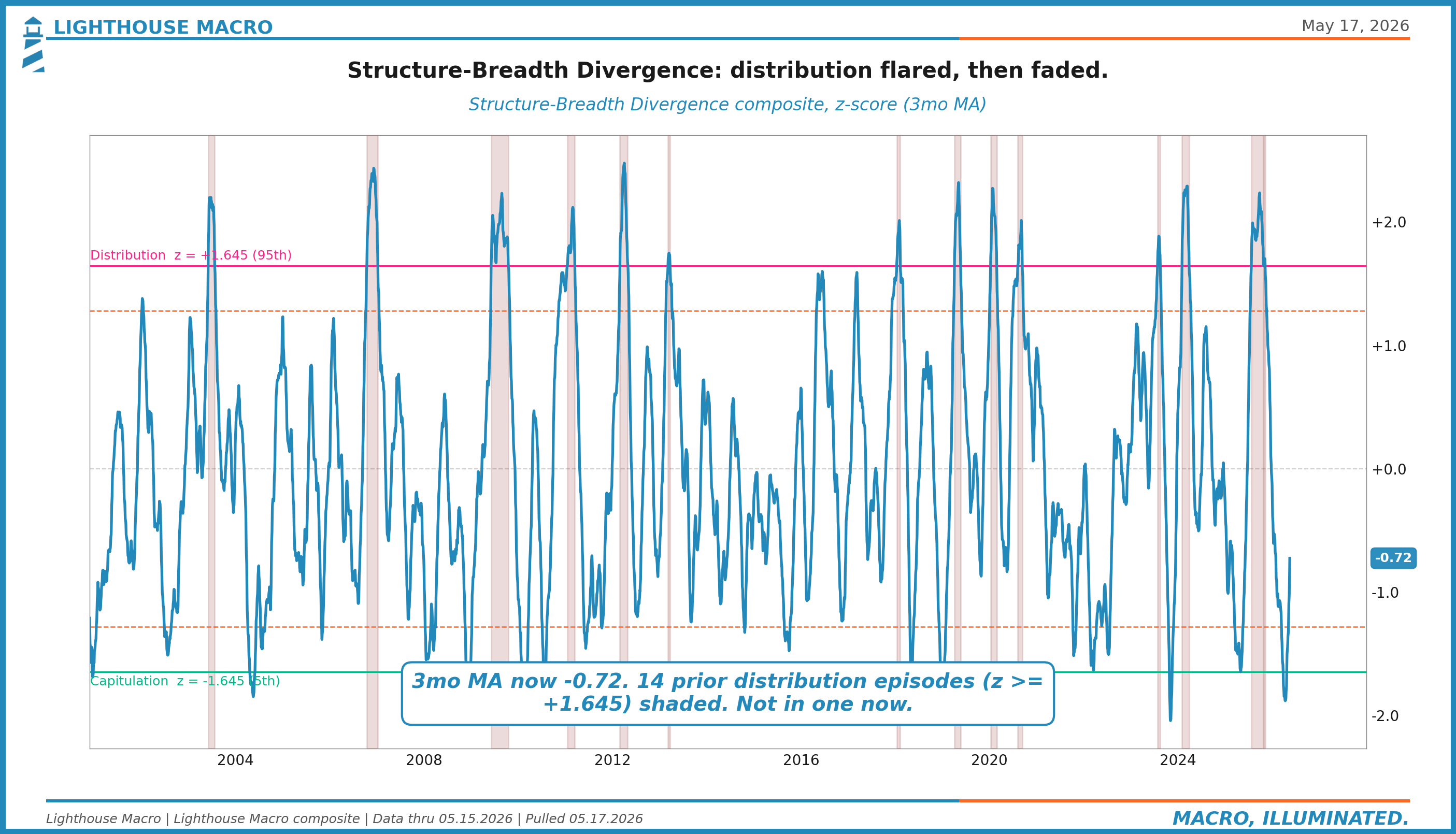
Our composite read of where the index sits relative to its 200-day against where the median stock sits relative to its 50-day, what we call the Structure-Breadth Divergence, flared toward its distribution band earlier this cycle and has since faded back below zero. On the 3-month smoothed series the read is negative today. We are not going to argue a top off a composite that is sitting below its own mean, and we are going to say that plainly rather than quote the one-day spike that would tell a louder story. The honest read is in the simpler internals, and they line up.
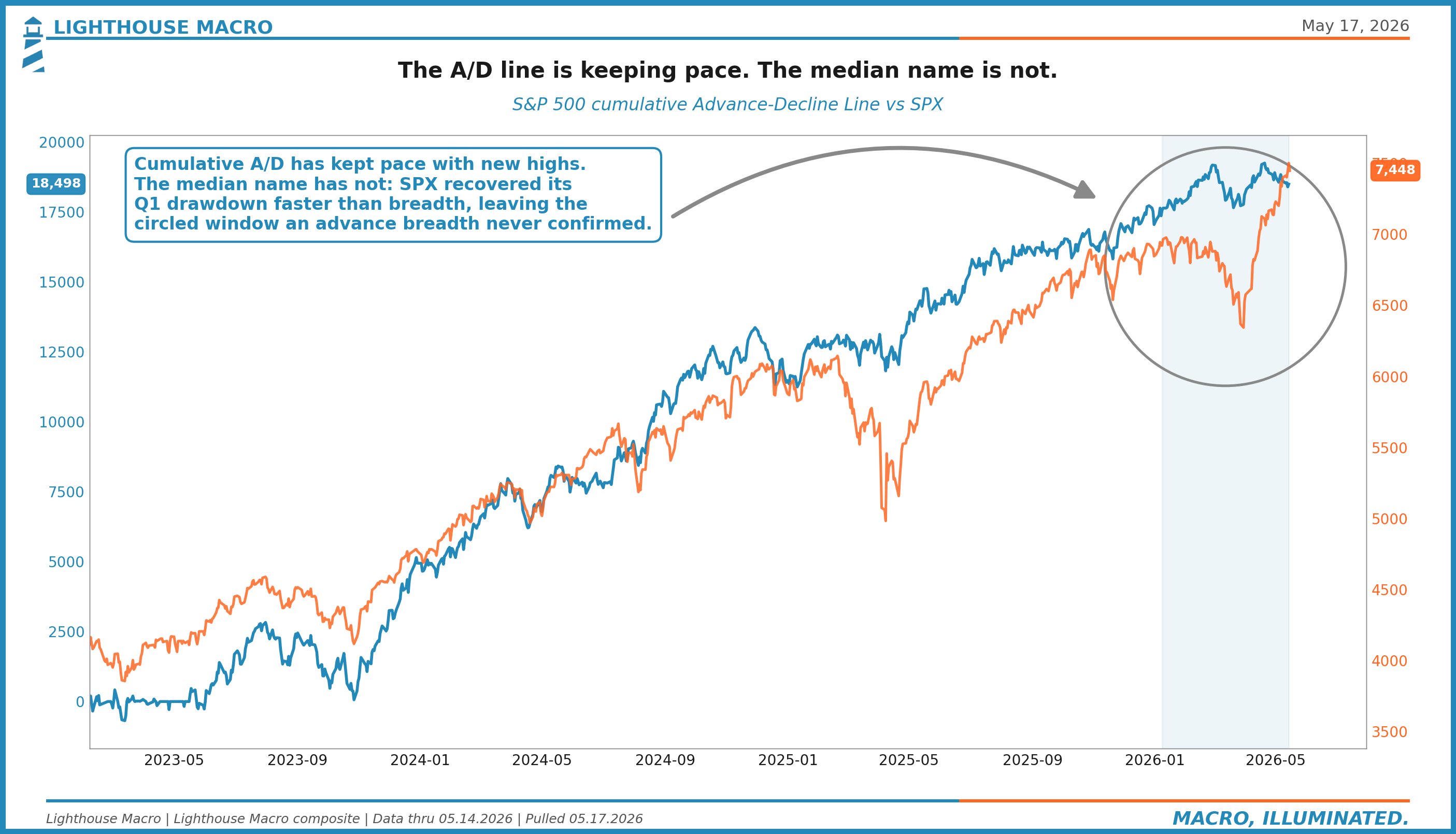
The cumulative Advance-Decline line has kept pace with the index. The median name has not. The S&P recovered its first-quarter drawdown faster than its own breadth did, which leaves a window where the index made back its losses on an advance the broad tape never confirmed. That is the circled region on the chart. An index can do that. It cannot do it indefinitely without either the breadth catching up or the index coming back to meet it.
The Mechanism
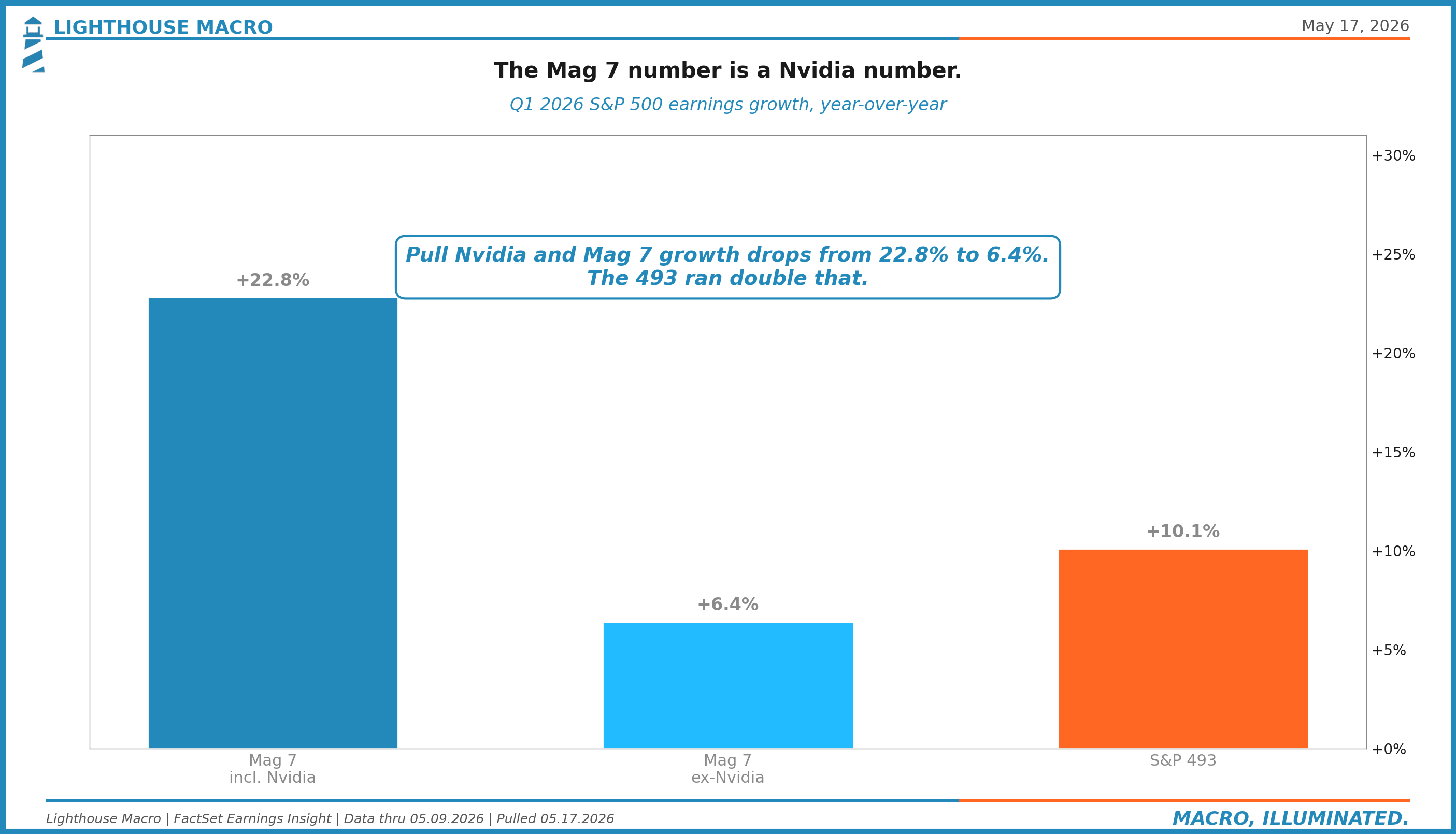
This is the engine. Q1 earnings growth ran +22.8% for the Mag 7 with Nvidia, +6.4% for the Mag 7 without Nvidia, and +10.1% for the S&P 493. Pull one company out of the cohort and the cohort’s growth more than halves and falls below the other 493. The top ten names are 38% of the S&P. The Mag 7 alone are 33%, the most concentrated the index has been in fifty years.
When breadth narrows into the cap-weighted top while the bottom of the index is still printing new 52-week lows, the index can rise while underlying participation thins. Capital is rotating out of the median name and into the largest names. The index does not show you the rotation. The high-low split and the median-name lag are how you read how far the rotation has already run.
What Consensus Is Missing
Consensus is reading Thursday’s record as confirmation of where the cycle sits. We read internal composition as the check on that, and the two have not agreed for two months. The gap is wider now than it was a week ago.
Narrowing participation while the index makes new highs resolves one of two ways. Participation broadens, which is the bullish path. Or the leaders roll over to meet the laggards, which is the bearish path. The leaders are still leading. The breadth read does not tell us the record is wrong. It tells us the question is when the leaders crack, not whether the laggards were a false alarm. The headline tape says they will not crack. The internals say that is the wrong thing to be sure of.
What Would Change Our Mind
The breadth thrust fires: the percentage above the 50-day crosses 70% within ten sessions of being below 30%. New 52-week highs on the common-stock tape outnumber new lows convincingly and stay there for a week. The cumulative Advance-Decline window closes because the median name catches up to the index rather than the index falling to the median name. Any one of those is a yellow light flipping toward green. Two together and the tape thread inverts, and we say so.
None of them are happening yet.
The So-What
The framework reads this regime as one of capital preservation, and the breadth picture is a large part of why. An index making highs on thinning participation is not a reason to be short. It is a reason not to chase the record. The patient regime is patient on purpose. We wait for the thread to break rather than guess which one and when.
That is the tape. It is the part anyone can see if they look past the index print. The two parts that follow are the parts the index is built to hide: the plumbing underneath the long end, and the institution that just changed hands on top of all of it.
Before you go: the book is live, and what is behind the paywall
The book is live. Crosscurrents runs on PiTrade under @LighthouseMacro, funded and auditable as it moves, the honest misses included. Watch it before you pay for the thinking behind it: https://app.pitrade.com/user/lighthousemacro
Parts 2 and 3 of this Beam are for subscribers. Part 2 is the plumbing underneath the long end, the balance sheet, term premium, funding stress, reserves, the spreads that move first when reserves get scarce. Part 3 is the institution: the dissent count Warsh inherits, what the curve and the committee are actually saying versus what consensus thinks they are saying, and where the framework puts the asymmetry. Ten more charts. The full positioning read.
Pricing. The price is $500 a year. We ran one launch window in the spring. It opened and closed on schedule, exactly as we said it would, and we are not repeating it. This is not that. We are holding the first year at $400 for a limited time, after which it returns to standard pricing.
If your decisions touch the macro environment, and almost everyone’s do, this is the cheapest insurance you will buy this year against being the last to know which thread broke.
