

The Honest Level
The Beacon · Term premium at 70bps, framework anchors at 150bps

Executive Summary
Term premium on the 10-year Treasury sits at roughly 70 basis points. A year ago it sat at 40. Five years ago it sat below zero. The drift is in one direction.
We anchor the framework’s honest level at 150bps. It is the median reading from 1970 to 2007, and we use it because the conditions facing the bond market today look more like that pre-QE regime than the 2014 to 2021 stretch when term premium ran negative. Structural deficits at full employment. Treasury funding short and deferring duration. The Fed out of the buyer seat. Inflation re-anchored at target with materially wider variance. None of those features were present during the QE-era anomaly. All of them characterized the pre-2008 regime, when term premium averaged roughly where we say it should sit today.
70bps is halfway home. The base case is straightforward: the front end stays anchored by a patient Fed, the long end keeps repricing higher as supply grinds against capacity, and the curve steepens through the back. That is what the data has been doing for two and a half years.
The next catalyst is Wednesday, May 6. The Quarterly Refunding Announcement gives Treasury’s read on issuance composition over the next three months and gives the market the chance to push the long end before the issuance hits. Refunding does not move the destination. It moves the pace.
The Reading: 70bps Today
We use the Adrian-Crump-Moench decomposition because it has the longest continuous monthly history, the New York Fed publishes it without revision games, and the cross-sectional behavior over four decades behaves the way theory says term premium should behave.
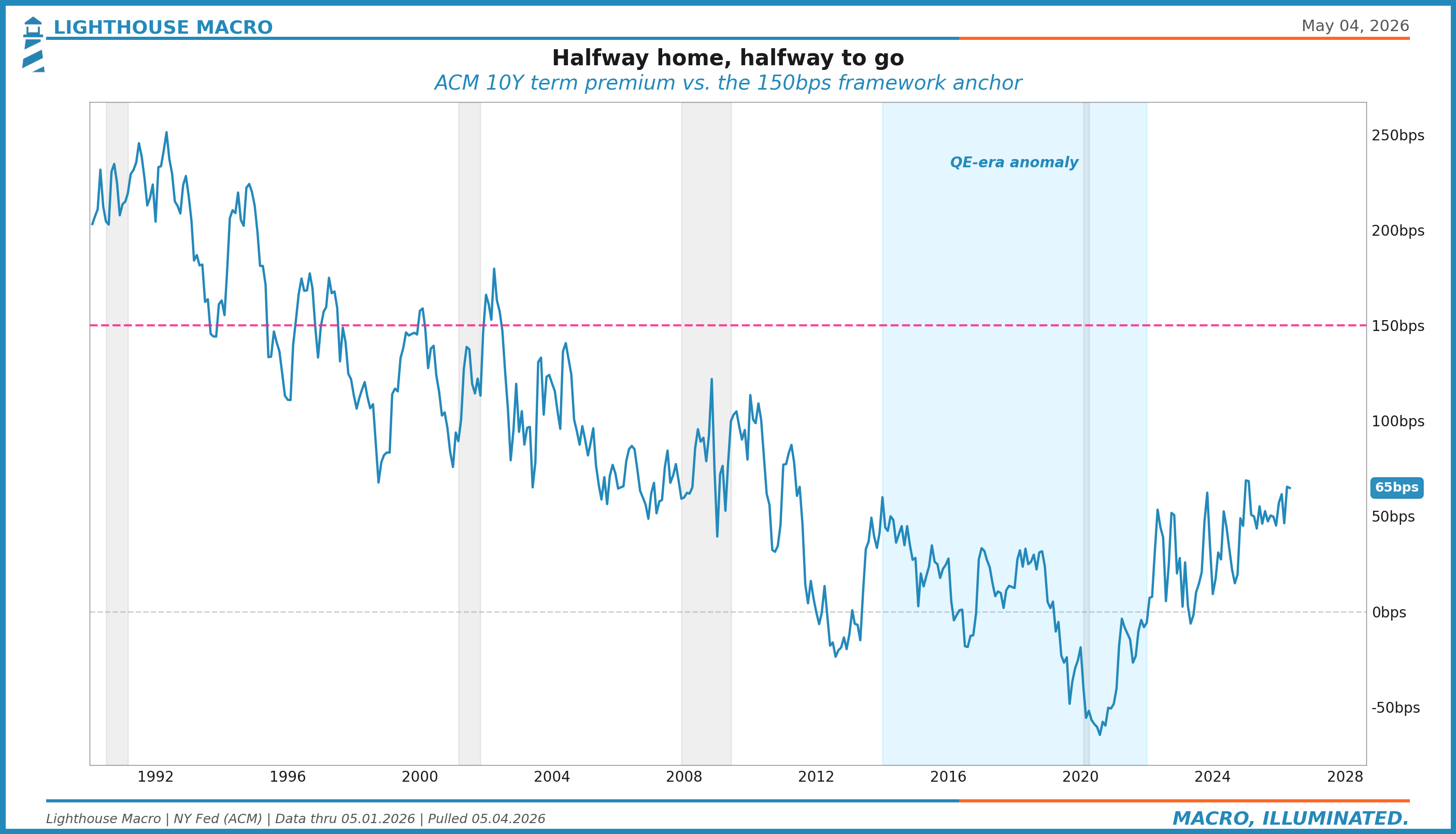
History matters here because the eye gets tricked by the recent past. From 1970 through 2007, term premium averaged a little above 150bps. The 1980s and early 1990s ran higher, regularly above 300bps. The mid-2000s ran lower, occasionally below 100. The full pre-crisis distribution clustered roughly between +75 and +250.
Then the world changed.
From 2014 through 2021, term premium ran negative for extended stretches. That was not a market judgment about future risks. It was an artifact of three forces compounding. The Fed owned a quarter of the Treasury market and absorbed duration aggressively through QE. Foreign official buyers, primarily China and Japan, ran reserve accumulation strategies that treated Treasuries as inelastic demand. And global growth and inflation expectations were anchored low enough that the path of short rates over a decade looked extraordinarily compressed. Term premium measured what was left over after those three forces. There was not much left over.
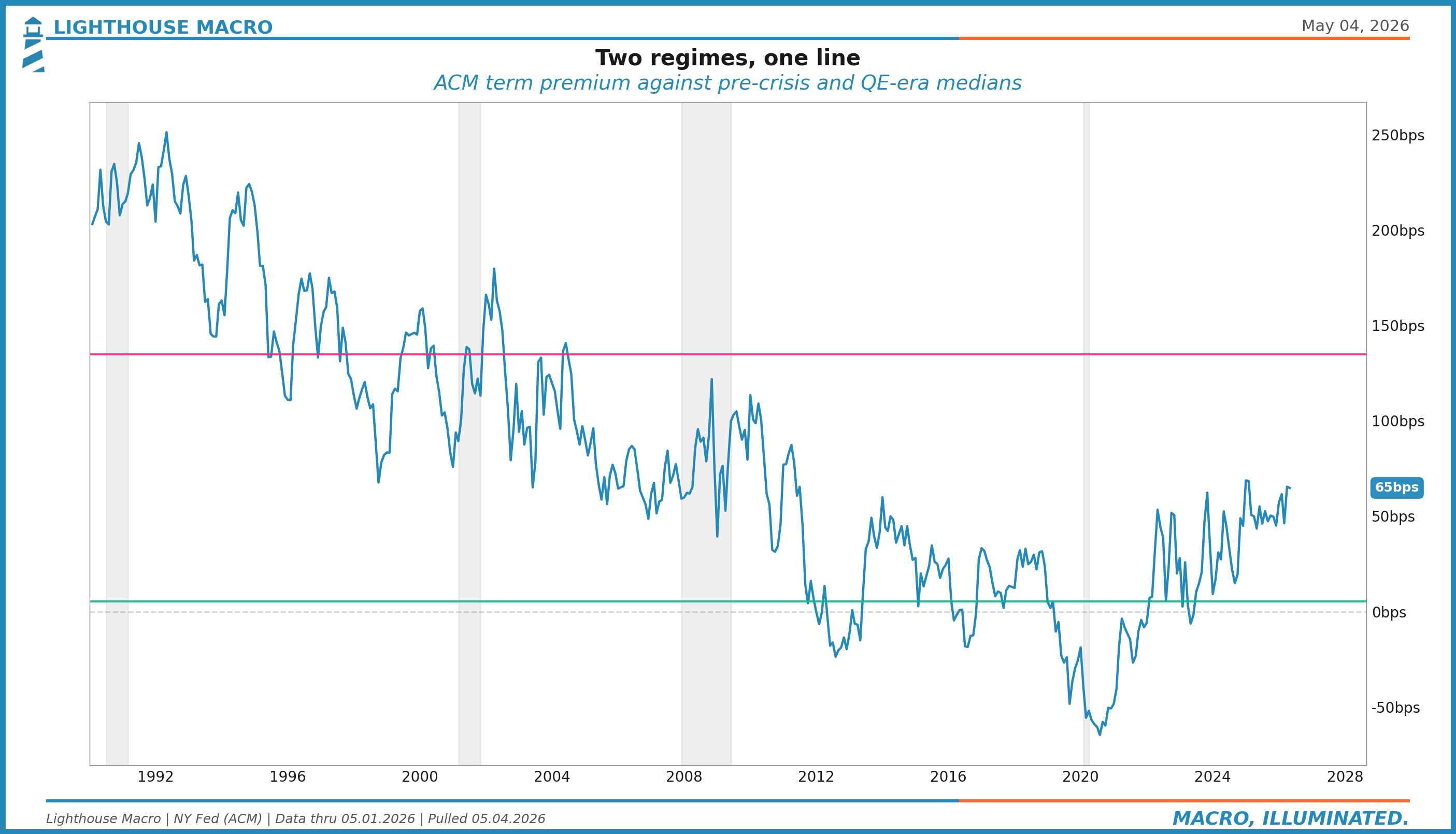
Those three forces have all reversed. The Fed has been a passive duration seller for two-plus years. Foreign official demand has flatlined and ceded share to private buyers who require compensation rather than absorbing reserve flows. Inflation expectations have re-anchored at target but at a variance materially wider than the 2010s carried. The conditions today look meaningfully more like the pre-2008 regime than the QE-era anomaly. The framework’s anchor falls out of that observation. Term premium lived in the 100-to-200 range for most of forty years under conditions that broadly resemble where we are today. We anchor at 150 because that is where the median sat across that distribution.
The 70bps current reading puts us at the floor of the pre-2008 range. The repricing has begun, and it has gone halfway. The framework’s argument is that the conditions warrant continuation.
The Spine: Fiscal Supply and Duration Mismatch
Every term premium framework that survives contact with the data starts here. The federal government issues debt. Someone has to hold it. The compensation that someone demands depends on how much debt is coming, what maturity it carries, and what the alternatives are.
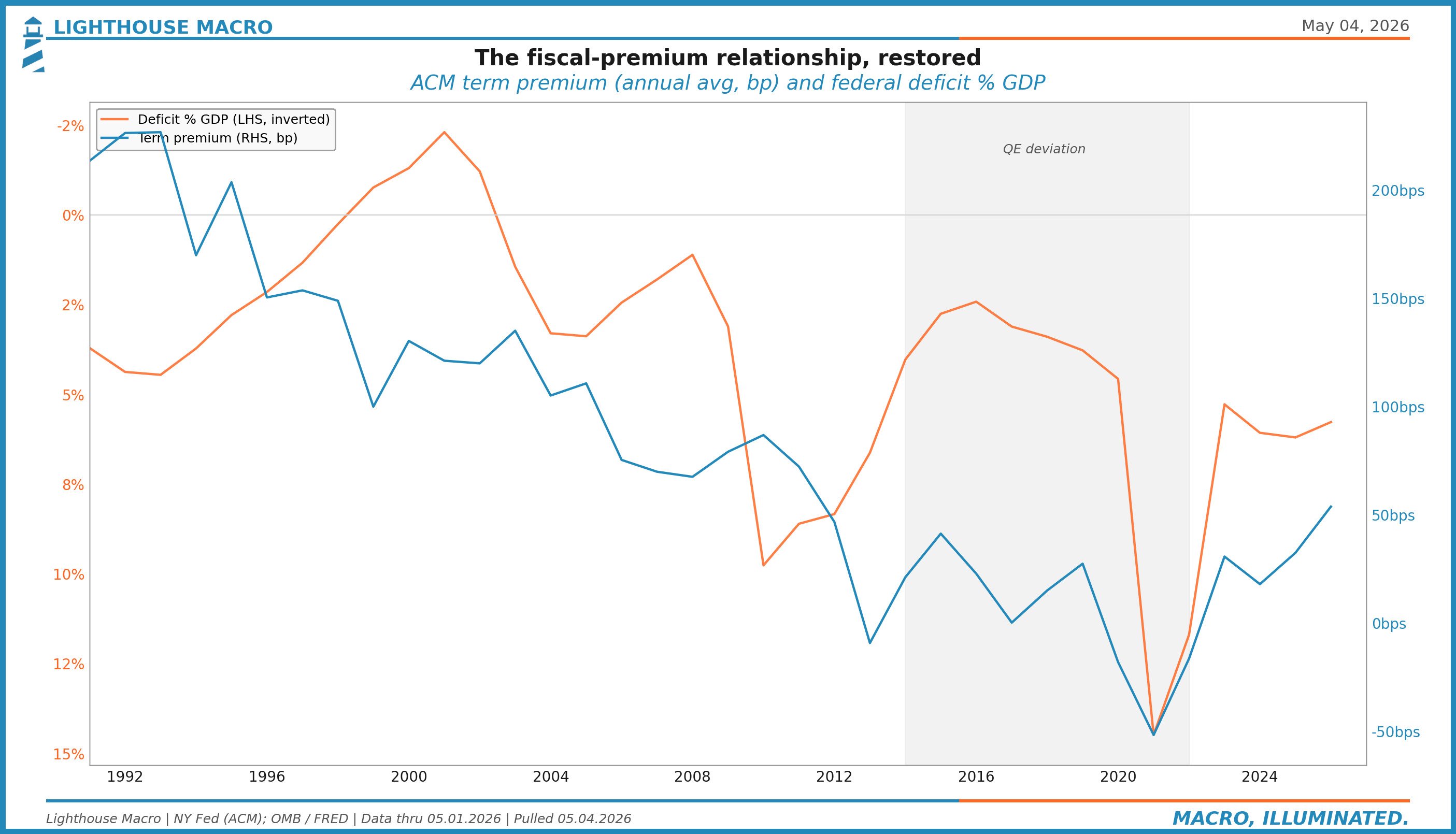
The first leg is volume. The federal deficit is running at roughly 6.5 to 7 percent of GDP. The level is remarkable not for its magnitude but for its composition. We are running peacetime, full-employment deficits at a scale historically associated with recessions or wars. The cyclical adjustment is meaningful. If the economy entered a normal recession tomorrow, automatic stabilizers and revenue rolloff would push the headline deficit toward 10 percent of GDP without any new policy. We are starting from a structural baseline that leaves no room for the business cycle.
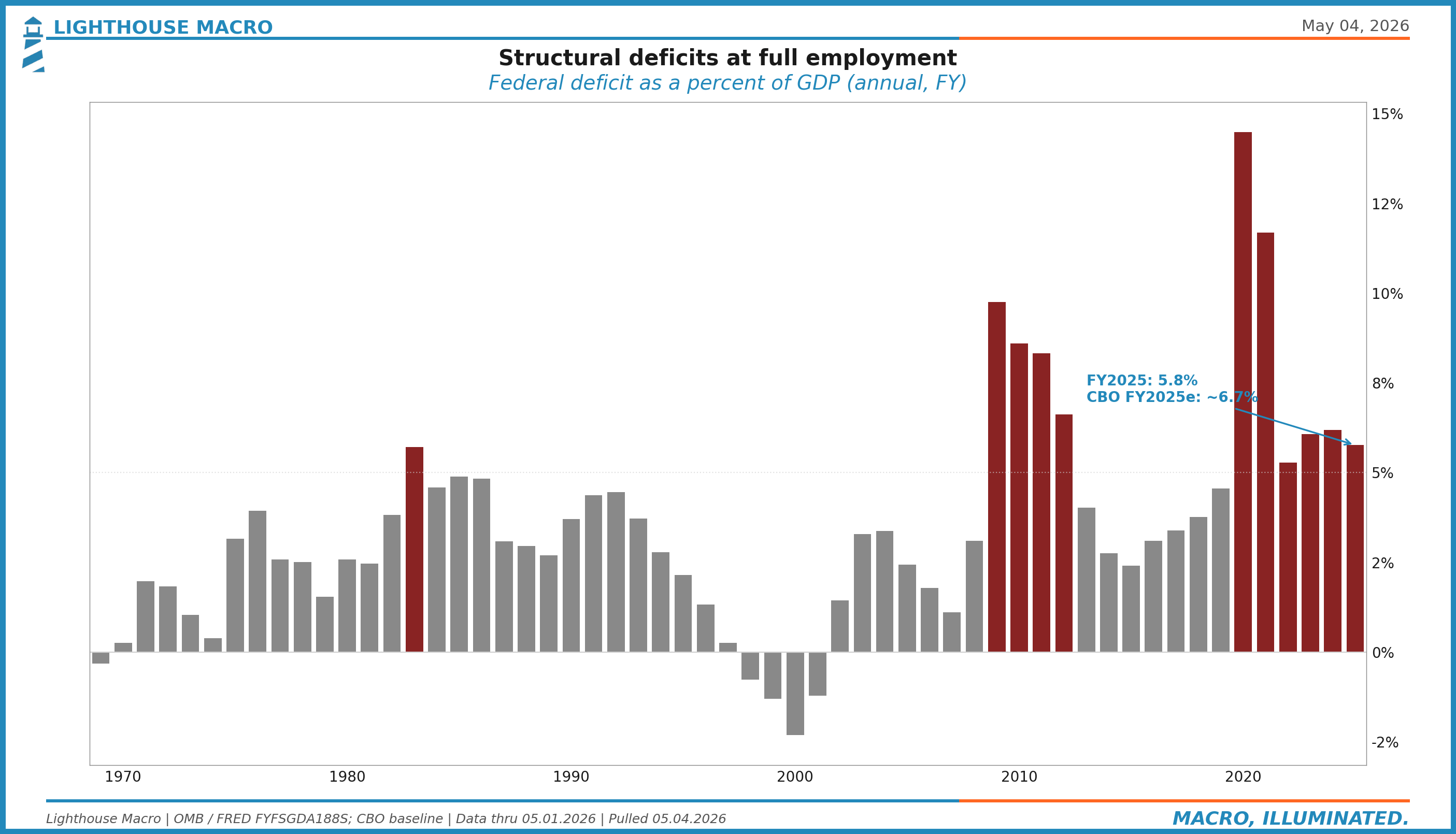
That baseline is not closing. CBO projections show deficits widening through the next decade under current law. The interest line alone, which was a manageable rounding error during the ZIRP years, now compounds against a debt stock that has roughly doubled since 2008 and a marginal funding cost that has materially repriced. We spend more on interest today than on defense.
The second leg is composition. Treasury has consistently chosen to fund a disproportionate share of issuance through bills rather than coupons. Bills are short-dated, easier to absorb, and roll cheaply when the front end is anchored. Coupons require buyers to take duration, which is where capacity constraints bite.
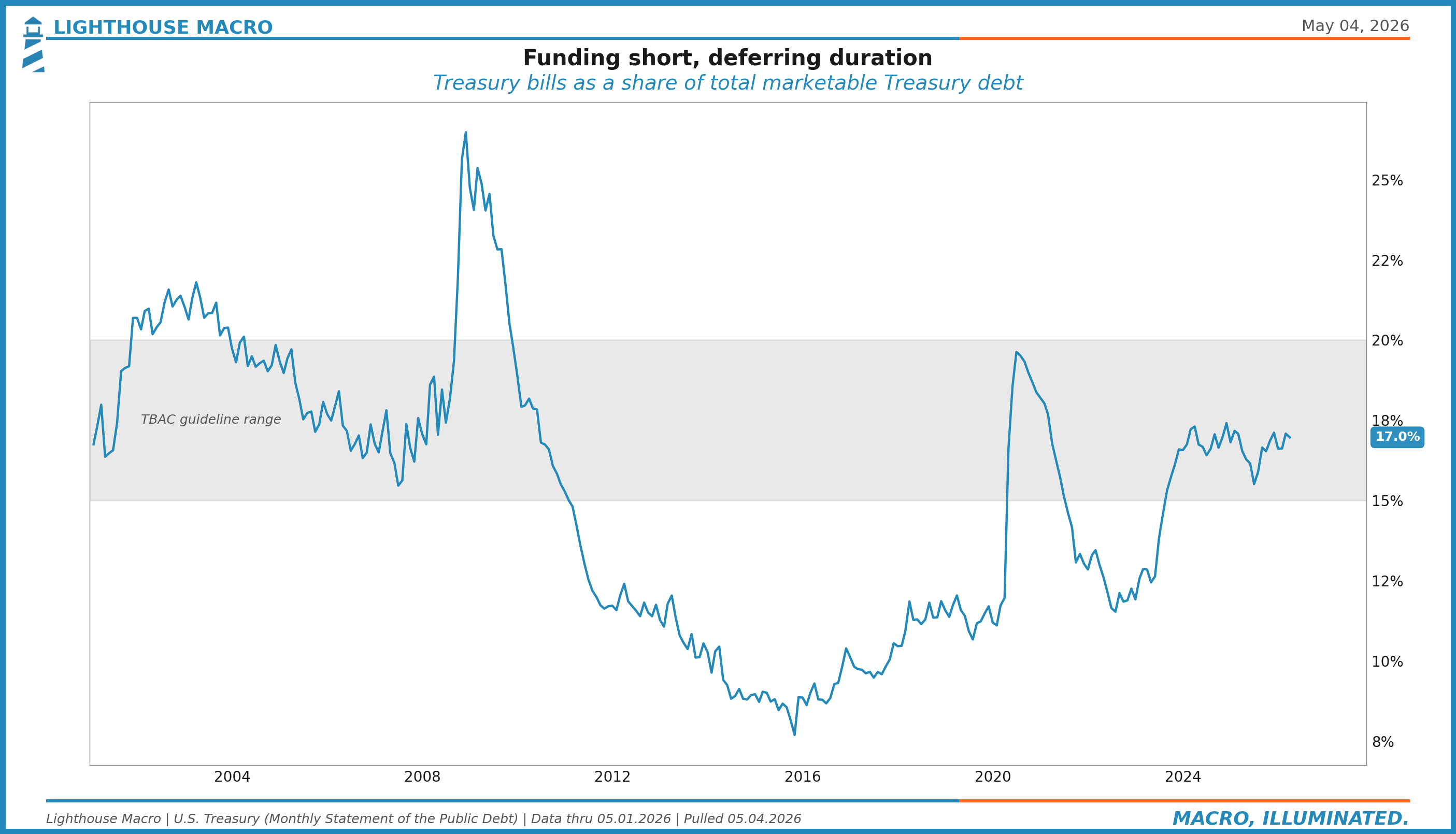
The bills share has ridden the upper half of the 15-to-20 percent range that the Treasury Borrowing Advisory Committee has historically described as appropriate, and has done so for two years now. The accounting of that choice is straightforward. By issuing bills today, Treasury defers the duration problem. By deferring the duration problem, Treasury accumulates an obligation to issue more coupons later. The math runs through eventually.
The third leg is maturity.
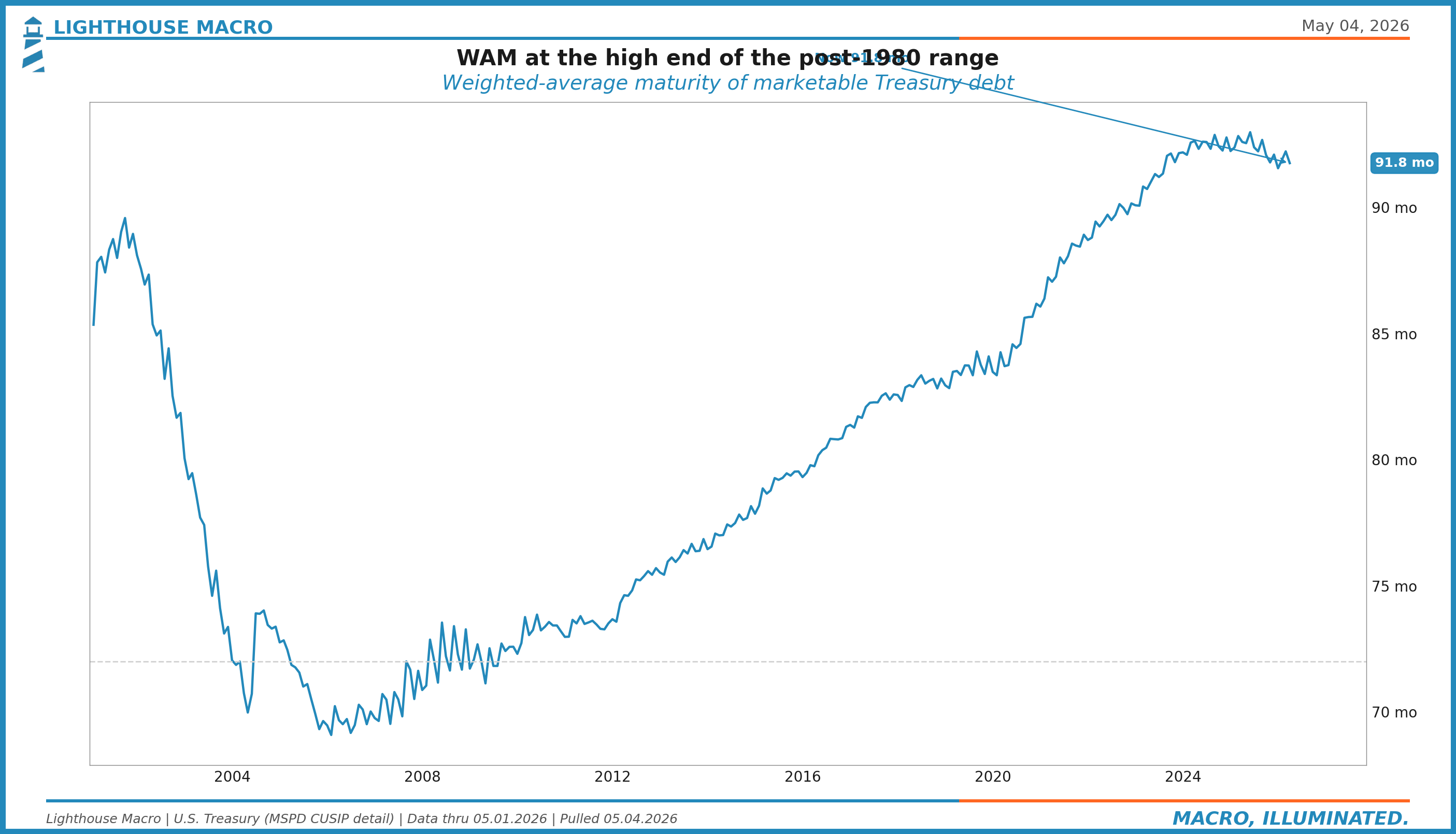
Weighted-average maturity sits near 92 months, the high end of the post-1980 range. This sounds like Treasury has done the duration work. It has not. WAM is a stock measure. The deficit run-rate is a flow problem. The deficit is wide enough that simply maintaining the current WAM requires accelerating coupon issuance from here. Letting WAM drift back toward Treasury’s historical six-year reference would require even more. Either path puts duration on the market faster. WAM tells us where we are. The forward question is what it takes to stay there.
The supply trajectory follows from those three legs.
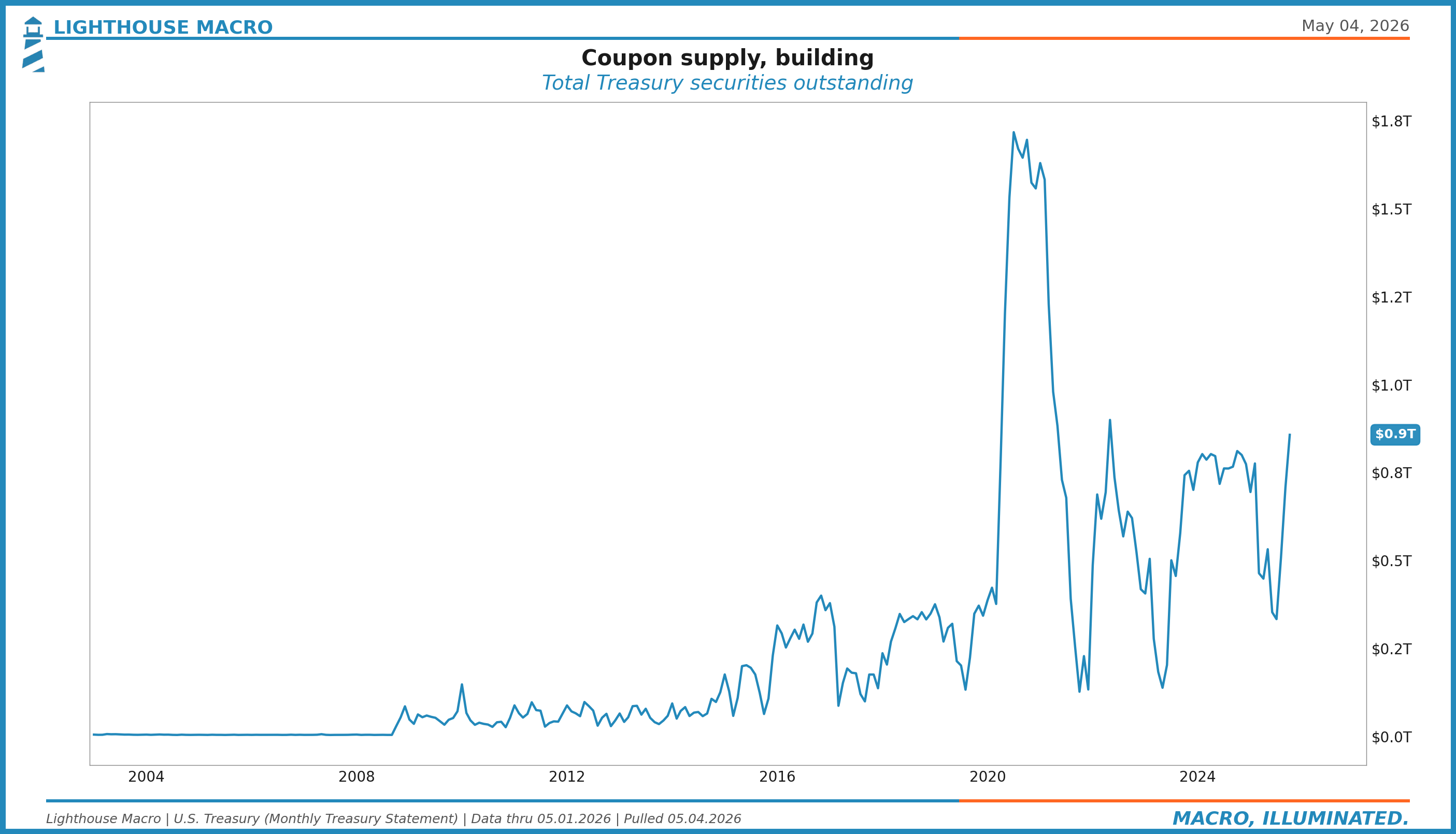
This is the spine of the framework. Volume that does not stabilize, composition that defers duration, and a maturity profile that sets up an accelerated coupon issuance trajectory. Term premium is the price of all of that, paid in basis points, by buyers who require compensation that QE-era buyers did not.
The Cushion That’s Gone
For most of the post-2008 era, the Fed was the marginal absorber of duration. QE1 through QE4 added roughly five trillion in Treasuries and MBS to the System Open Market Account. That demand came in regardless of price, and it was the dominant reason term premium ran where it did during the QE years.
Quantitative tightening reversed that. Starting in 2022, the Fed began letting maturing Treasuries roll off the balance sheet at a defined cap.
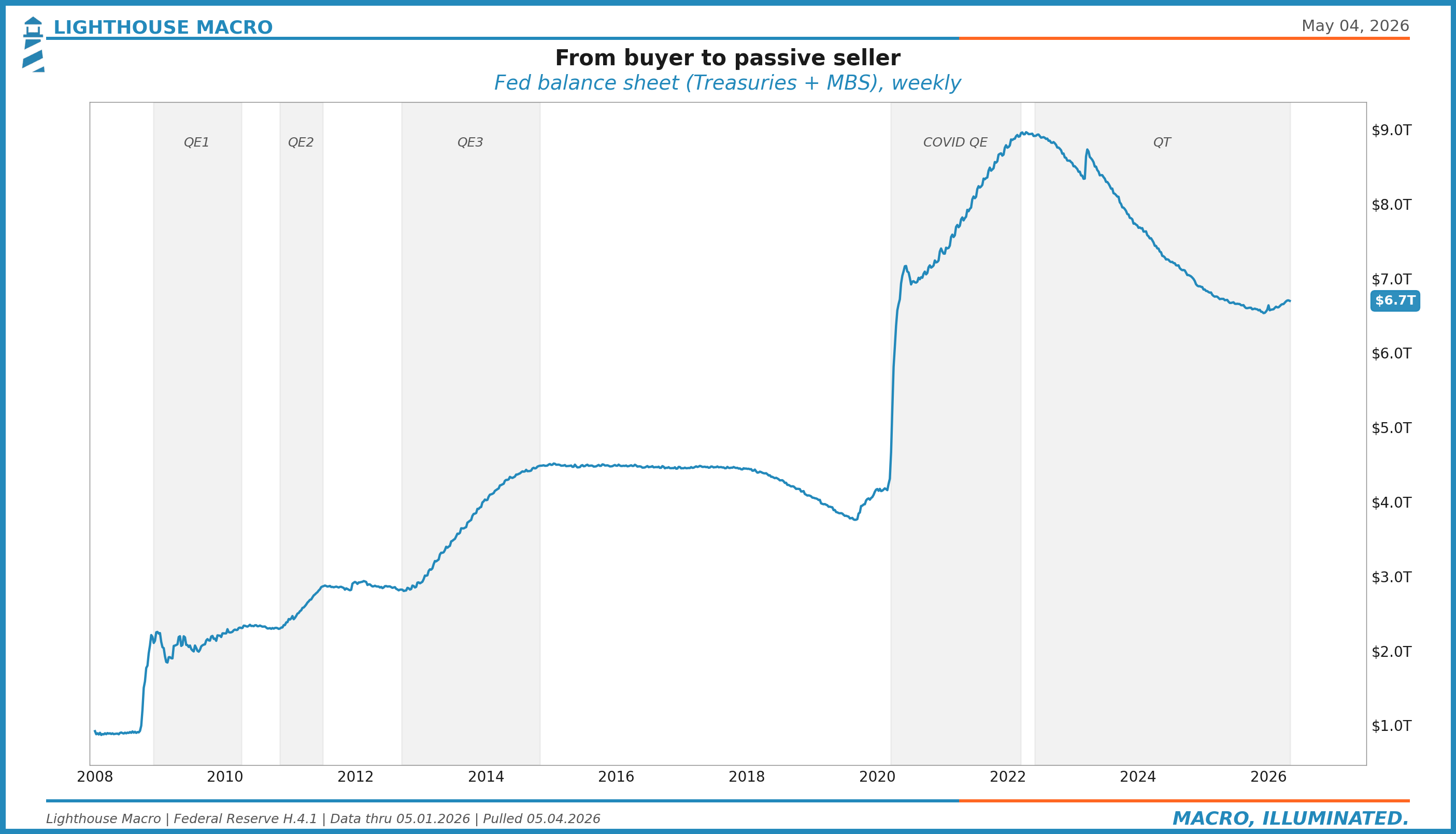
The pace of QT moderated in 2024 and again in 2025 as Fed officials grew increasingly attentive to reserve scarcity. There is now active discussion about whether QT should end entirely. We expect it will, sometime in the next two to three meetings, depending on how reserves and money-market functioning behave. Ending QT is not the same as restarting QE. The Fed exiting the seller role does not put the Fed back in the buyer role.
What absorbed the duration that QT released? Primary dealers, on their balance sheets. Foreign private buyers when the currency-hedged yield pencils. Domestic real-money allocators when liability-driven mandates demand it. And money-market funds, indirectly, by lending into repo and term funding rather than buying Treasuries outright.
That last buyer matters. From 2021 through 2024, the Reverse Repo Facility absorbed peak balances above two trillion dollars. Money-market funds parked cash with the Fed at the RRP rate when private alternatives offered nothing. As the front end repriced and bills became more attractive, money-market funds rotated out of RRP and into Treasury bills directly.
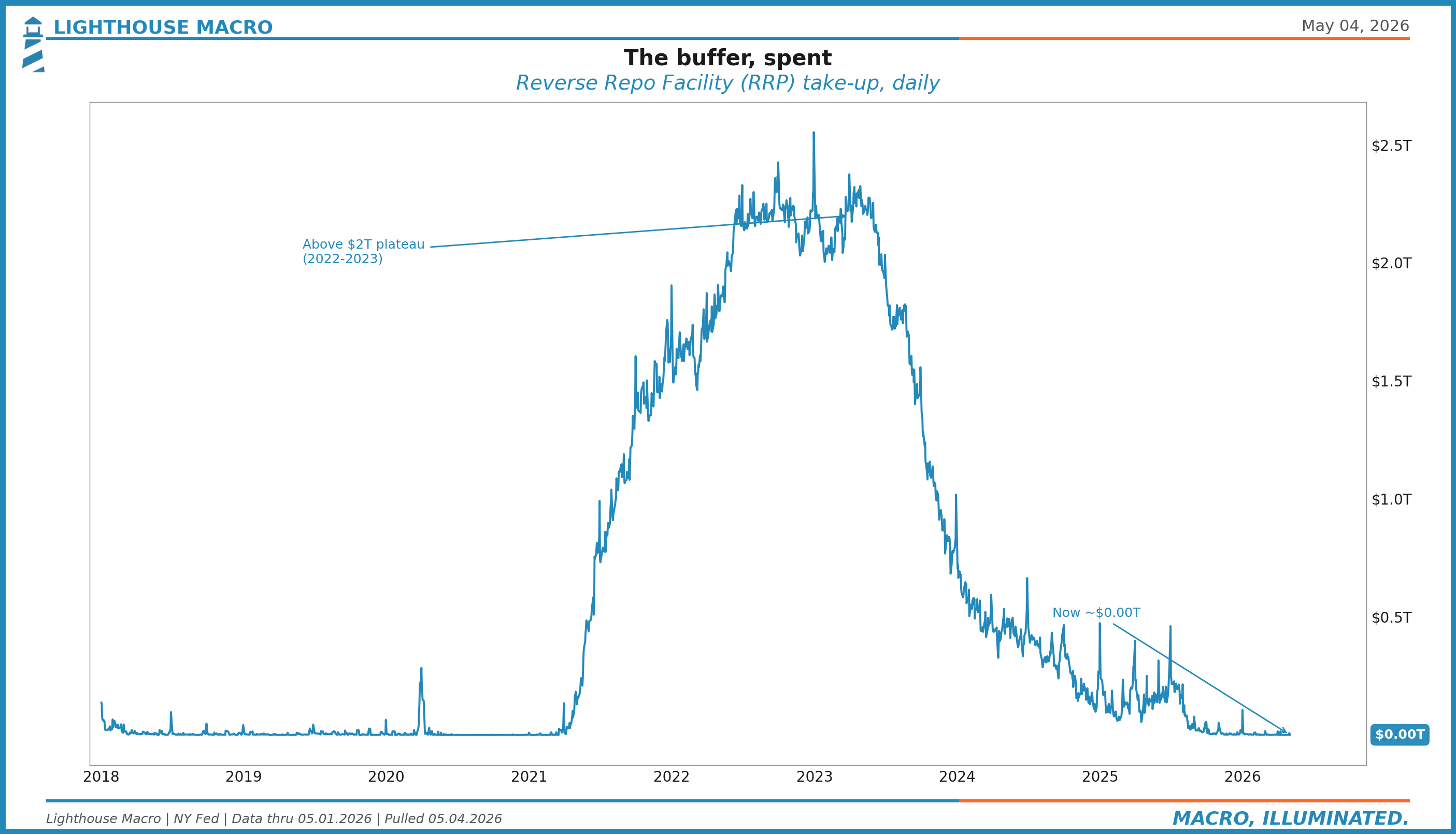
That rotation was a one-time event. The buffer is gone. There is no longer two trillion of money-market liquidity sitting at the Fed waiting to flow into Treasuries when supply hits. That liquidity has already flowed. It is in the bills market now, and it will roll, but the cushion that absorbed every funding shock from 2022 to 2024 has been spent.
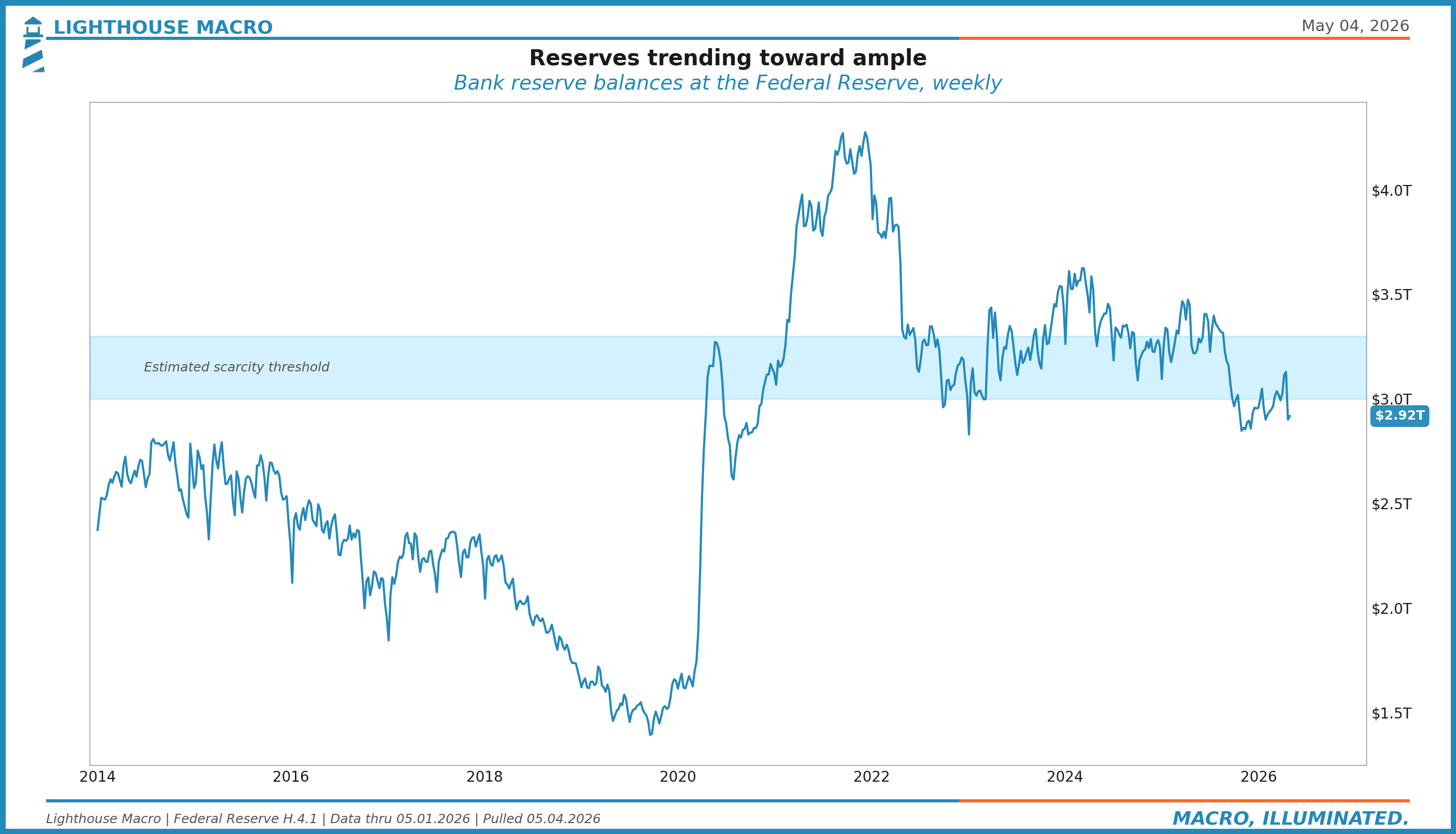
Reserves are the other side of the same coin. They have come down materially from peak. They have not yet hit the level Fed officials describe as scarce, but they have moved from abundant toward ample, and the trajectory matters. Without RRP as a release valve, reserve scarcity becomes the next pressure point.
The Plumbing Layer
When QE ran the duration market, vol was suppressed because the buyer of last resort had effectively unlimited capacity. With the Fed out of the seat, vol shows up first in the plumbing, before it shows up in the long bond.
Three signals carry this layer.
The first is funding spreads. SOFR-IORB and EFFR-IORB are the cleanest reads on whether reserves are doing the work they need to do. When reserves are abundant, SOFR runs at or below IORB. When reserves tighten, SOFR drifts above IORB, and the spread becomes a real-time gauge of dealer balance sheet stress.
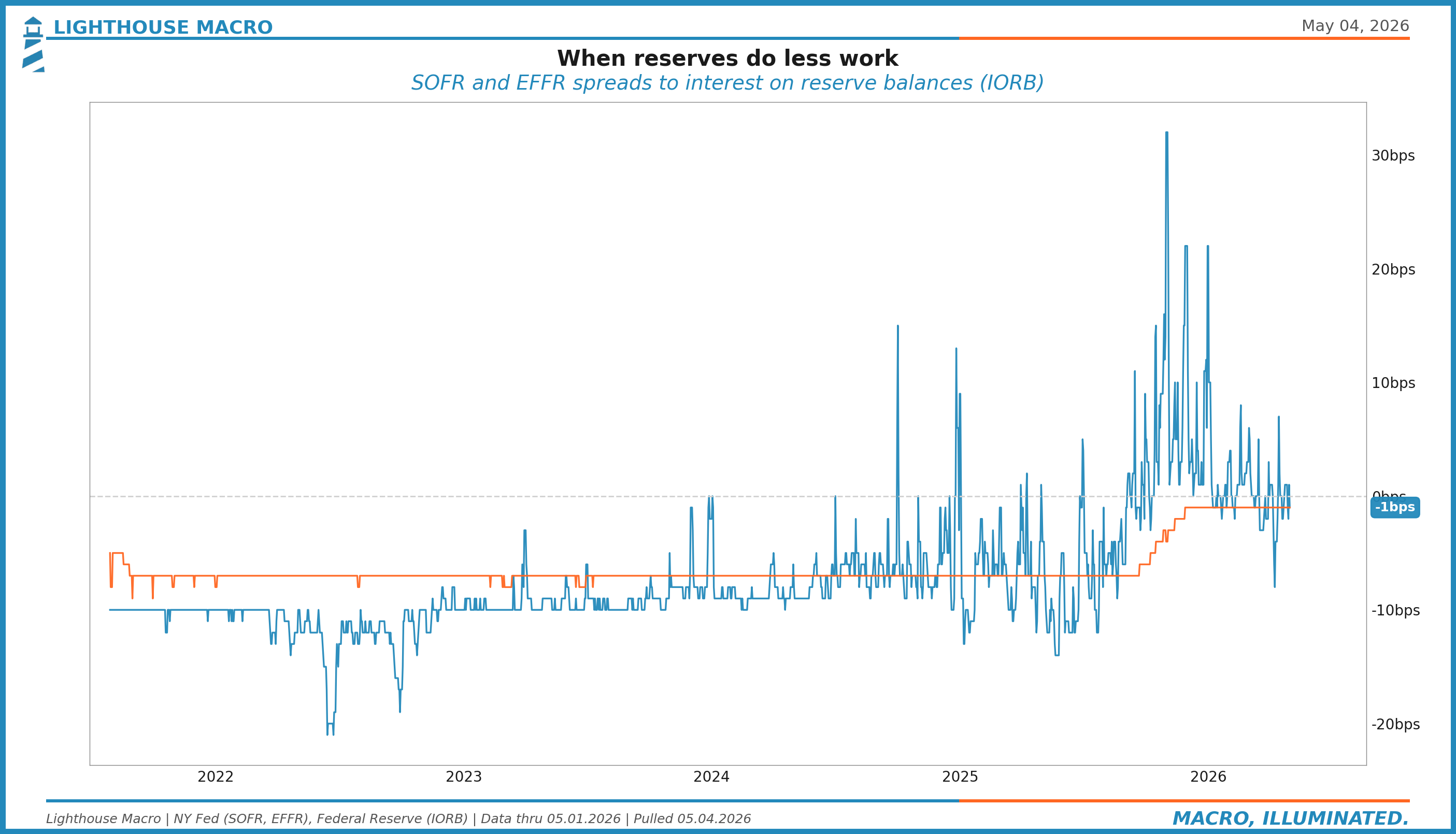
Episodes through late 2024 and into 2025 saw SOFR-IORB widen on quarter-ends and tax dates. Those episodes are no longer isolated. They are the early warning that the system is operating closer to its capacity than the headline reserve number suggests. The pattern matters. A single quarter-end blip is noise. Repeated blips at predictable cash-management dates, growing in magnitude, are the system telling us that the buffer between abundant and scarce reserves is thinner than the level alone implies. That distinction is why we treat the SOFR-IORB spread as a regime indicator rather than a level indicator. The level says ample. The frequency and amplitude of the dislocations say closer to the threshold than ample suggests.
The Fed knows this. It is the reason QT pace has been throttled twice and why the ending-QT discussion is no longer hypothetical. The plumbing is doing the speaking, and the policy response is following.
The second is auction performance. The bond market gives us a quarterly stress test in real time. Tails, the gap between the auction stop yield and the pre-auction when-issued level, are the cleanest measure of whether dealers are stepping up.
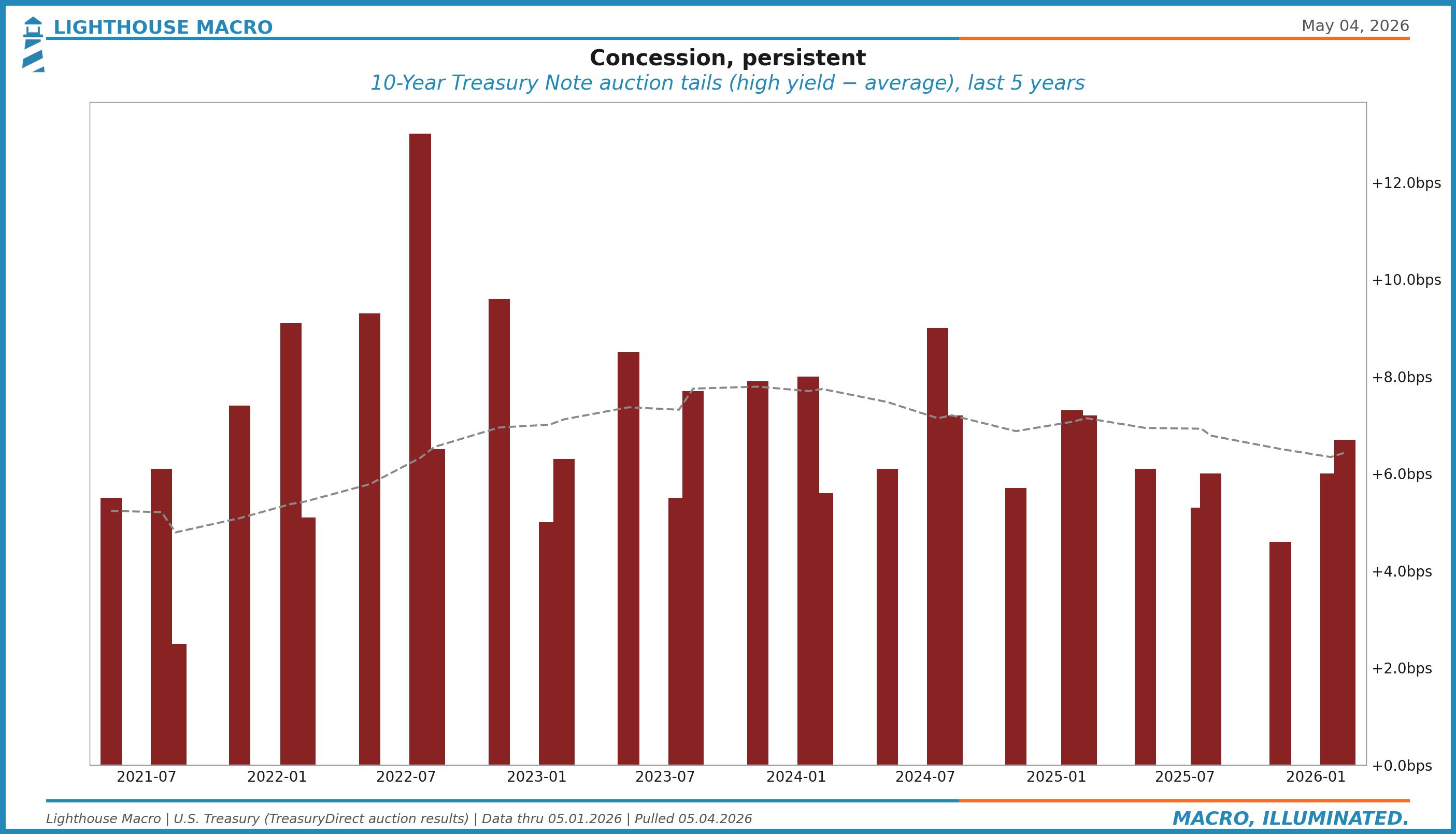
Tails on the 10-year sat near zero through most of the 2010s. They have run consistently positive at four-to-eight basis points since 2022, and the trailing twelve-auction average has not retraced. The market is requiring a level of concession to absorb 10-year supply that simply was not asked of it during the QE years. Bid-to-cover has run softer than the trailing twelve-month average more often than not. Indirect share has been volatile, with weakness concentrated in the months immediately following announcements of larger issuance sizes.
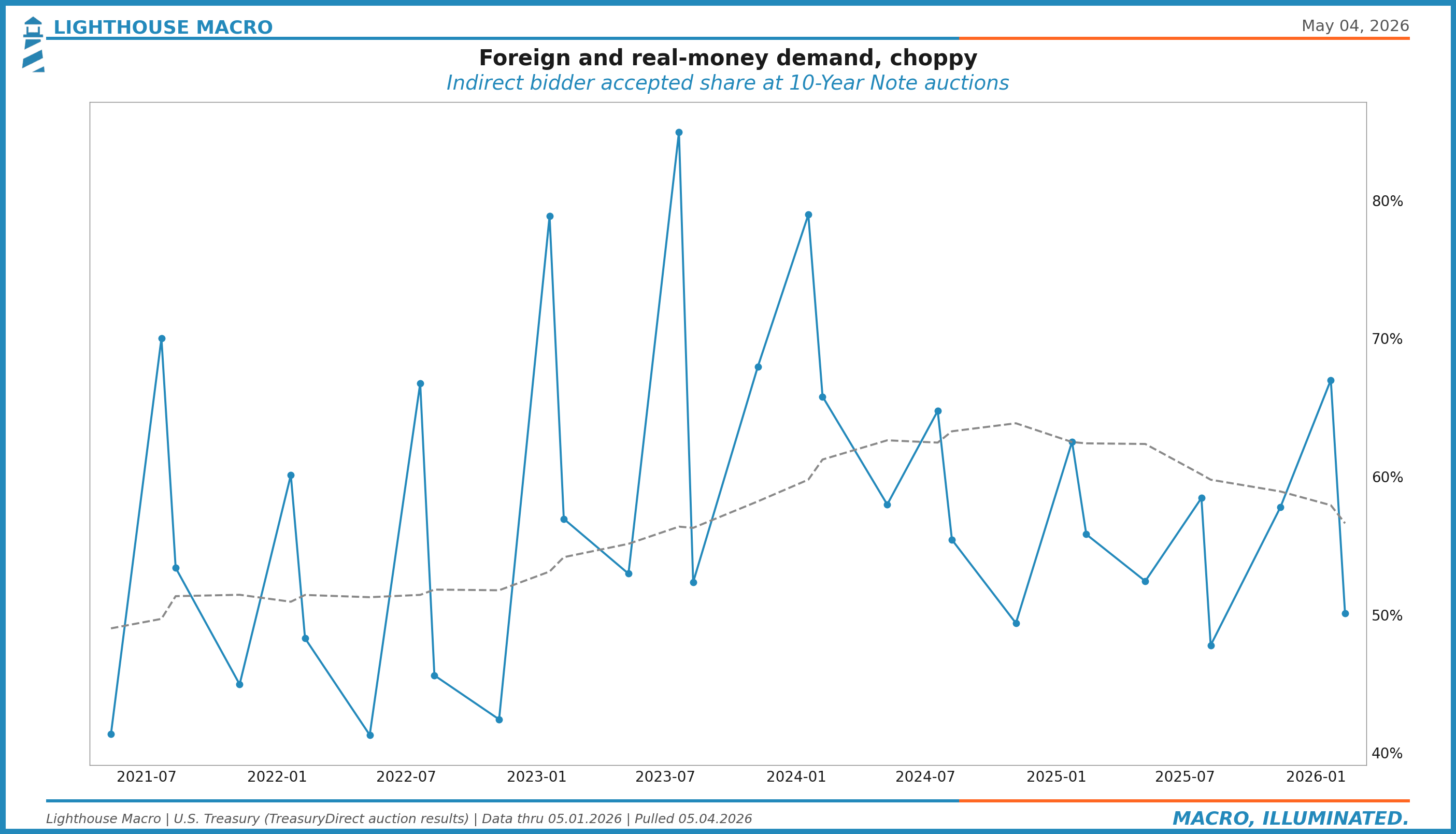
These are not crisis signals. They are pace signals. They tell us the market is requiring more concession to absorb supply than it required two years ago, and the trend is not retracing.
The third is the futures-spot basis. When dealers are balance-sheet constrained, the basis between Treasury futures and the cheapest-to-deliver cash bond widens. The basis trade has historically been a relatively small position concentrated in a handful of hedge funds, but it has grown to a multi-hundred-billion-dollar size, and dislocations in the basis are the canary for broader funding stress in the Treasury market. Vol and dealer capacity both transmit through this channel.
Inflation and the Path
Term premium does not include the expected path of short rates. That path is the other component of the long-term yield, and inflation expectations bound where term premium has room to move.
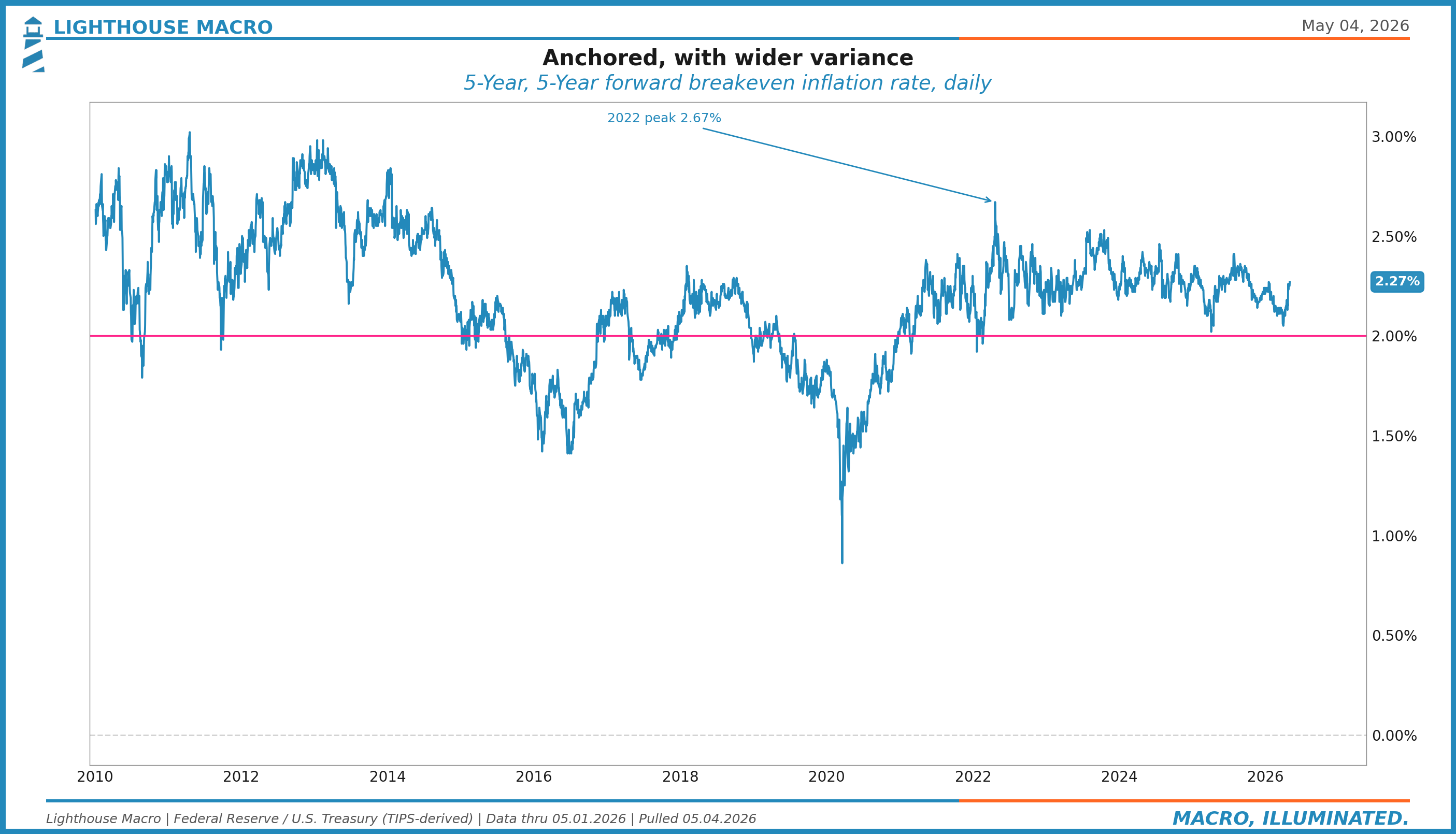
The 5-year, 5-year forward breakeven sits in a range broadly consistent with the Fed’s 2 percent target plus a modest risk premium. Anchored is the right word. Stable is not. The variance of inflation outcomes is materially wider than the 2010s carried, and term premium has to compensate for that variance even when the central tendency lands at target. A 2 percent expected path with a 50bps standard deviation is not the same risk profile as a 2 percent expected path with a 150bps standard deviation. The framework reads the latter as the current regime.
Growth runs the other direction. If growth surprises higher, the Fed stays restrictive longer, the path of short rates carries the load, and term premium can sit lower. If growth rolls, the Fed eases, the path falls, and the curve steepens through the front rather than the back. Our base case is neither extreme, which leaves term premium as the marginal pricing variable. That is the working assumption. It is also the one most exposed to a regime shift in either direction.
The Honest Gap: What We Don’t Price
Six lenses are load-bearing today. One is not. We will tell you which.
Pension and insurer regulatory demand for long-duration assets is a real long-end force, and it is not in our tactical framework. The mechanism is straightforward. Defined-benefit pensions and life insurers carry liabilities with very long durations. Liability-driven investment frameworks and NAIC capital rules push these institutions to hold duration on the asset side to match. When equity markets rally and pension funded status improves, pensions de-risk by rotating from equities into long-duration fixed income. That flow can act as a structural force in the back end of the curve. The 2022 UK gilt episode exposed the fragility of LDI on the way down. The slow grind of pension de-risking is the same mechanism on the way up.
We do not load on it tactically because the pace is wrong for our timeframe. We work on a three-to-six-month horizon. Pension de-risking is a multi-year flow. The signals are slow, the data lags, and the conviction that any individual quarter shows it cleanly is low. The position sizing implication of getting the regulatory demand piece exactly right over a six-month window is small relative to the position sizing implication of getting fiscal supply or plumbing wrong.
This is on the build list. A multi-factor term premium model that incorporates LDI flows, NAIC capital rules, pension funded status dynamics, and insurer reserve requirements would tighten the framework’s strategic positioning view. That work will ship. It will not ship before May 6.
We tell readers this because the alternative is overclaiming. The 150bps anchor sits on the fiscal supply leg, the duration mismatch leg, the Fed balance sheet leg, the plumbing leg, and the inflation-and-growth path. It does not require the regulatory demand leg to hold up. The pension flow is real, the LDI bid in the back end is real, the insurer reserve dynamics are real. They are simply slow enough that they look like a level shift across the framework’s window rather than a tactical signal inside it. When the model exists, we will fold them in. Until then, the honest answer is that we know the leg matters and we know our framework does not currently price it. That is a statement about our toolkit. The bond market itself is unchanged by it.
May 6 Setup
The Quarterly Refunding Announcement is the most important data point on the rates calendar between FOMC meetings. Treasury announces three things that move the long end. The composition of issuance over the next quarter, broken out by tenor. The guidance on coupon sizes through the rest of the year. And any updates to the buyback program for off-the-run securities.
We are watching four things.
First, the bills-versus-coupons mix. If Treasury continues to lean on bills disproportionately, the framework’s deferral observation gets stronger. Eventual coupon issuance grows, and the trajectory steepens. If Treasury rotates back toward coupons, the front-loaded duration accelerates and the long end has to absorb more, sooner.
Second, the language on average maturity. Treasury Borrowing Advisory Committee minutes and the Assistant Secretary’s statement carry signal about how Treasury thinks about the WAM trajectory. Any acknowledgment of WAM extension as a deliberate policy stance, or of WAM drift as a problem requiring correction, would push duration earlier in the issuance schedule.
Third, buyback program guidance. Buybacks remove off-the-run duration from the market, support liquidity in older issues, and at the margin shift duration absorption from real-money to dealer balance sheets. Expansion of buybacks would be incrementally bullish for back-end yields. Contraction or flatlining would be neutral.
Fourth, the dealer-tone tells. The TBAC minutes are released alongside the announcement and they carry the dealer community’s read on absorption capacity over the next quarter. Language about indirect demand softening, about dealer balance sheets bloating, or about specific tenors where issuance increases would be challenging is the kind of detail markets price within hours. The minutes are not flashy. They are the closest thing we have to a primary-source assessment of where the duration capacity actually is, written by the people who clear it.
The framework’s destination does not move on May 6. The pace can.
Invalidation
The framework can be wrong. Here is what would tell us so.
If term premium retraces below 40bps without a return to QE or a material foreign demand surge, the framework is wrong. The drivers we model would have to be overwhelmed by a force we have not identified, and that would mean the structural story is incomplete.
If the federal deficit narrows to below 4 percent of GDP through either revenue growth or expenditure restraint, the fiscal supply leg weakens materially. We do not consider this a base-case path under current policy, but a sustained move below 4 percent would force a reweight.
If Treasury executes a meaningful WAM extension over the next six to twelve months, accelerating coupon issuance and absorbing duration earlier than expected, the back-loaded supply story compresses. The framework still calls for higher term premium, but the path becomes faster and the destination potentially moves.
If inflation expectations re-anchor materially above target, with 5y5y breakevens persistently above 2.5 percent, then 150bps becomes a floor rather than a target, and the framework’s call understates the destination.
If the Fed restarts QE as a response to plumbing stress, the term premium repricing pauses or partially reverses for the duration of the program. The destination still holds. The path is interrupted.
We watch these. If any of them register, we revise.
Bottom Line
Term premium has reflated from a regime-driven anomaly to the floor of the prior distribution. The conditions facing the bond market in 2026 are not the conditions of 2005. The framework reads 150bps as the honest level given fiscal supply, duration mismatch, post-QT plumbing, and a re-anchored inflation regime with wider variance.
We are at 70bps. We see 150bps as the destination. May 6 does not move the destination. It sets the pace.
The reaction function we are watching is straightforward. A bills-heavy refunding with neutral coupon guidance and a steady buyback program is the path of least resistance, and it leaves term premium grinding higher week by week as supply hits a buyer base that is no longer subsidized by the Fed. A rotation toward coupons or an acknowledgment of WAM extension as deliberate policy is the path that pulls forward the back-end repricing, with the 30-year typically leading the move and the 10-year following within a session. A surprise announcement of expanded buybacks is the path that compresses term premium short term and gives the framework’s destination a slower glide. We are positioned for the first path and watching for the second.
The base case is repricing higher. The risk is that the pace is faster than the position size assumes.
That’s our view from the Watch. We’ll keep the light on...
Bob Sheehan, CFA, CMT
Founder & Chief Investment Officer
Lighthouse Macro | Research | @LHMacro
Great piece, and I tend to agree with Path 1. I still struggle to see why Bessent would normalize maturity issuance at this point in time. The Fed providing RMP at the short end helps the Treasury keep issuing bills for now, and with long-end yields near 5%, why stress the system with more duration supply at this point?
If anything, I think more buybacks could be in play. The Treasury has little incentive to force more long-end issuance into the market when the current setup allows it to keep leaning on bills without immediately pressuring the back end of the curve.