
Pulled Back, Moving Forward
The Beacon | August 16, 2026

On August 3 of last year, I woke up on a Sunday morning and decided to get a tattoo on my forearm featuring an arrow with a semicolon built into its shaft.
I hadn’t planned it in advance or told anyone about it. A close friend and his family had suffered through a truly heartbreaking loss earlier in the year. When it happened, he reached out to me. Yes, to talk with a friend because he was in pain, but also because he’d known very well that I have spent years in the tumultuous throes of my own mental health battles. On August 1, he called again to tell me about the tattoo he’d gotten to honor his younger brother. Multiple times throughout his year from hell, he reached out to me. Not because he had to but because of who he is. This fall he begins his second year of his Master’s program working towards becoming a mental health professional. I’m proud of him. Within 48 hours of him getting his tattoo, I was walking out of my apartment to go find a parlor without an appointment nor a concrete design. I simply woke up Sunday and went without a thought. I had made excuses for a long time. It wasn’t the tattoo I was nervous about. I think it was more of what it would mean if I finally did so.
I put it on my forearm where I see it every single day in the mirror, whether I’m brushing my teeth or fixing my hair. Most everyone was enthusiastic when they first saw it. Some become a bit less comfortable once they learn its meaning. For me, it was a physical and visual representation of an uncompromising promise I made to myself that I did not fight all the way back from the depths just to let the dark win later. I put it where everyone could see it because I was done hiding and completely done tiptoeing around other people’s discomfort.
That choice set the tone for the rest of the month, and not even a week later while still sitting at my previous firm, I spent a beautiful summer Saturday indoors doing a deep dive into the Treasury Markets. ‘Hell of a pivot there, Bob…??’ Bear with me.
At the time, I was deeply frustrated with the gap between the research-intensive role I’d been sold and the glorified “Copywriter and Headline Beautician” work I found myself pushed towards. I missed doing deep, meaningful research where I could take complex systems apart, test popular narratives against hard data, and uncover exactly what the consensus was missing.
I posted my findings in a Twitter thread on an account impersonating a maritime warning tower. Before doing so, I made sure to block my employer’s various socials. The next week, I actually sent around a deck with some of my findings. My team, seemingly interested enough, told me to set up a meeting. When the meeting came, everyone was busy and we cancelled. My findings, to be shared at a later date which ultimately never arrived. The thread, however, had gotten solid traction on the twittersphere and so a few days later I expanded it into an article titled Cracks in the Foundation on a dormant Substack with barely 50 followers. To my surprise, some incredibly smart people found the piece and began to engage with it on Substack as well. I particularly remember Vítor Constâncio, the former Vice President of the ECB, sharing it with his followers along saying some kind words about the work.
Suddenly, readers from all across the world were checking out the work. The people sitting four feet from me in the office, entirely unaware that my semi-anonymous report was receiving the exact sort of dialogue our boss was hoping to spark with our firm’s research. Eventually, I brought it up to our team’s second-in-command in hopes of getting ahead of the inevitable backlash. I hoped it might also show them the value of in-depth reports that actually retained their teeth rather than being stripped bare by four rounds of editorial stops, legal, compliance, and the CEO's desk. Ultimately, all doing so won me was a few more uncomfortable weeks in a seat that became increasingly unpleasant, near a boss increasingly annoyed by my presence. And I would do it again in a heartbeat.
The visibility of that piece led to an appearance on Less Noise More Signal, a growing friendship with Pascal, and eventually meetings with prospective institutional clients for a business I did not yet have. What followed was a brutal sequence of unpaid trials, shifting deliverables, and soft promises that ultimately bore no revenue. I hadn’t sought those trials out and hadn’t even fully decided on a plan when they came to me, but those experiences forced me into the deep end, establishing my business officially in January of this year. Moreover, they made me establish the operating laws needed to build a real and sustainable research business.
The sequence of all these events ended up mattering immensely. The tattoo served as the reminder I gave myself months before I knew I would actually need it, and while very little of this new venture’s early days went according to plan, it wasn’t all that long ago when there wasn’t a plan at all.
As I turn 33 next Sunday, Lighthouse Macro sits at another transition point where the research needs to be a cleaner product, Pharos must keep developing into a standalone utility, and our distribution engine requires a sustainable weekly cadence. The personal story here is about enduring tension before moving forward, and the market story mirrors that by asking what happens when risk assets are carried by a protection structure that is no longer guaranteed.
The core question for institutional investors today is not whether central bank support historically existed, because we know it did. The real question is whether markets are still pricing risk assets as if that protection will automatically appear on command.
A month ago, I posted that $500 was the floor for the complete Lighthouse platform with Pharos included. That standard holds. Early paid subscribers remain grandfathered into Pharos at their locked rate as promised.
For my 33rd birthday, I am unbundling the tiers for one week so new readers can join at the level that fits them best.
Research Only: Full access to Beacons, Beams, The Horizon, monthly Chartbooks, and macro allocation summaries.
Complete Bundle ($500/yr | Moves to $750/yr Aug 24): Everything in Research, plus the Pharos Terminal, the 60-indicator PDF deck, real-time Crosscurrents trade logs, and active position weights.
On Sunday, August 23 at 11:59 p.m. Eastern, this window closes permanently.
Note on Today's Beacon: I’m keeping this entire article 100% free with all 15 live Pharos Terminal charts fully exposed. I want you to see the exact quantitative infrastructure, model teardowns, and diagnostic pillars paid members get before the Birthday Special window closes on August 23 and the Complete Bundle moves to $750/yr.
The Thesis: Protection is Changing
The market can remain near record highs while the protection structure underneath it fundamentally breaks down, a distinction that matters deeply because market price is merely a lagging summary of what investors have already agreed to tolerate. An equity index near its peak can still be deeply vulnerable when the monetary and fiscal response functions to bad news shift. The classic market reflex over the post-GFC regime was predictable enough, where decelerating economic growth and tightening financial conditions would reliably pull risk assets back just enough to prompt the Federal Reserve into intervening with liquidity injections or dovish forward guidance. That reflex established a persistent “Fed Put” beneath the market whether central bankers acknowledged the term in public or not.
Our core thesis centers on the reality that the Fed Put has been retired as a default structural assumption.
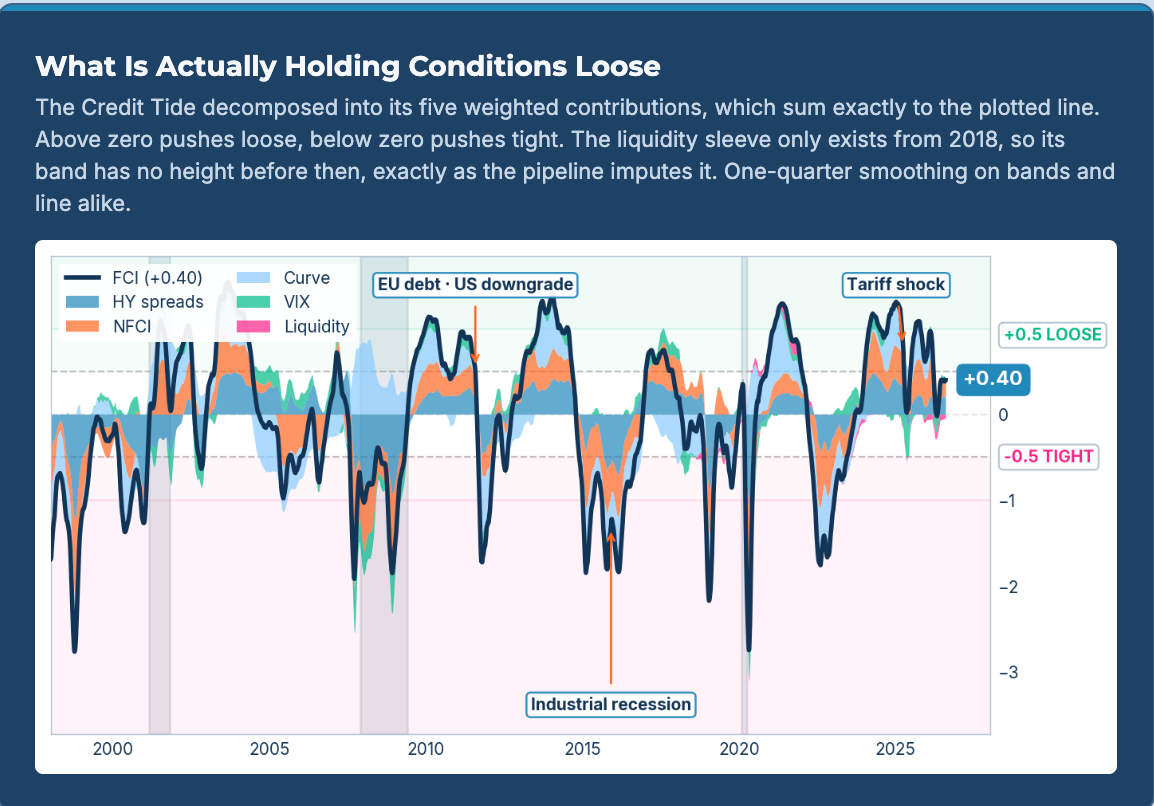
The preliminary stress test arrived at the July 29 FOMC meeting when the Committee held the federal funds target range at 3.50% to 3.75% via a 9-3 vote, as Hammack, Kashkari, and Logan dissented explicitly in favor of an immediate 25-basis-point rate hike. The decision delivered none of the comforting forward guidance that risk assets have historically relied upon during periods of growth moderation.
While a single FOMC meeting does not confirm a complete structural regime shift on its own, it does reset the burden of proof by showing that investors can no longer assume equity drawdowns will automatically trigger central bank easing. The monetary reaction function is tightly constrained by persistent inflation components, long-end Treasury term premiums, labor market structural composition, physical energy dynamics, and the broader political tolerance for renewed price pressures.
This shift fundamentally alters how institutional portfolios must analyze incoming data. Long-end Treasury auctions become a primary variable rather than a secondary financing detail, just as physical oil market balances dictate policy space rather than serving as isolated commodity noise. Labor market compositional trends matter far more than a single headline payroll number, and equity breadth or sentiment metrics cease to be mere technical charting tools to become core elements of the macroeconomic argument.
The market’s protection structure relies on several distinct pillars spanning monetary policy flexibility, Treasury market duration absorption, real-economy cash flow resilience, and structural market participation. Breadth and sentiment reveal precisely how much risk investors are currently taking under the unverified assumption that these safety nets remain fully intact.
Policy: The Fed Put, Retired
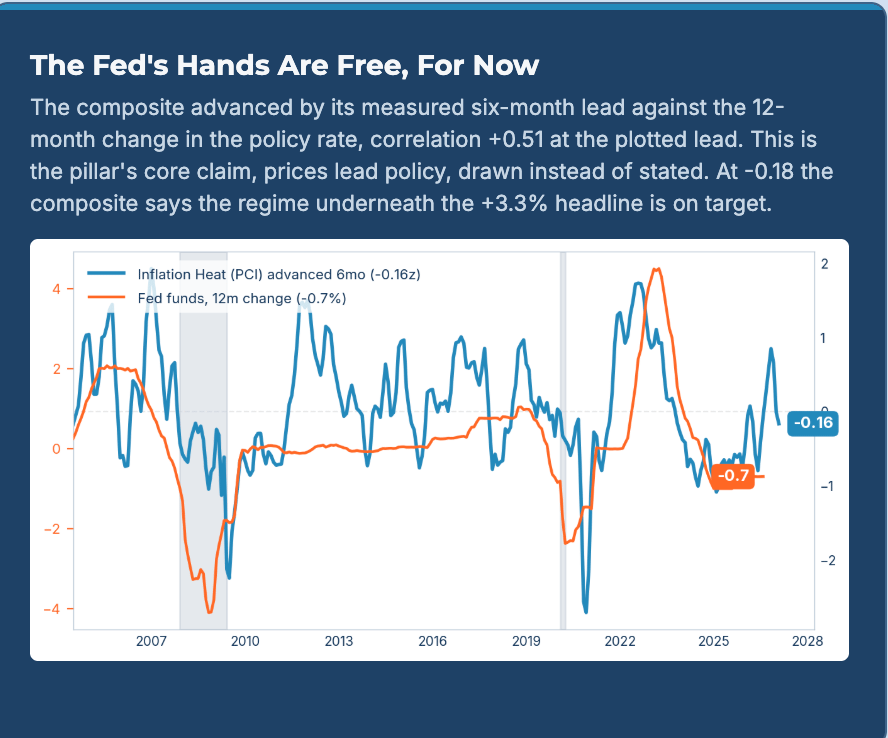
Three dissenters (Hammack, Kashkari, Logan) advocated for a +25 bps hike at the July meeting. The reaction function is no longer unified around automatic accommodation.
The key argument here is not that the Federal Reserve will never cut rates again, as central banks will obviously adjust policy rates when conditions demand it. The argument is that monetary easing is no longer a free and unconditioned insurance policy embedded directly into risk-asset valuation multiples.
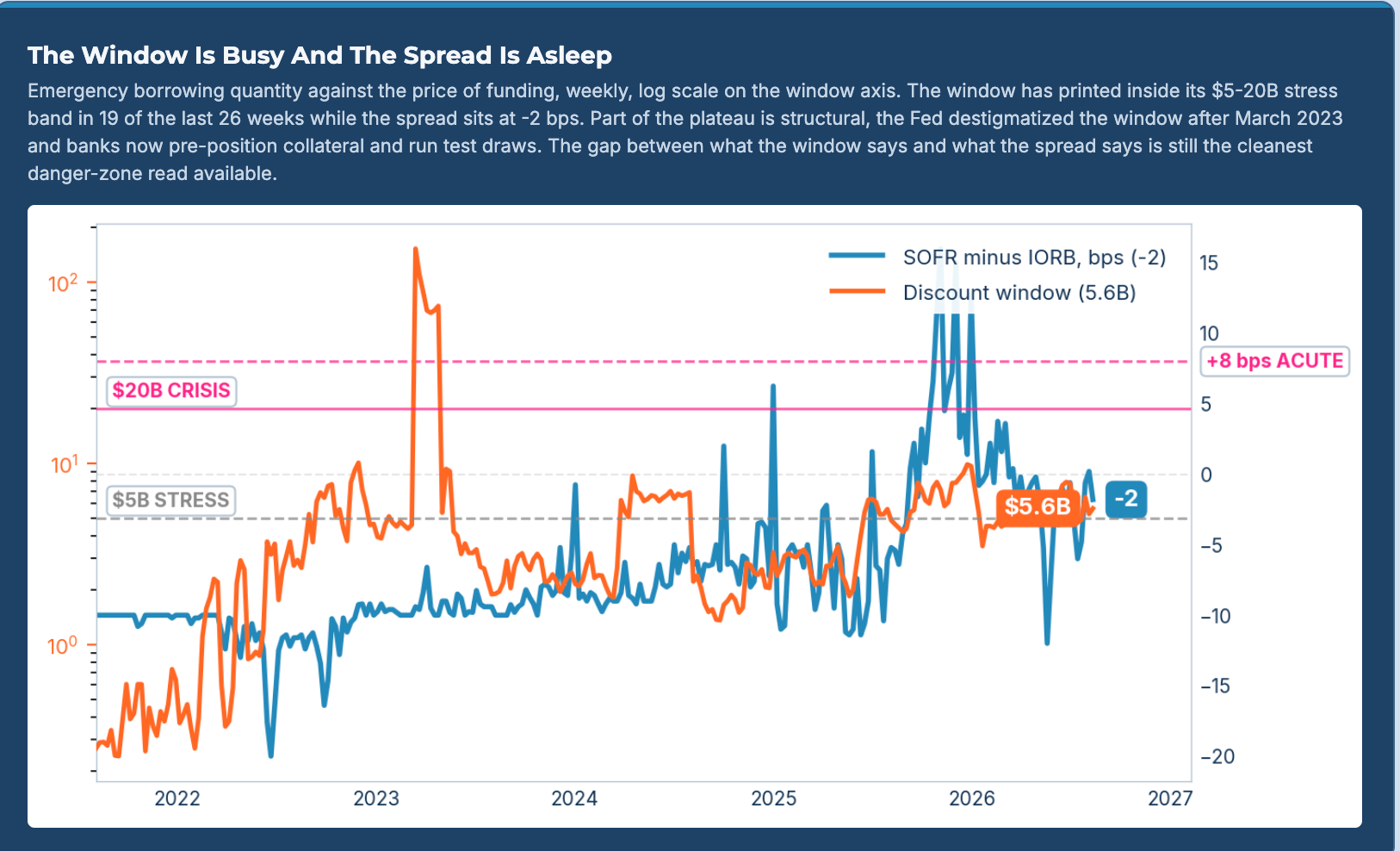
Every policy decision now carries severe trade-offs. Sticky core inflation, physical supply constraints in energy, elevated long-end yields, and currency pressures force central bankers to choose between stabilizing asset prices and preserving long-term institutional credibility. The vote split on July 29 illustrates this internal tension clearly, with three hawkish dissenters advocating for higher rates within a single meeting to demonstrate that the internal reaction function is no longer unified around automatic accommodation.
The upcoming September 15 to 16 FOMC meeting should be viewed as a crucial market checkpoint rather than an automatic monetary catalyst. Between now and that decision, risk assets must absorb long-end yield pressures, sticky producer prices, shifting labor data, and physical oil market developments without expecting central bank intervention to neutralize adverse outcomes. A retired put does not mandate an immediate market crash, but it absolutely means that the market must carry a significantly larger share of its own risk.
The Long End: The Market Sets a Harder Price
78% of the last year’s move in the ten-year is duration compensation, not the policy path. Term premium at 83bps is the 96th percentile since 2010.
On August 13, the U.S. Treasury auctioned $25 billion of 30-year new-issue bonds that cleared at a 5.216% high yield, marking the highest nominal new-issue clearing yield for the 30-year bond since February 2001
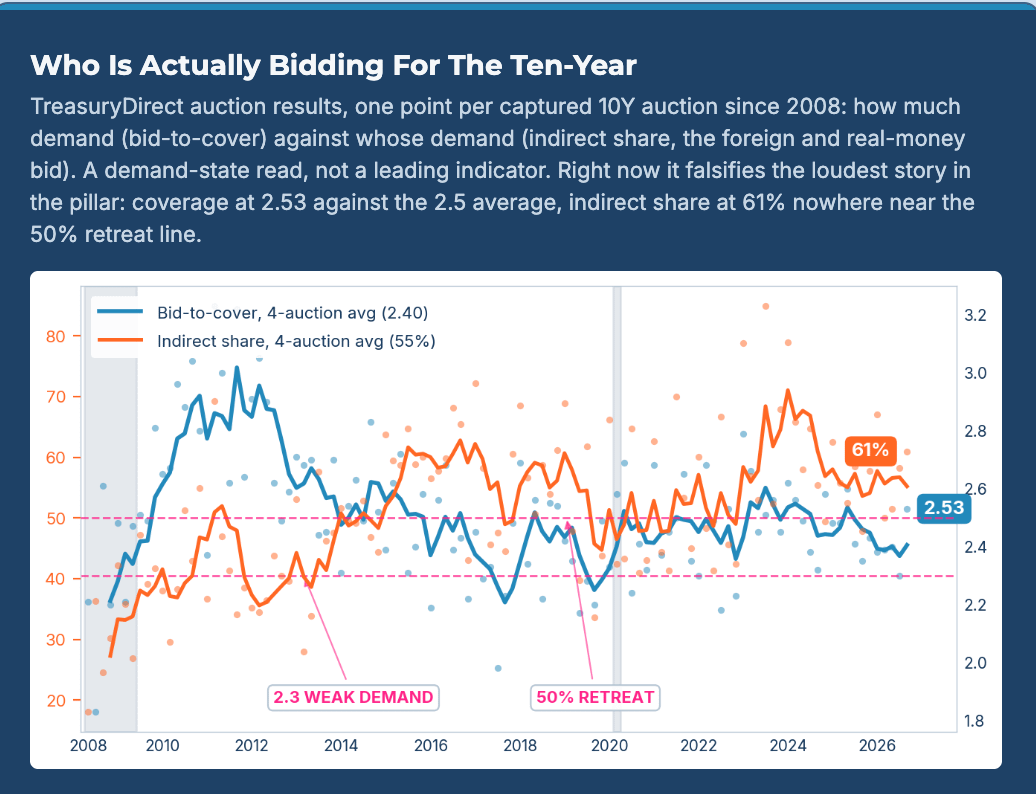
Lazy market commentary frequently attributes high auction yields to a total collapse in buyer demand, but the underlying data contradicts that simple story entirely. The bid-to-cover ratio for the August 13 auction printed at 2.39x, coming in higher than May’s 2.30x coverage ratio which had cleared at 5.046%. Buyers were absolutely present and willing to participate, but they demanded a significantly higher clearing price to take on long-duration sovereign risk.
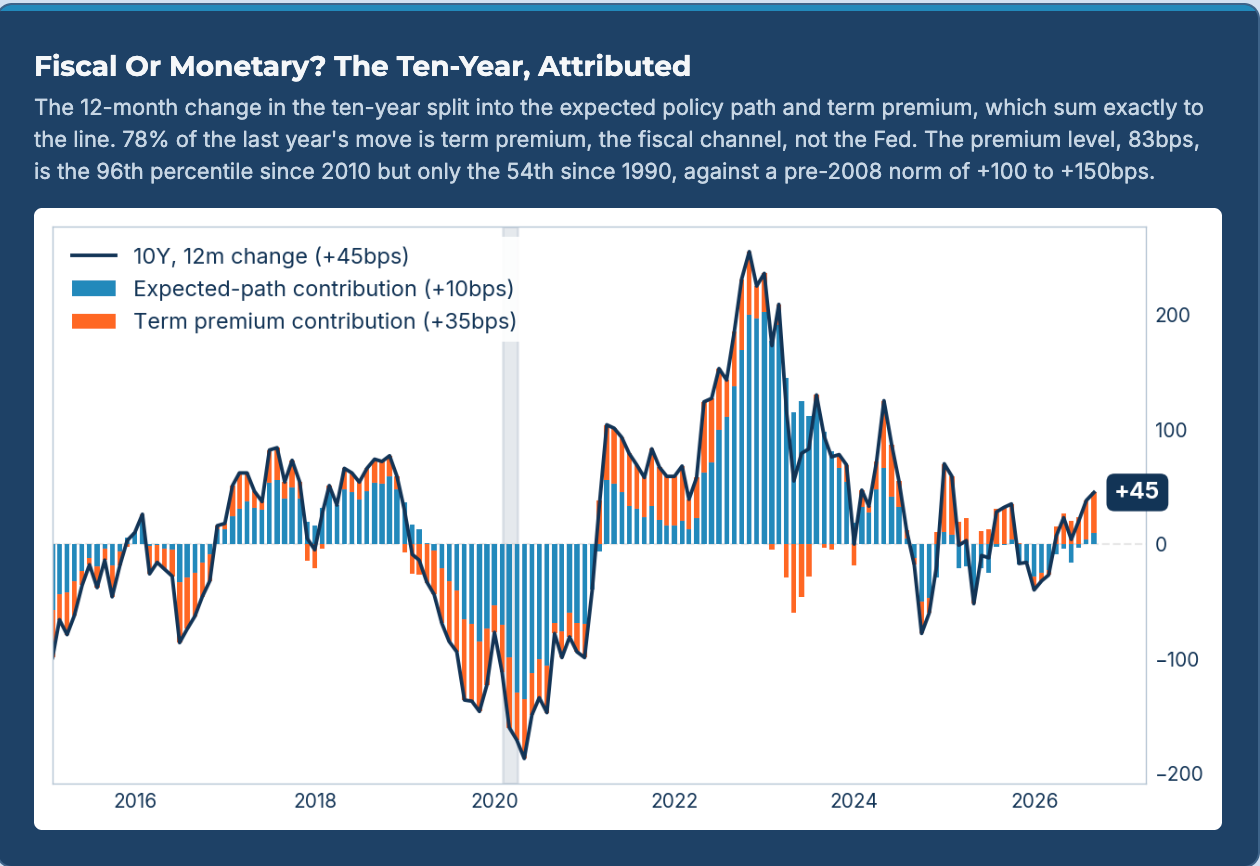
This yield level carries direct consequences across the financial architecture since the long end of the yield curve sets the baseline discount rate for global capital allocation, corporate debt refinancings, mortgage pricing, fiscal deficit sustainability, and equity valuation models. The previous market regime operated under the comfortable assumption that central bank rate cuts at the front end would automatically pull down long-term yields across the entire curve. The August 13 auction proves that the long end maintains its own vote, and persistent long-term yields driven by heavy supply and rising term premiums can prevent short-term policy rate cuts from easing broader financial conditions.
Inflation and Oil: Buffers Are Not Restoration
The July inflation prints generated a false sense of security across equity markets, particularly given the modest monthly headline CPI print of +0.1% m/m alongside cooling shelter inflation and a flat final demand PPI
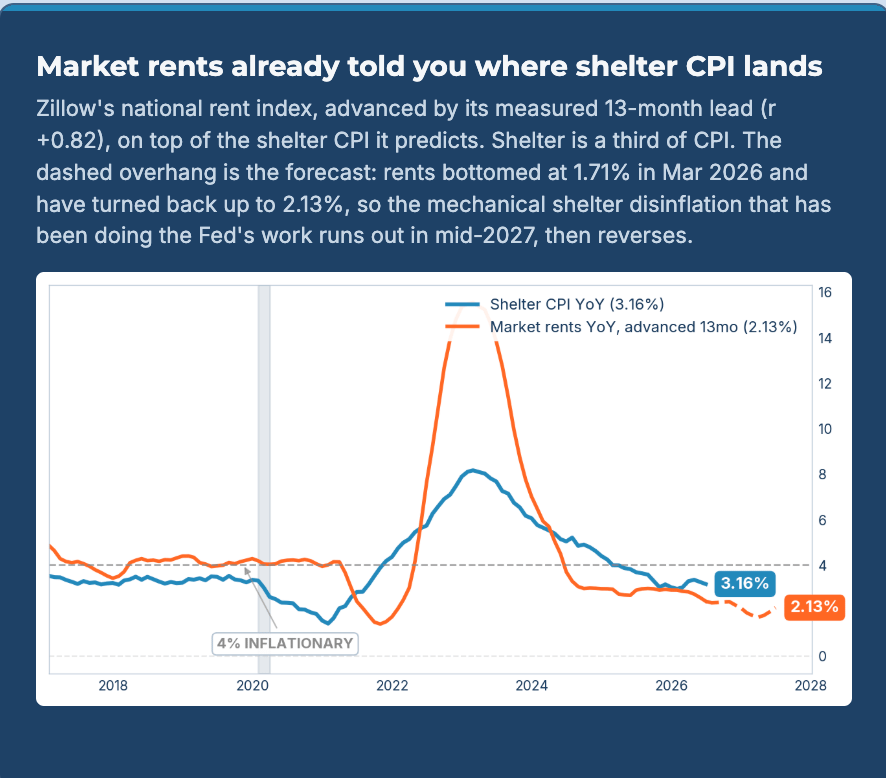
A closer look at pipeline inflation tells a different story regarding lingering pressures, with the underlying producer price measure excluding food, energy, and trade services rising +0.4% month-over-month in July. Disinflation progress has notably slowed down, and pipeline input costs remain active enough to limit how far central bankers can comfortably lower rates.
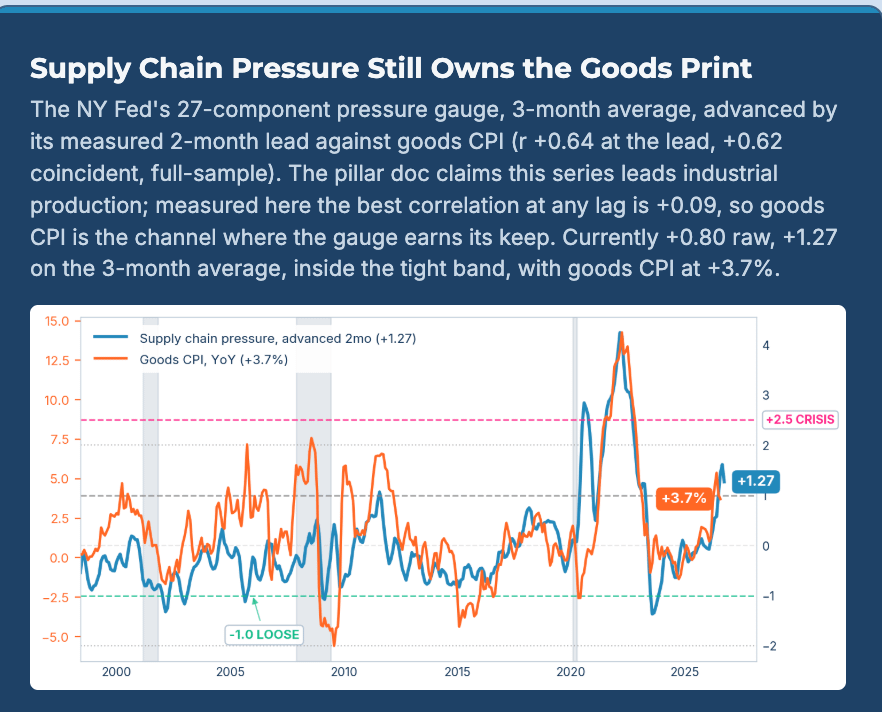
Geopolitical risks around the Strait of Hormuz make this inflationary backdrop even more volatile since the oil market functions as an interconnected physical transportation system. Elevated marine insurance premiums, extended tanker rerouting, reserve drawdowns, and supply timing lags all alter the effective price of delivered crude even without a total blockage of maritime routes.
Data sources currently reflect conflicting signals regarding physical oil supply. The IEA projected a substantial Q3 global market deficit of 1.8 million barrels per day while citing a 69-million-barrel global inventory draw during July, whereas the EIA subsequently reported a sharp +17.4 million barrel build in domestic commercial crude inventories. These two data points track entirely different scopes, demonstrating that while static inventory buffers can temporarily absorb localized supply disruptions, they do not guarantee long-term supply restoration. Depleting physical energy buffers while pipeline producer prices remain elevated creates an environment where inflation risks can re-emerge rapidly.
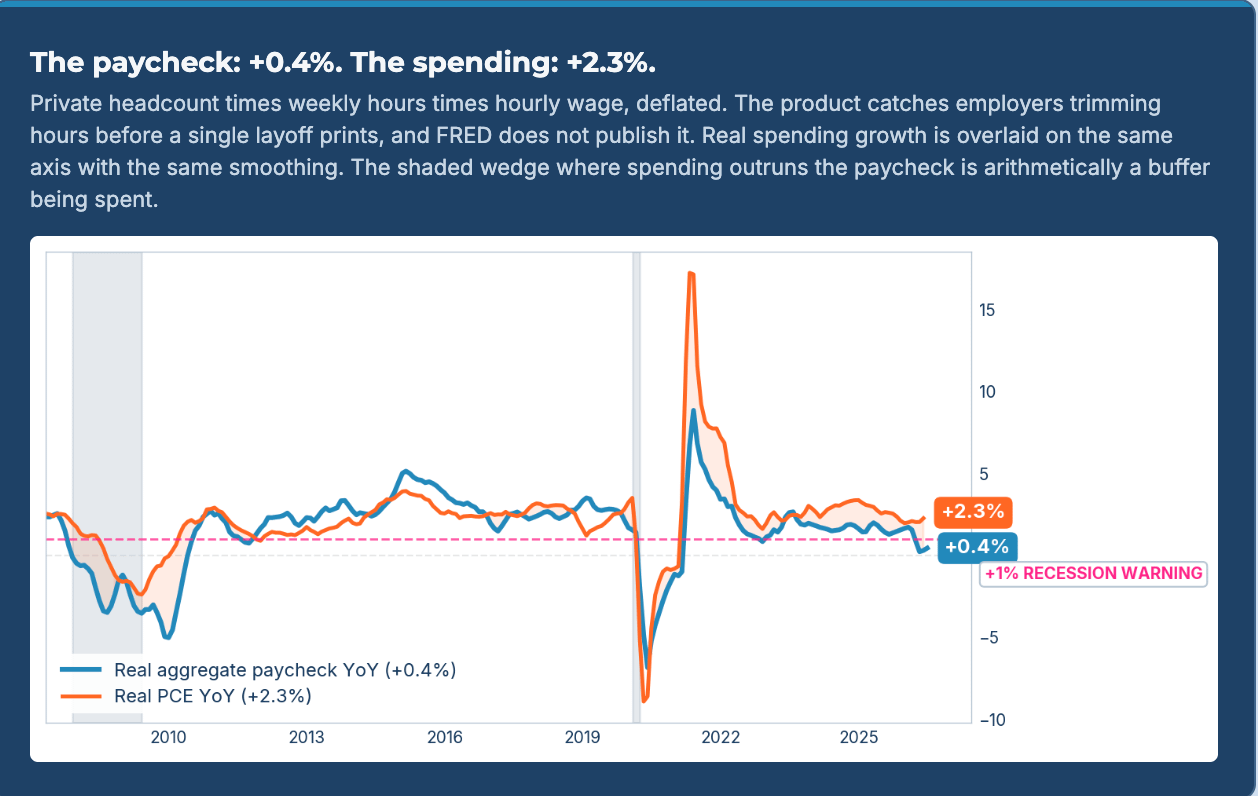
Labor: Easing Without CollapseThe labor market is undergoing a gradual cooling process rather than an abrupt collapse and continues to resist simple binary narratives.
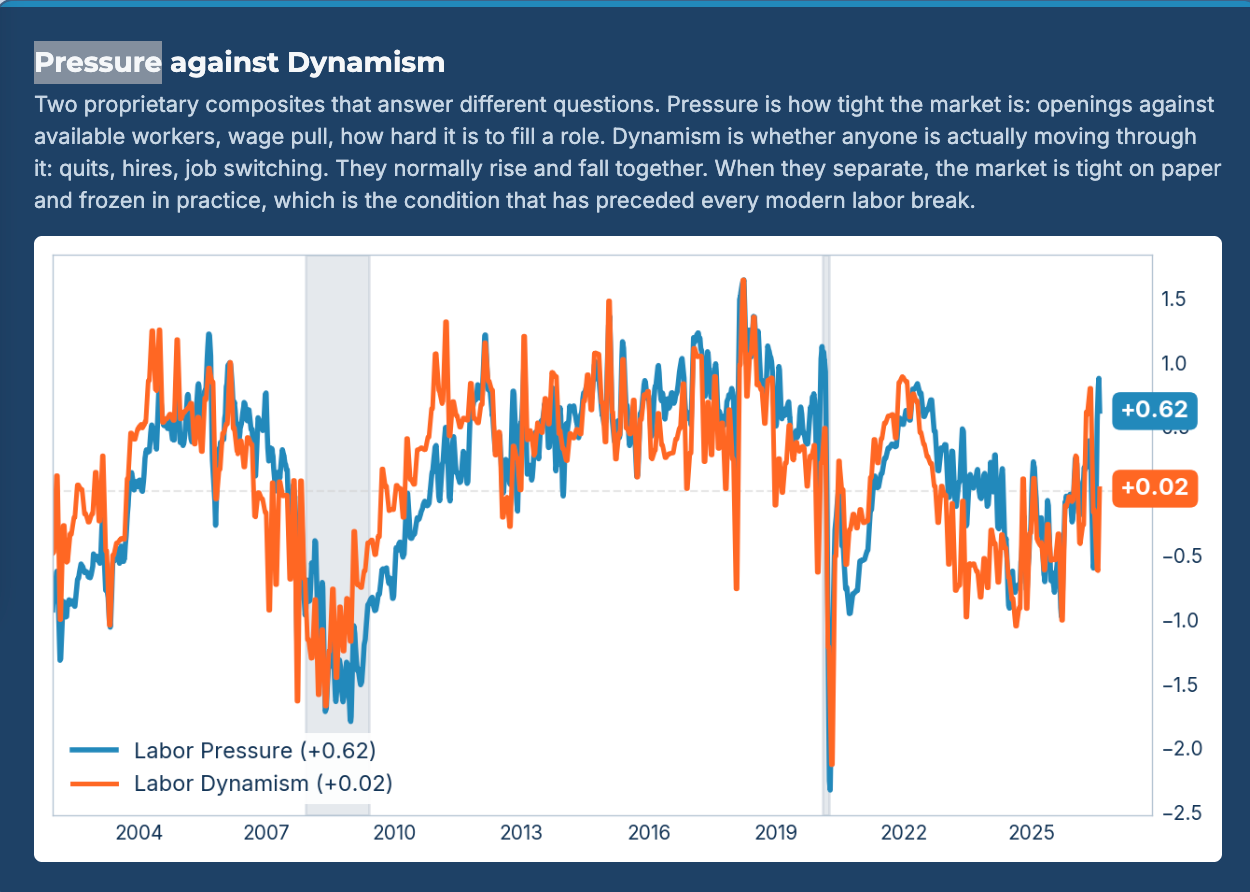
Headline non-farm payrolls dropped by 23,000 in July, a figure reinforced by a cumulative -103,000 downward revision to May and June data, though private-sector payrolls still expanded by 30,000 jobs while government employment contracted. Meanwhile, June JOLTS data showed job openings moderating to 7.4 million alongside 5.3 million hires and 2.0 million voluntary quits. Initial jobless claims remain steady around 209,000 while continuing claims at 1.777 million are consistent with a slowing market rather than a systemic downturn.
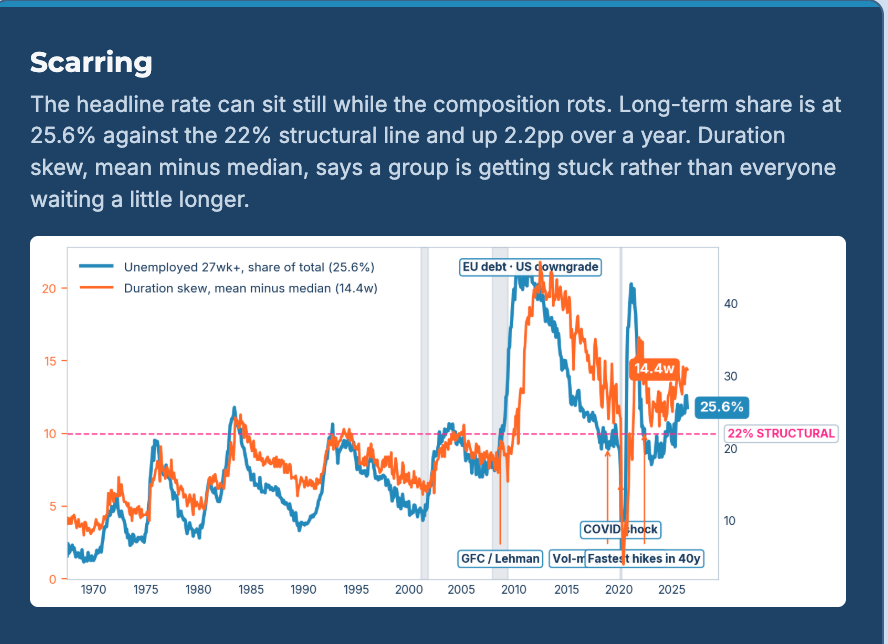
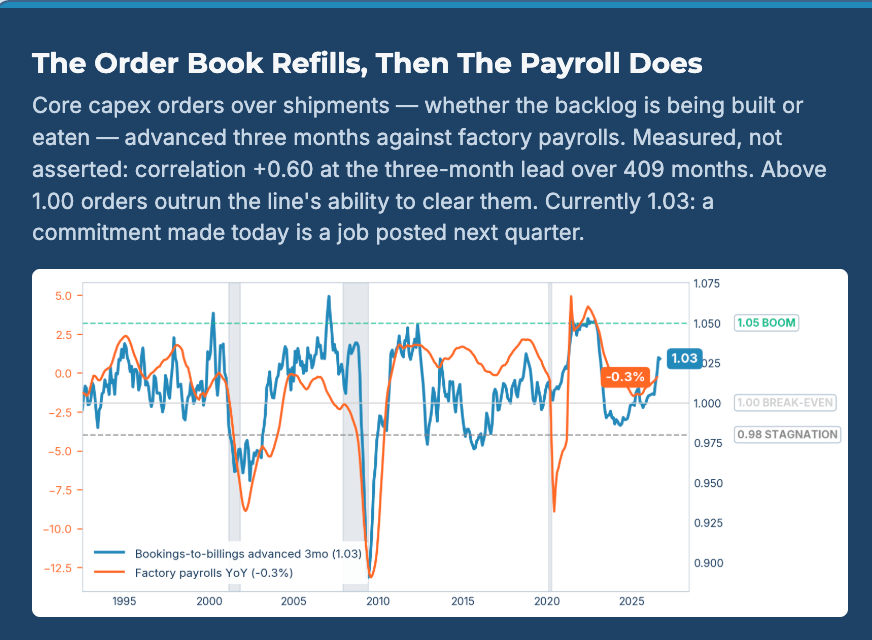
This labor dynamic directly influences our thesis on the Fed Put because a gradual labor market deceleration allows the Federal Reserve to hold policy steady without forcing emergency liquidity injections. It keeps the economy expanding on paper, but leaves risk assets heavily exposed when earnings growth slows or interest rates remain elevated for longer periods of time.
Equities: Narrow, Euphoric, and Carrying the Assumption
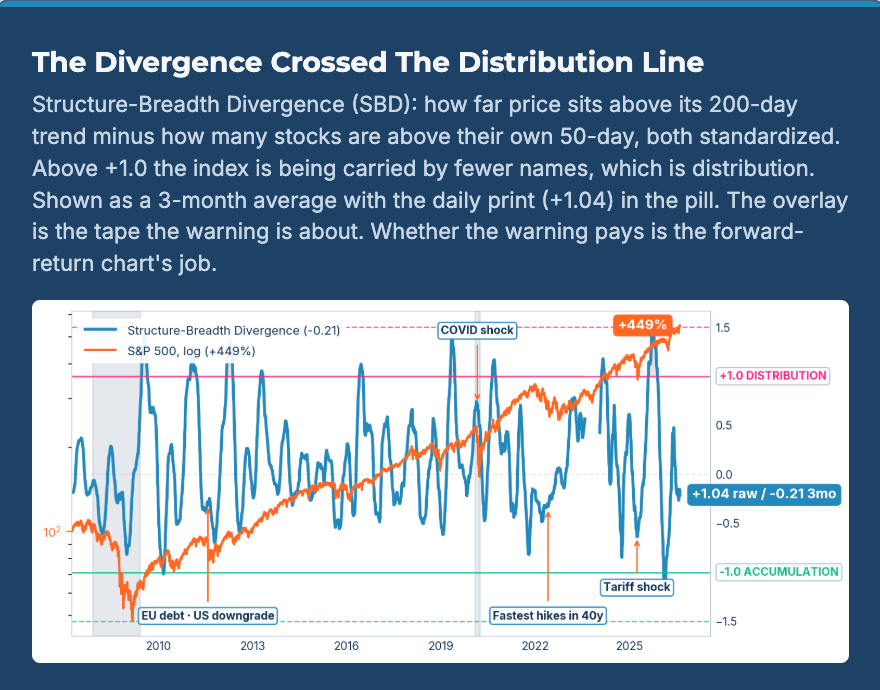
Headline equity indices trade near record levels while broad market participation has thinned significantly, as a small group of mega-cap equities accounts for an outsized share of broad index returns and disguises the underlying weakness across broader sector components.
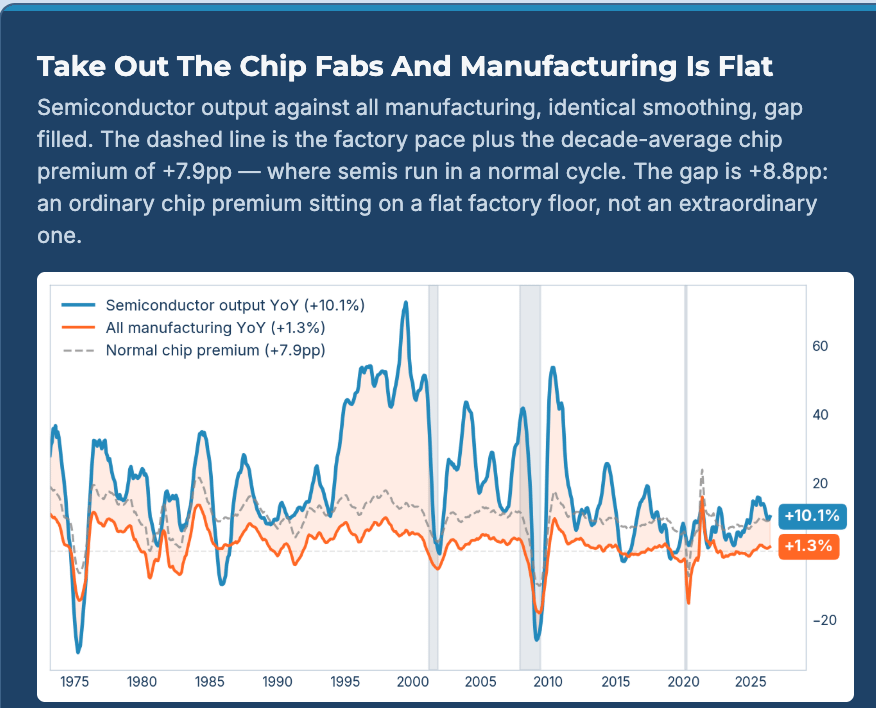
Our proprietary Structure-Breadth Distribution (SBD) framework sits at +1.04 to cross the distribution warning line. Simultaneously, our Sentiment Tide (SPI) reads -1.01, pushing into euphoric territory driven heavily by options-market complacency while the VIX curve reflects minimal hedging activity.
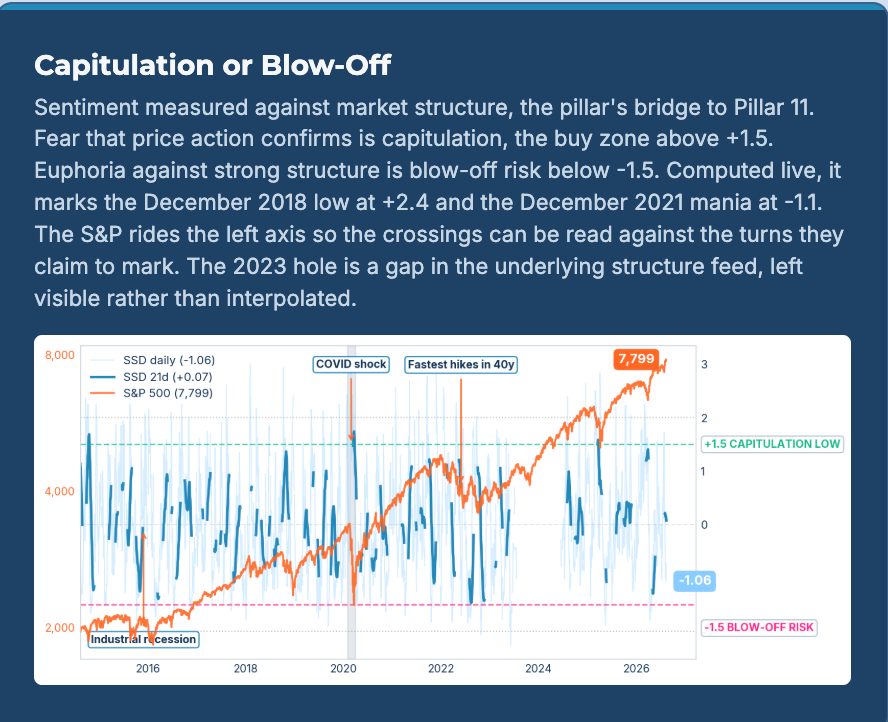
Simultaneously, our Sentiment Tide (SPI) reads -1.01, pushing into euphoric territory driven heavily by options-market complacency while the VIX curve reflects minimal hedging activity.
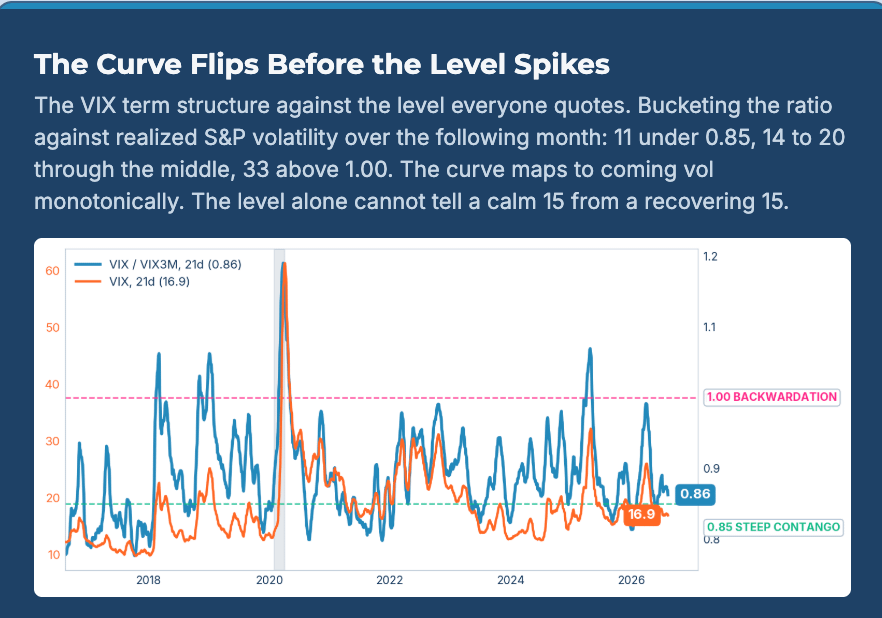
Narrow markets can certainly continue to push higher during momentum phases, but pricing an index on the assumption that multiple macroeconomic conditions will remain favorable simultaneously leaves the entire structure vulnerable. A sudden spike in long-end yields, sticky inflation surprises, or an energy disruption can trigger a sharp repricing across the broader structure. What Would Change Our Mind
Analytical rigor requires clear and unambiguous conditions that would invalidate our core macroeconomic thesis:
Monetary Policy Reaction: Unconditional liquidity commitments from the Federal Reserve backstopping falling asset prices, supported by a unified FOMC voting consensus.
Treasury Yield Absorption: Sustained declines in 30-year auction clearing yields across consecutive issuances alongside expanding bid-to-cover ratios, proving structural market absorption of duration supply without higher yields.
Inflation Trends: Sustained deceleration in core CPI and underlying PPI metrics well below target thresholds, accompanied by energy market stabilization without depleting global inventory buffers.
Labor Market Conditions: Significant expansion in private-sector payroll losses, weekly initial jobless claims rising well above historical averages, and rapidly accelerating continuing claims that force immediate central bank policy cuts.
Equity Market Structure: Substantial expansion in participation across broader industry sectors, accompanied by realistic options pricing for downside risk protection.
Our perspective is strictly conditional on these macroeconomic factors, meaning we do not predict an inevitable market crash so much as we identify that market protection mechanisms have fundamentally changed and raised the baseline standard of evidence required to confirm long-term market health.
Business Frame, Pharos Utility, and Wednesday Cadence
As I’ve said before, and I’ll say again, we have no plans for Lighthouse Macro to be "just a newsletter." We provide the tools for a complete, institutional-quality system backed by live quantitative infrastructure and real-time execution. Standard paid subscriptions include full access to the Pharos Terminal, which is an institutional dashboard featuring 27 dedicated monitors spanning our Diagnostic Dozen pillars, asset class dashboards, transmission chains linking macro drivers to asset pricing, and Main Street monitors tracking everyday economic conditions. This sits alongside a downloadable Chartbook deck detailing 60 proprietary indicators and nowcast models.
Directly embedded within the Chartbook are models like the Labor-Led Curve Steepener, the Energy CPI Pass-Through, and our out-of-sample Case-Shiller Home Price Nowcast. For free subscribers, teasing these Chartbook teardowns and Crosscurrents trade logs demonstrates the clear line between public commentary and institutional execution, while paid members receive the entire engine room including Beacons, Beams, The Horizon, the Pharos Terminal, active trade positioning, and broader allocation shifts.
Building an independent research business in a noisy market involves enduring a lot of friction, and reflecting on a year filled with structural setbacks, trial disappointments, and hard lessons makes feedback like this vital:

That level of systematic rigor is exactly what $500 per year delivers through actionable signal, institutional tools, and clear cross-asset direction.
To maintain this standard without burning out on daily content treadmills, we’re planning a new weekly stream every Wednesday. This should hopefully spark some more dialogue between myself and all of you while also letting non-subscribers see how the framework operates before deciding to upgrade.
A month ago, I posted a note saying $500 was the floor for the complete Lighthouse platform with Pharos included, and that standard absolutely holds. Early paid subscribers remain grandfathered into Pharos at their locked rate just as I promised.
For my 33rd birthday, I am unbundling the tiers for one week so new readers can join at the level that actually fits them.
RESEARCH ONLY (Birthday Special: $335/yr | Standard: $500/yr)
Flagship Beacons, Tactical Beams, and Monthly Horizon Forward Outlooks
Monthly Chartbook releases
High-level macro allocation summaries and directional takes
LIGHTHOUSE COMPLETE BUNDLE (Birthday Special: $500/yr | Aug 24: $750/yr)
Everything in Research Only
Full Pharos Terminal access (27 dedicated quantitative dashboards)
Downloadable 60-indicator Chartbook PDF teardown deck
Crosscurrents live portfolio, real-time trade log, and position weights
You can lock in Research Only for $335 for your first year, or you can lock in the Complete Bundle for $500 right now to get the full quantitative infrastructure, real-time trade logs, and the 27 Pharos dashboards before the complete bundle moves to $750 on August 24.
On Sunday, August 23 at 11:59 p.m. Eastern, this window closes permanently with no fake seat counters and no artificial scarcity. It is just real quantitative tools, transparent models, active cross-asset positioning, and institutional research offered at a fair price.
The Next Pullback
My tattoo did not predict any of this, nor did it foresee that a thread written while blocking my employer would travel farther than expected or lead to podcast conversations and the decision to build Lighthouse Macro. It marked a personal decision to keep moving forward after being pulled back, and the market is now asking for its own version of that discipline.
We cannot confuse a calm price with a protected market, a benign inventory print with restored physical supply, a weak payroll headline with a private-sector collapse, or one steady Fed meeting with a permanent policy regime. The evidence is deeply mixed right now because the system itself is mixed, which is the exact reason why doing this work matters.
Markets remain near highs while the protection structure underneath them is changing. The next move will depend less on whether investors can find a comforting story and far more on whether the buffers behind that story are still actually there when tested.
A year ago I was still trying to find the work again, and now I am building the business that lets me keep doing it. That process is my own version of the next pullback before moving forward, and I invite you to join the Watch so we can navigate these shifting structures together.