

No Landing
The Beacon · June 28, 2026

The short version
Consensus spent late 2025 positioned for a slowdown and a rate-cutting Fed. The 2026 hard data did the opposite. Manufacturing climbed out of a four-month contraction, core capital-goods orders hit an all-time high, and the economy reaccelerated into the summer.
This is the inflationary kind of reacceleration. Import prices are running their hottest since 2022, the factory engine is demanding into tight capacity, and the second wave of inflation that started last year is finding its legs. Headline CPI sits at 4.2%.
The rebound is concentrated in the part of the economy that does not feel interest rates. Factory orders, capex, services. The part that does feel rates, housing and the marginal household, is frozen or living off drawn-down savings.
That split is the whole story. The boom is strong enough to relight inflation and lock in higher-for-longer. It is narrow enough that higher-for-longer lands as a tax on the part of the economy that can least take it.
The market is still half-priced for cuts. The data says the cuts are not coming. The next three prints, July 1 ISM, the June jobs report, and June CPI on July 15, decide how fast that gap closes.
The Setup
Go back to the tape from six months ago. The consensus call for 2026 was tidy, and it was nearly unanimous. Growth would cool, the labor market would soften just enough to give the Fed cover, and the cutting cycle everyone had been waiting on since 2024 would finally arrive. Manufacturing was in contraction. The consumer looked tapped. The only debate worth having, the story went, was how many cuts and how fast they would come. The slowdown was the base case. The cuts were in the price.
Then the hard data showed up, and it refused to cooperate.
The Institute for Supply Management’s manufacturing index bottomed at 48.2 in November and 47.9 in December, the back half of a four-month contraction, and then it turned. It printed 54.0 in May. New orders, the forward-looking piece of that survey and the one that tends to lead the cycle, ran 56.8, up 2.7 points from 54.1 in April and the fifth straight month of expansion after four months in the red.
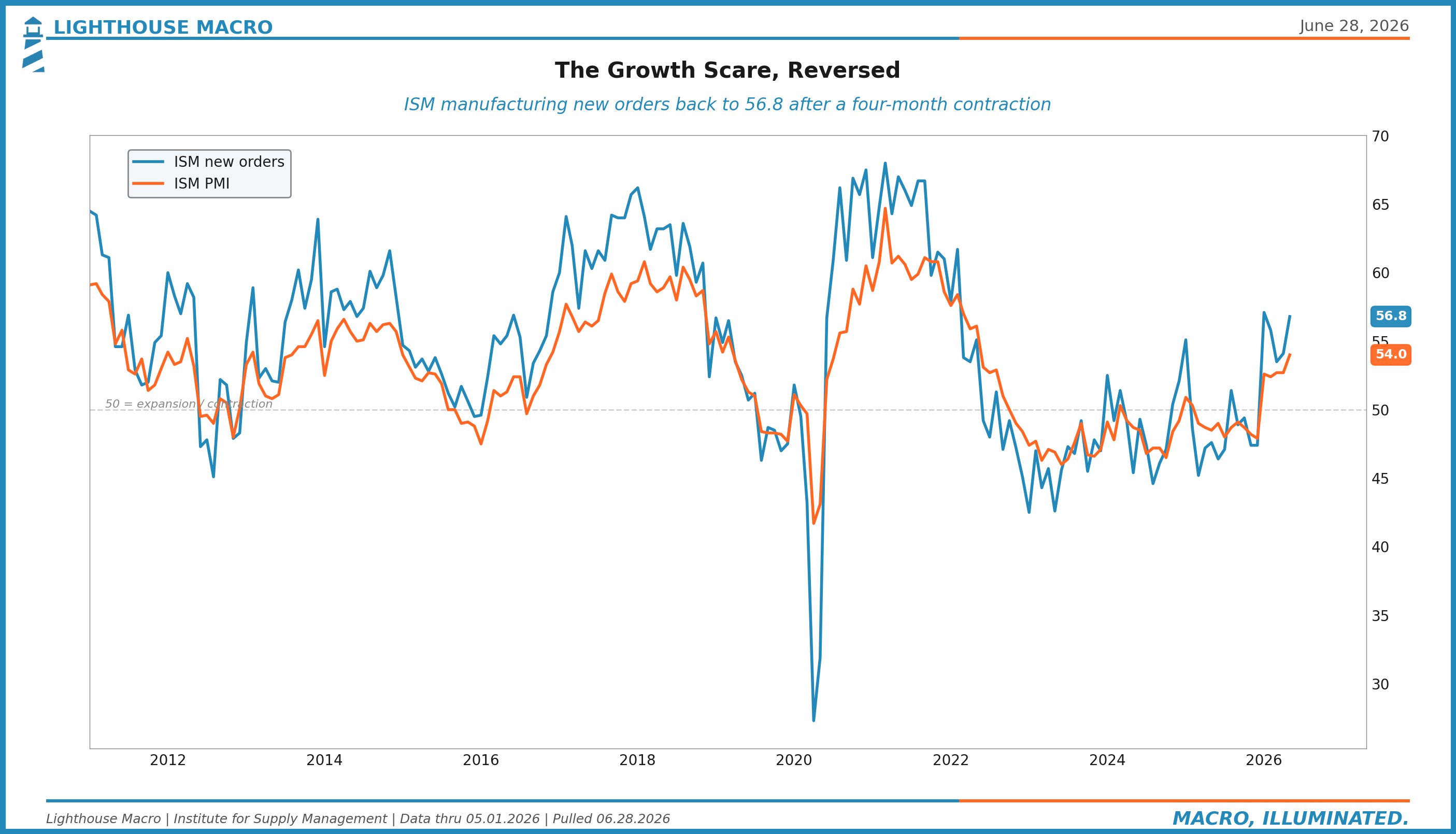
That reads less like a soft patch stabilizing and more like a manufacturing economy coming back to life, right as everyone had finished writing the obituary.
The rest of the activity picture tells the same story. Real GDP grew 2.1% annualized in the first quarter, and the Atlanta Fed’s GDPNow tracker had the second quarter running at 2.5% as of June 25. The services side never broke, with the ISM services index at 54.5 and its new-orders component at 57.3. Retail sales hit a record $763.7B. The economy that everyone expected to be sliding toward cuts is instead speeding back up into the summer. Consensus did not just miss the magnitude. It missed the direction.
That is the first half of what happened. The second half is the part that matters more, because it changes what the reacceleration means.
The Inflationary Kind
There are two kinds of reacceleration. One is the benign kind, where supply loosens, productivity does the heavy lifting, and growth comes without a price. The other is the kind that runs into a wall of capacity and feeds straight into prices. The 2026 version is the second kind, and the factory data is where you can see it most clearly.
Look at what businesses are actually committing to. Core capital-goods orders, the nondefense ex-aircraft series that proxies real business investment intent, hit $84.0B in May. That is an all-time high, up 10.5% year over year.
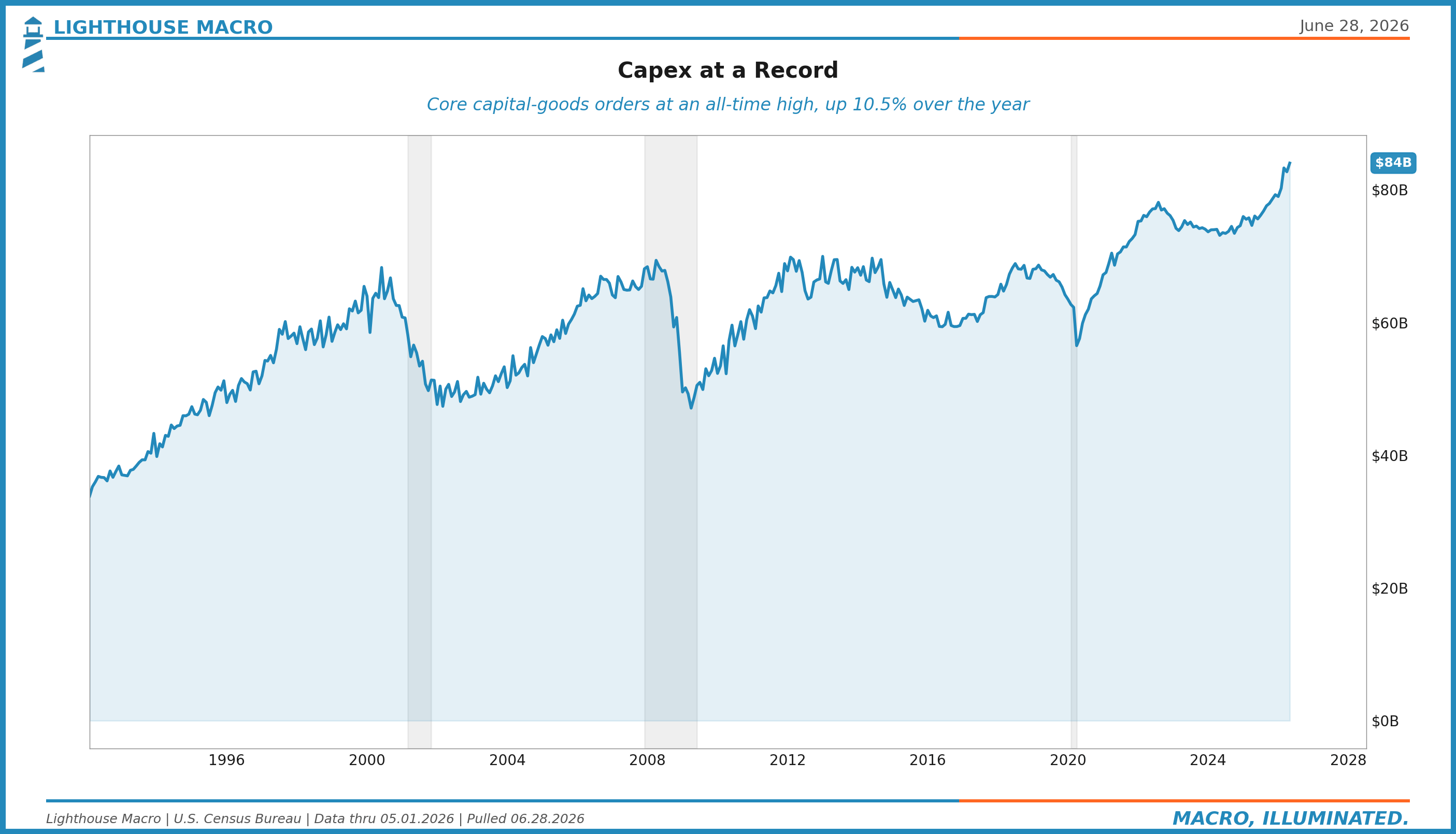
Core capex measured on a shipments basis is running 10.2% above last year. Total manufacturers’ new orders are up 11.7%. Capacity utilization in manufacturing has climbed back to 75.7%. Companies do not commit to capital equipment at a record pace because they expect a recession in two quarters. They do it because demand in front of them is real and they are short the capacity to meet it.
Now the part that gives the rebound its inflationary signature. The one place the manufacturing recovery is not showing up is the payroll. The ISM manufacturing employment index sat at 48.6 in May, still in contraction even while new orders ran at 56.8. Demand is climbing faster than hiring. That is precisely the configuration that pushes on prices before it pushes on wages. Order books fill, lead times stretch, capacity gets tight, and the marginal unit gets more expensive to produce well before anyone gets hired to make it.
Then there is the leg of the inflation story the slowdown camp never accounted for at all. Import prices. The import price index rose 6.7% year over year in May, the largest annual increase since August 2022. The monthly prints have been hot and getting hotter, up 2.0% in April and 1.9% in May.
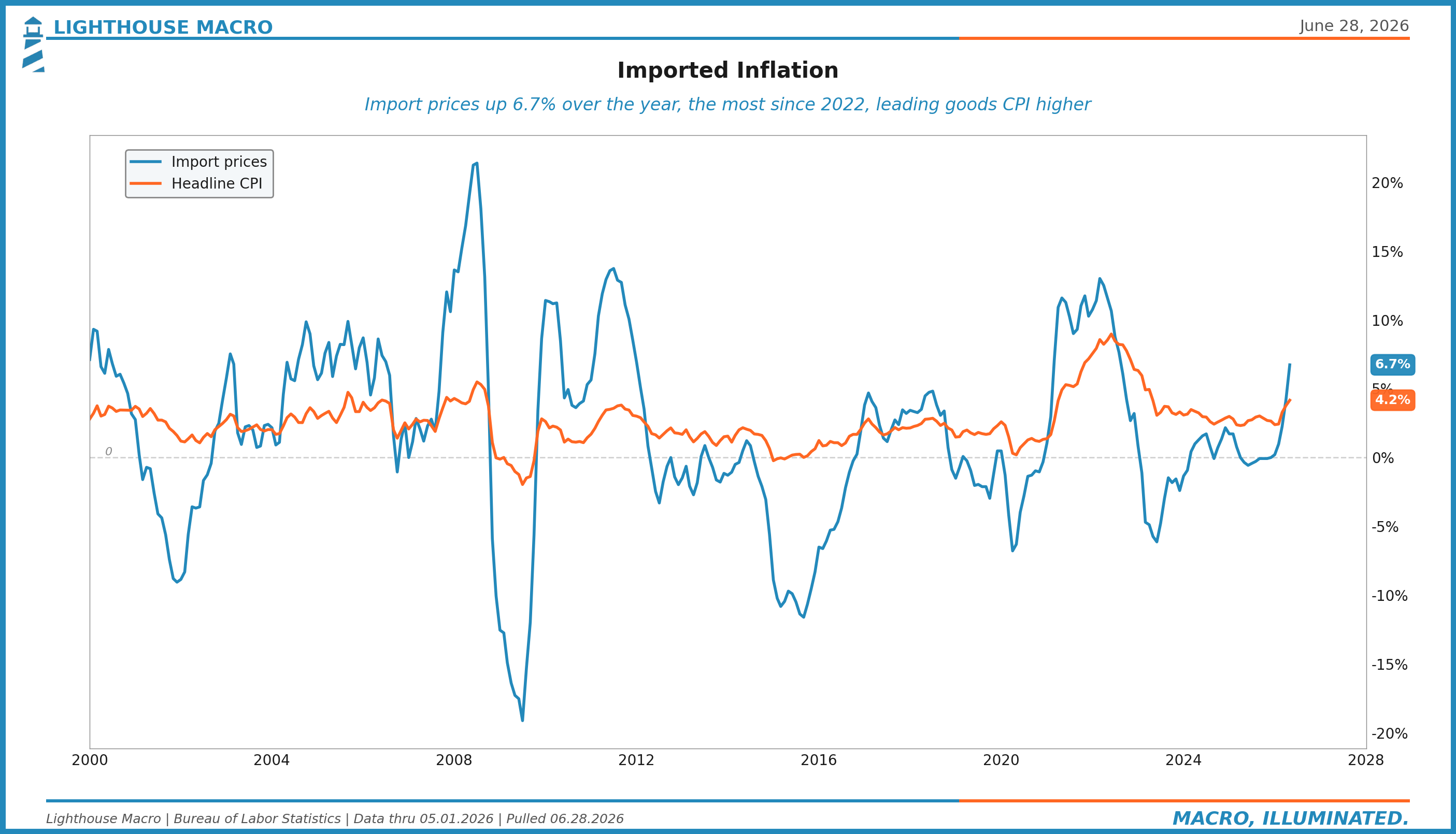
That is a tariff regime and a softer dollar feeding directly into the goods channel, and it lands upstream of the consumer price data rather than after it. When imported goods are inflating at 6.7%, the back-half disinflation everyone penciled in has a sourcing problem before it ever reaches a store shelf.
This is the kind of read subscribers get every week. The data, the cross-pillar synthesis, and what we are doing about it.
Fourth of July offer: the annual plan is $400 right now, 20% off the standard $500, through Monday, July 6. Subscribe during the window and you also get this week’s full supplementary chart pack, the other half of the charts behind this piece, plus the full paid archive.
