

Earnings Week, Macro Week
THE BEACON · APRIL 27, 2026

96 hours that test the read
There are weeks where a lot of small things happen, and there are weeks where the whole economic story compresses into a single window. This is the second kind. Over the next ninety-six hours, we get the Federal Reserve decision, the four largest companies in America reporting earnings, and the three biggest data releases of the quarter. Most of it lands inside thirty hours starting Wednesday afternoon.
The reason it matters has been building for two months. The headline economy has looked fine. Earnings are growing at double digits for the sixth straight quarter. The unemployment rate has not moved. Consumer spending has held up. But underneath all of that, the data we watch most carefully has been telling a quieter story. Hiring has slowed to a level we have not seen outside recessions. Workers have stopped quitting their jobs at a rate that says they do not believe they could find a better one. Credit markets, the parts of finance that tend to flinch first when the cycle turns, have stayed completely calm.
That gap between what the surface says and what the flows say is the thing this week is going to test. Either the surface is right and the flows are noise, or the flows are right and the surface is about to follow. The data over the next four days will tell us a lot about which one it is.
The shape of the week
The architecture is unusually compressed.
Tuesday morning brings consumer confidence numbers. The University of Michigan series finalized at a record low for April. Conference Board confidence sat near 92 in March. Whether households are pulling back on spending, or whether this is sentiment running ahead of behavior, is one piece of the puzzle.
Wednesday is the spine. The Fed announces its rate decision at 2pm Eastern. Chair Powell holds his press conference at 2:30. Then between 4pm and 5:30, four of the five largest companies in America report earnings: Microsoft, Meta, Alphabet, and Amazon. Together they will tell the market how much they plan to spend on artificial intelligence infrastructure in 2026. That number, more than anything Powell says, will move the entire AI-adjacent economy on Thursday morning.
Thursday morning is the data triple. At 8:30am the government releases first-quarter GDP, March inflation through the Fed’s preferred measure, and the Employment Cost Index, which tracks how fast wages are rising. Apple closes the earnings cluster after the bell. Friday’s manufacturing survey tidies up the week. The April jobs report and the March JOLTS print fall outside this window, releasing the following week. The convergence we care about is FOMC, hyperscaler capex, and the Thursday data triple. All of it lands inside thirty hours.
Five trading days. Four pieces of our framework getting tested in real time. We have spent the year mapping the cycle. Now the cycle reads back.
Powell’s last podium
Markets are pricing roughly a 98 percent probability the Fed holds rates steady on Wednesday. We agree. There is no path to a rate cut with headline inflation at 3.3 percent year over year, gasoline prices climbing on the back of the Iran supply shock, and crude back near triple digits.
What matters is the tone. The April meeting does not include the Fed’s quarterly economic projections, which means every word in the statement and every Powell answer carries more weight than usual.
Three things are worth listening for.
First, whether the statement keeps describing risks as roughly two-sided. The March meeting framed it that way, which gave the Fed room to move in either direction without committing to anything. We expect that frame to hold. It is the language of a central bank that wants to signal patience.
Second, whether Powell repeats the line he used at Harvard at the end of March. He explained that supply shocks like the oil disruption tend to fade by the time monetary policy could respond to them, and so the right move is to look through them. Here is exactly how he put it: “By the time the effects of a tightening in monetary policy take effect, the oil price shock is probably long gone, and you’re weighing on the economy at a time when it’s not appropriate. So the tendency is to look through any kind of a supply shock.” That sentence is the Fed’s permission slip to ignore the gasoline-driven inflation print. If Powell repeats some version of it, the market reads patience. If he hedges, expectations for cuts later this year fade.
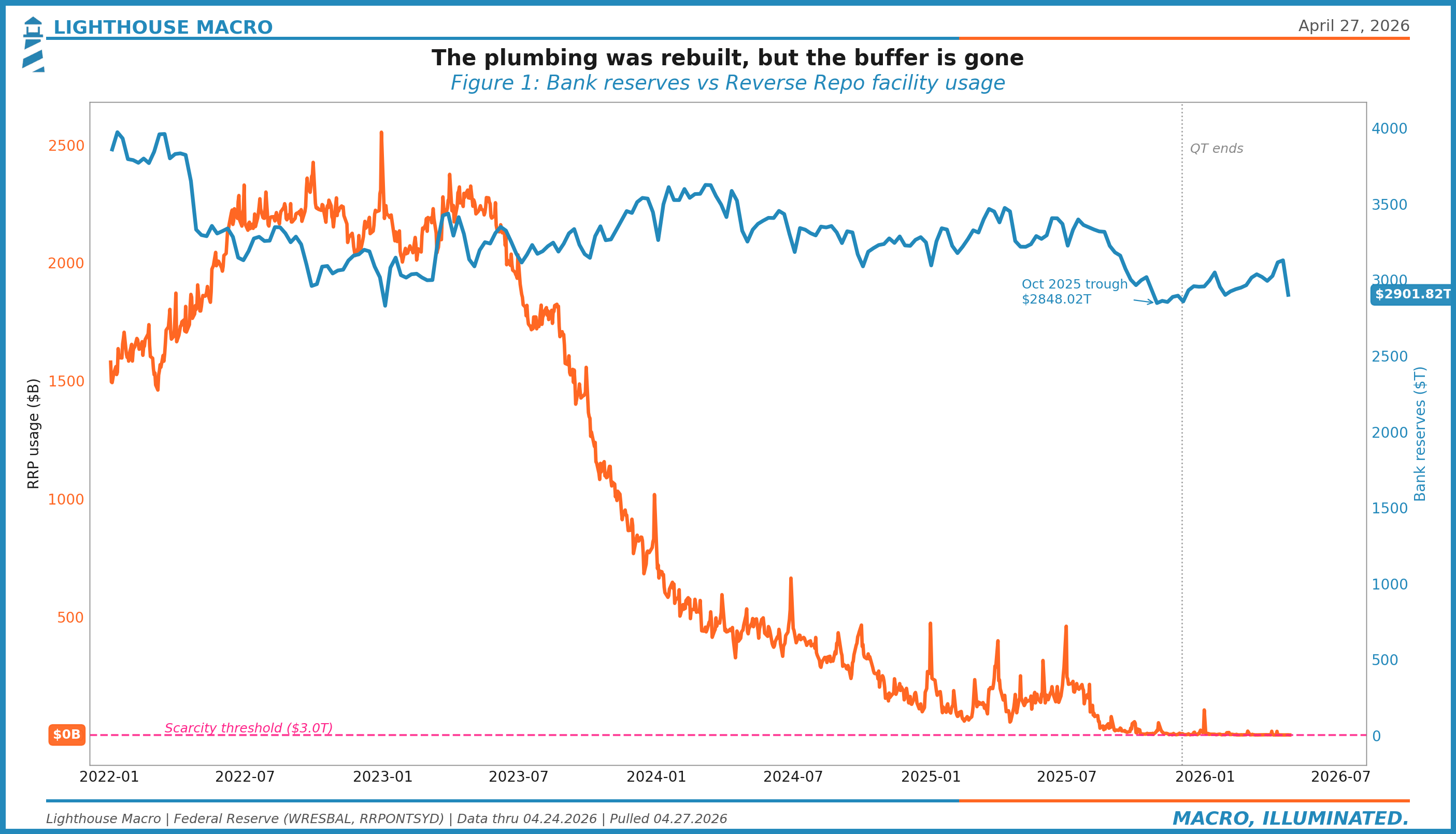
Third, whether the Fed signals anything about its balance sheet. The technical name for what ended in December is quantitative tightening, but what it really means is that the Fed had been letting bonds roll off its books for two years and stopped doing so. Since December, it has been quietly buying around forty billion dollars of short-term Treasury bills per month, which is supposed to wind down in May. The plumbing of the financial system is calm but thin. Bank reserves have been rebuilt from a stress trough last October, and the buffer that used to absorb shocks has been functionally drained.
This is most likely Powell’s last press conference as Chair. His term ends May 15. Kevin Warsh has been named as his successor, with Senate confirmation pending. We do not expect Powell to use the moment for theater. He is institutionalist by temperament, and the institution is what he has been protecting all year.
The internal composition of the committee has already shifted under the surface. On one end, Cleveland’s Beth Hammack is the only voter publicly entertaining a hike. On the other, Michelle Bowman has emerged as the dovish anchor, with multiple cuts in her March projections submission. The most interesting voice is Austan Goolsbee, who has historically been the most cut-friendly member in the room. He told Semafor in mid-April that if the oil-shock inflation lingers, cuts get “pushed out of ‘26” entirely. When even Goolsbee gives up on cuts this year, patience is the path of least resistance for the chair.
The capex print is the macro print
We have written before that hyperscaler capital expenditures are now a macro variable, not a tech-sector variable. What that means in plain English is that the spending plans Microsoft, Meta, Alphabet, and Amazon announce on Wednesday night will move the entire industrial economy on Thursday morning. Semiconductors, power infrastructure, data center real estate, utilities, copper, natural gas, all of it.
The arithmetic is the easy part. The four hyperscalers spent roughly $230 billion on capital expenditures in 2024. They spent roughly $350 billion in 2025. Their guides for 2026 add up to somewhere between $610 billion and $640 billion. At that level, four companies are spending the equivalent of nearly two percent of US GDP on what is mostly AI infrastructure. There is no precedent for this in any prior tech cycle.
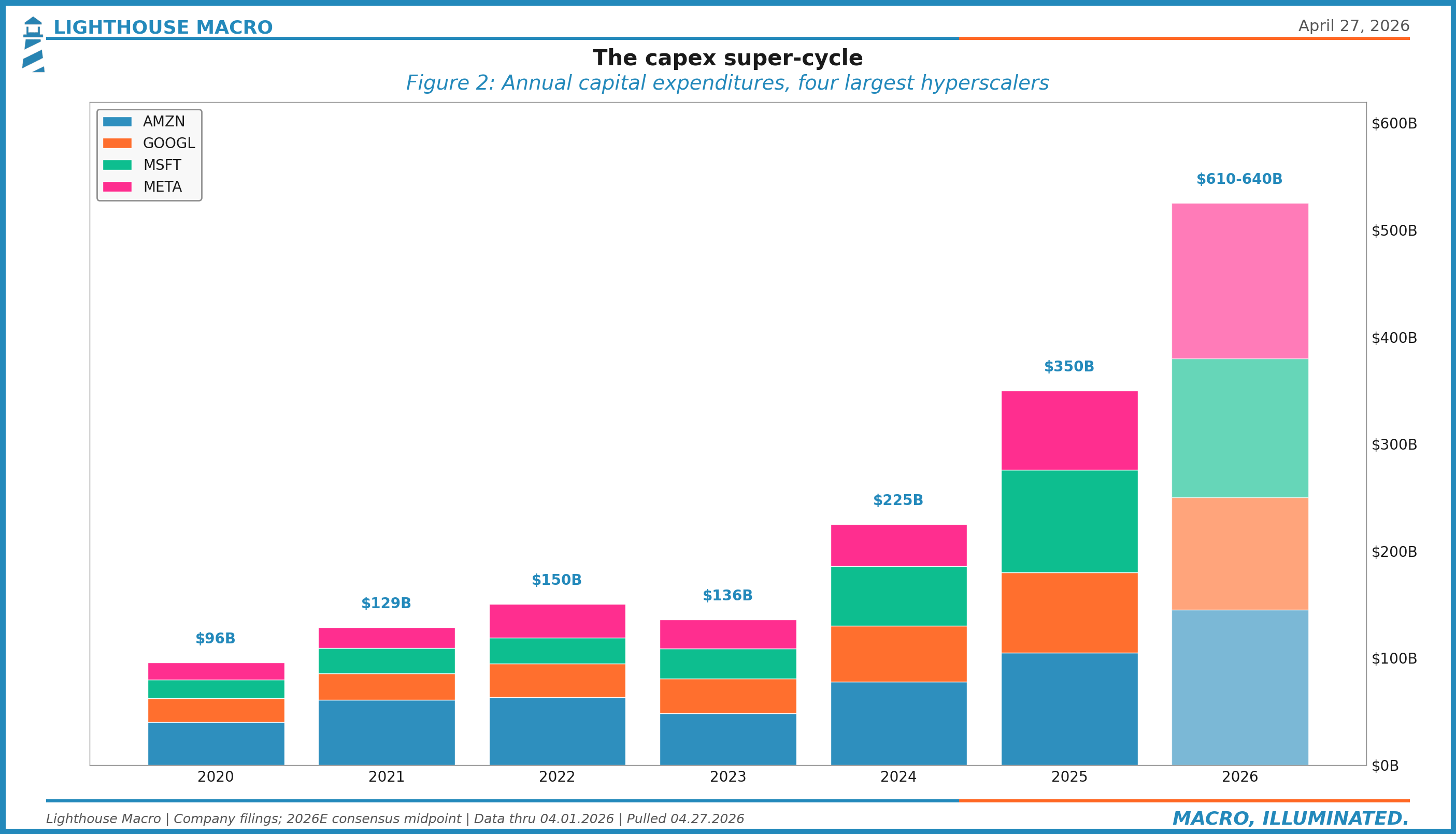
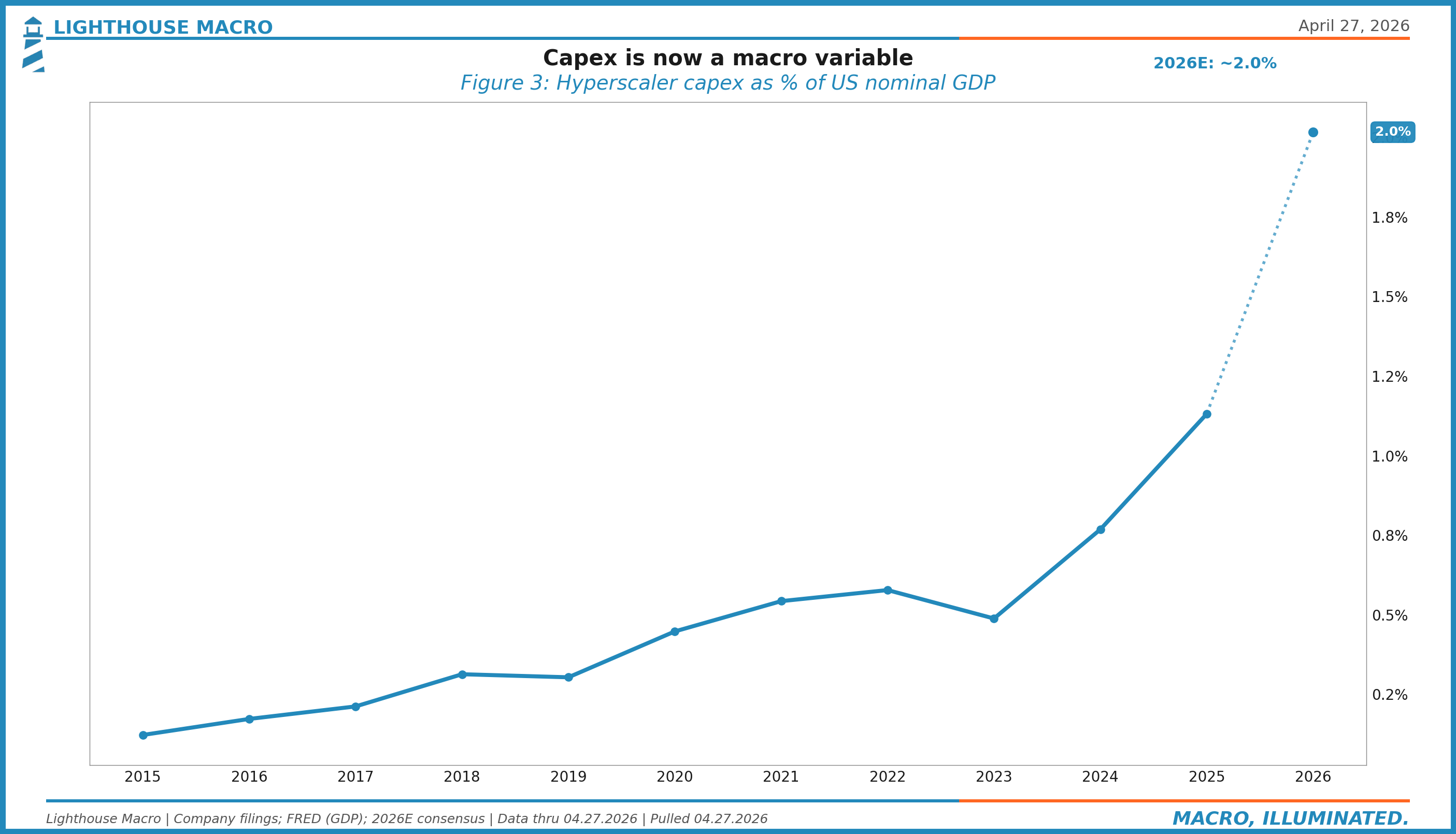
What we are watching Wednesday night is whether any of these guides flinch.
Amazon is the cleanest tell. Its cloud business, AWS, is the part of the company that powers most of the AI demand the others are also chasing. If AWS grows above thirty percent and Amazon raises its 2026 capex guide, the AI cycle extends. If AWS slows toward twenty-five percent and the capex guide stays flat, that is the first crack in the story.
Meta carries a different question. The company has built itself a $115 to $135 billion capex envelope for 2026, and the question is whether ad revenue can carry that without margins compressing. Reality Labs, the part of the company building the metaverse, lost more than nineteen billion dollars across 2025. Meta is the largest single-stock event of the night.
Microsoft and Alphabet are both spending at rates that are reshaping their financials. Microsoft has said capacity, not demand, is the binding constraint on its cloud business. Alphabet’s earnings per share are actually expected to decline this quarter despite revenue growth, because the depreciation schedule on all the new data center capacity is now hitting the income statement. Both companies are showing what it costs to be in the AI infrastructure race.
The capital intensity ratios make the story concrete in a different way. Capex as a percentage of sales now runs roughly 86 percent at Oracle, 54 percent at Meta, 47 percent at Microsoft, 46 percent at Alphabet, and 25 percent at Amazon. Bank of America’s credit team estimates that AI-related capex consumes roughly 94 cents of every dollar these companies generate after dividends and buybacks across 2025 and 2026, up from 76 cents in 2024. Barclays models Meta’s free cash flow falling roughly 90 percent in 2026. The cycle is being financed by what is left after capital returns to shareholders, and what is left is shrinking.
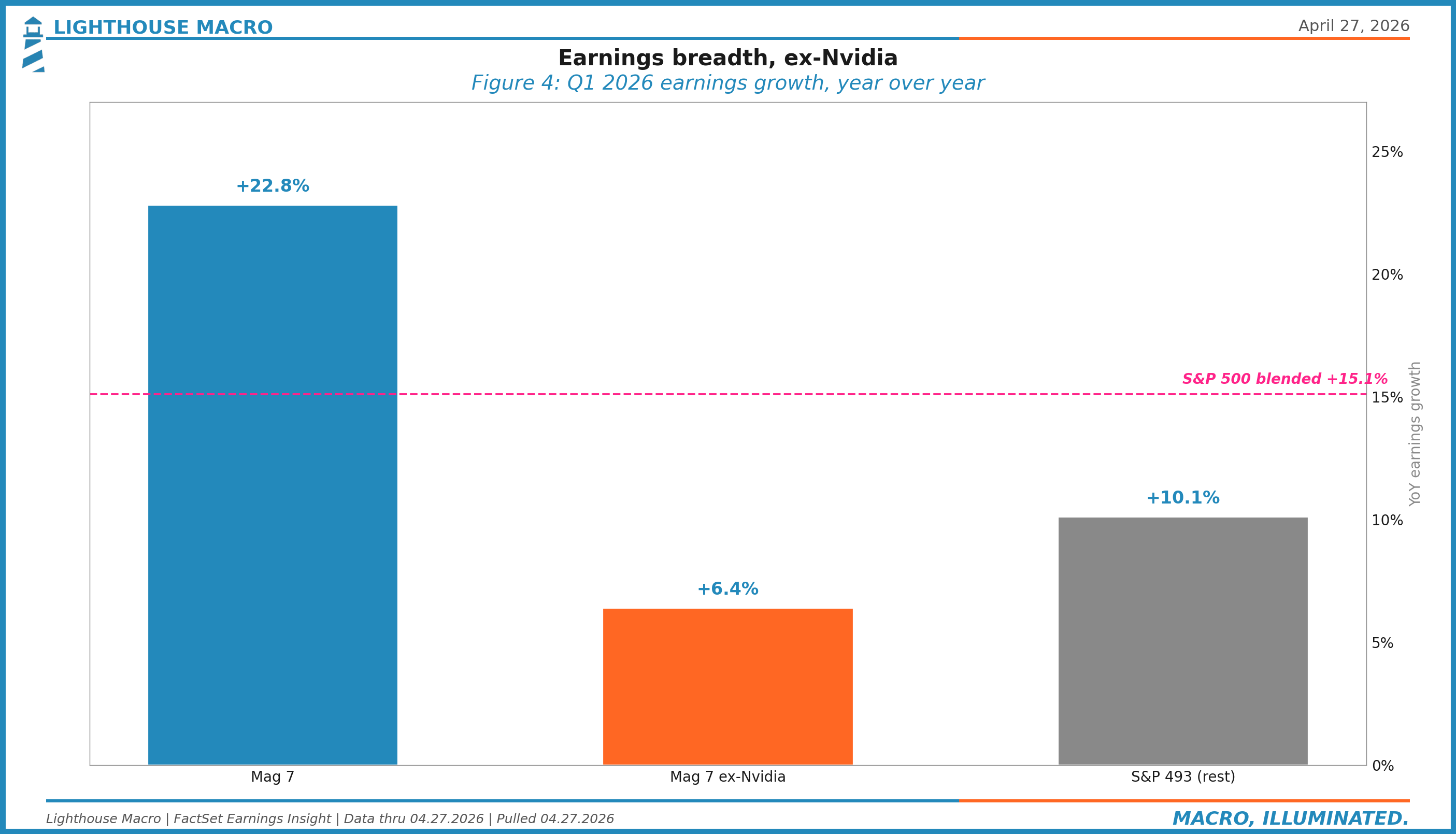
There is one more wrinkle to all of this that does not get enough attention. The double-digit earnings growth we mentioned at the top is real. It is also extremely concentrated. The S&P 500’s blended growth rate of fifteen percent gets driven by the Magnificent Seven at twenty-three percent. But strip out Nvidia alone and that group falls to six percent, which is below the rest of the index at ten. The “everything is great” earnings tape is, on closer reading, an “AI infrastructure is great, plus Nvidia” tape. The rest of the S&P 500 is far more sensitive to consumer and labor conditions than the platforms are. And the consumer data is not great.
Three releases, one signal
Thursday morning at 8:30am, the government releases GDP, the inflation print, and the wage data inside the same minute. The market gets one number for growth, one number for inflation, one number for wages. The triangulation between them is what tells us where the economy actually is.
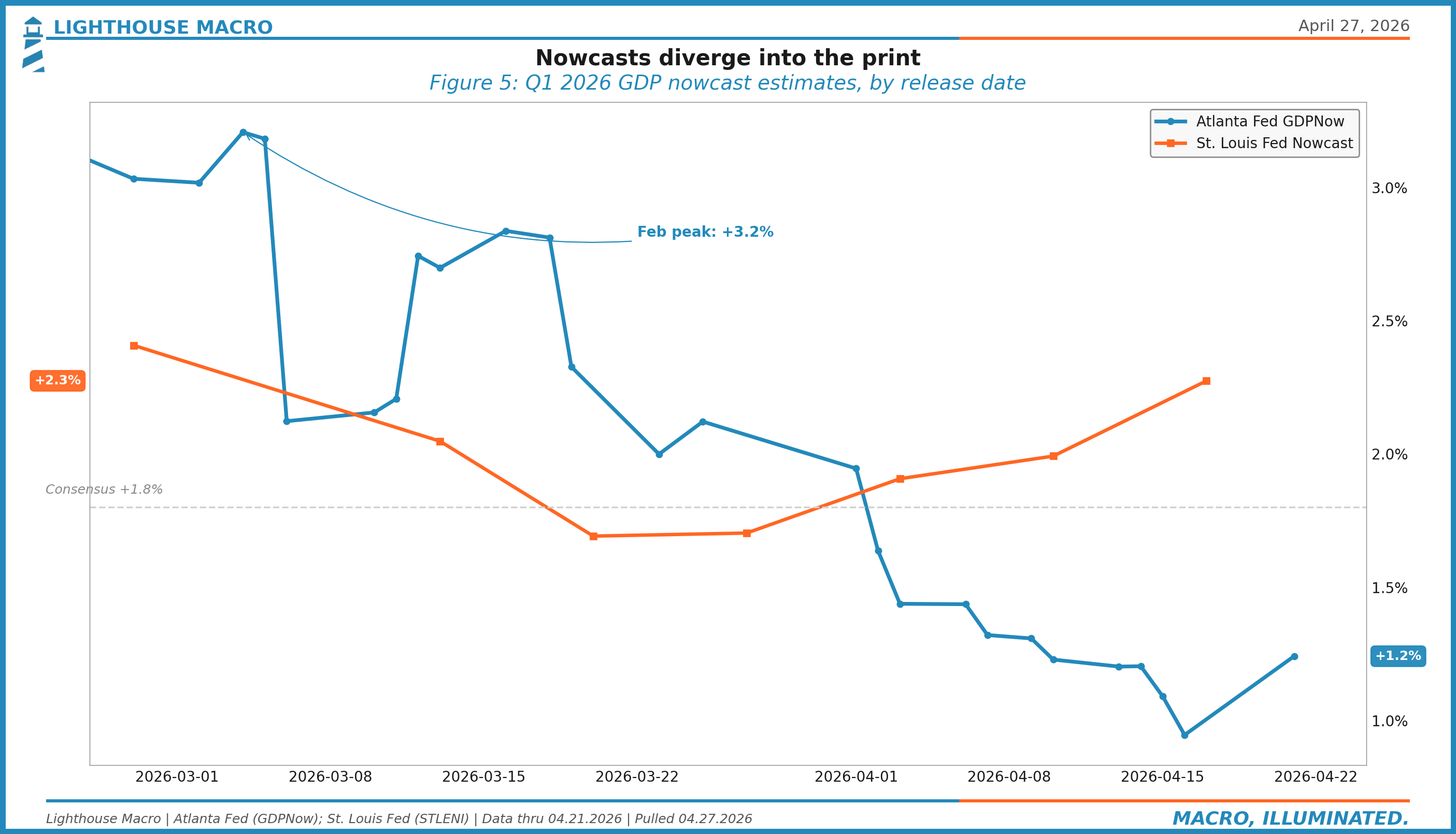
GDP first. The Atlanta Fed’s running estimate for the first quarter has drifted from a healthy three percent in late February down to roughly one percent. The St. Louis Fed’s version of the same exercise tracks closer to two and a half percent. Most of the gap reflects different ways of treating the surge in imports we saw in early 2026, as companies front-loaded purchases ahead of tariff actions. A print near one and a half percent, with consumer spending holding up, is the soft-landing read. A print under one percent, paired with hot inflation, is the start of a different conversation entirely.
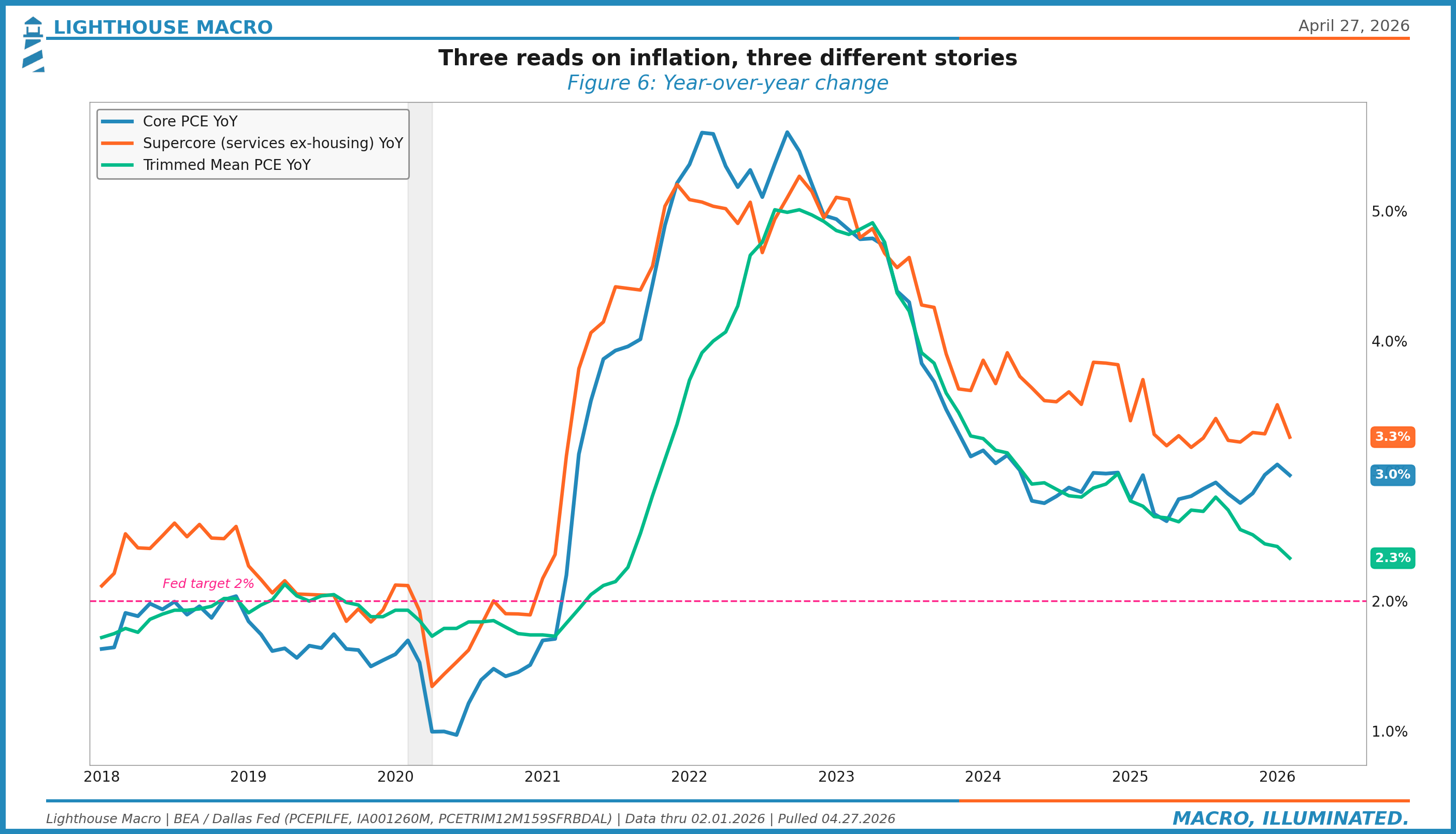
Inflation second. The measure the Fed actually targets, called core PCE, has held steady around three percent year over year. The piece of it that matters most for monetary policy is what gets called the “supercore” reading, which strips out housing because housing tends to lag everything else by twelve to eighteen months. Anything in the high 0.3s on the monthly supercore reprices the cuts curve hawkishly. Anything at 0.2 or below buys the Fed more time. There is a quieter measure published by the Dallas Fed that trims out the most volatile categories on either side, and it has been running closer to two and a half percent. That is the calmer read on inflation, and it is probably the one Powell will privately weight.
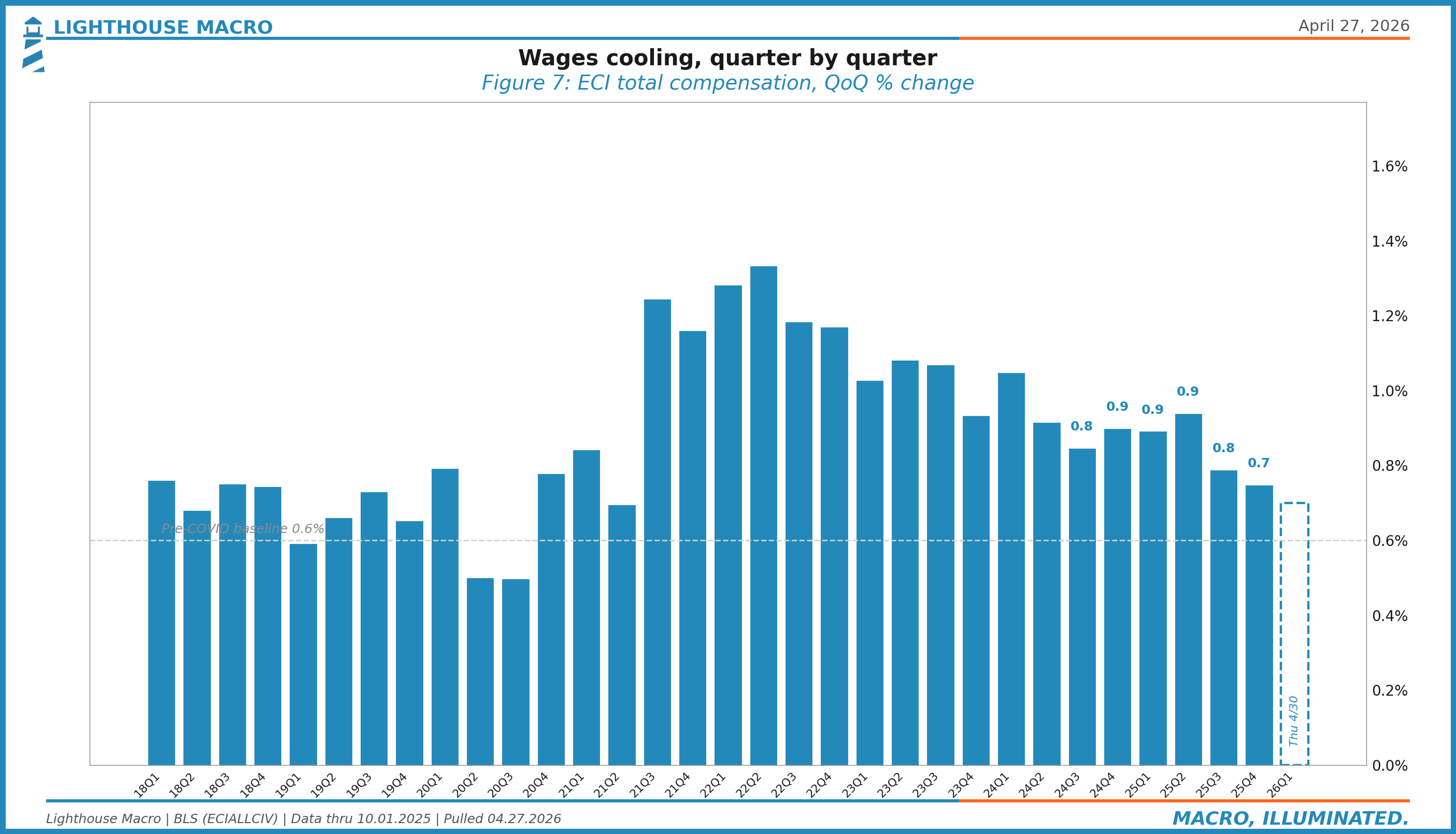
Wages third. The Employment Cost Index has been cooling on a steady glide path for six quarters. The most recent print at 0.7 percent was the softest reading since 2021. A print at 0.7 again confirms wages are no longer adding to inflation pressure and gives the Fed cover to ease later this year. A print at 0.9 breaks the cooling trend and complicates everything.
The market reaction on Thursday morning is going to be asymmetric. A clean trio (growth around two percent, inflation cooperating, wages soft) is the soft landing. Equities hold the bid, the yield curve steepens a little, the dollar drifts. A bad trio (weak growth, hot inflation, hot wages) is the stagflation tape, and it will not be subtle. Yields rise on both ends, equities sell. The most likely outcome is somewhere in between: data that confirms the framework directionally without forcing the Fed’s hand or anyone else’s.
The flows tell the truth
We have written about this before, but it is the central argument of the year, so it bears repeating. Most of the time, the headline employment number does not lead the cycle. It lags it. The level of unemployment moves up only after the economy has already turned. What turns first is the flows: how often workers are getting hired into new jobs, how often they are quitting their current ones to look for better ones.
The flows have been telling a story all year that the headlines have not.
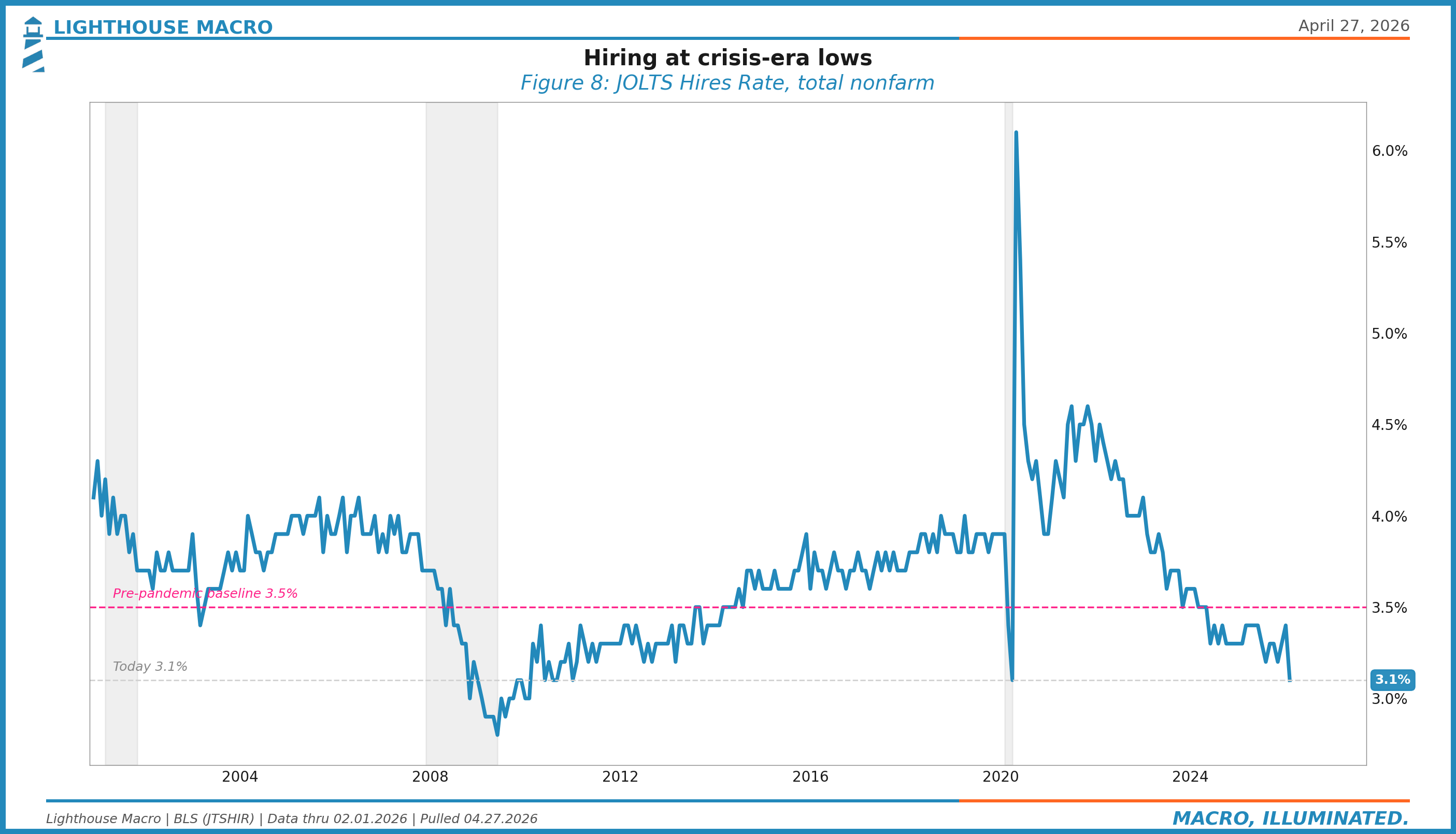
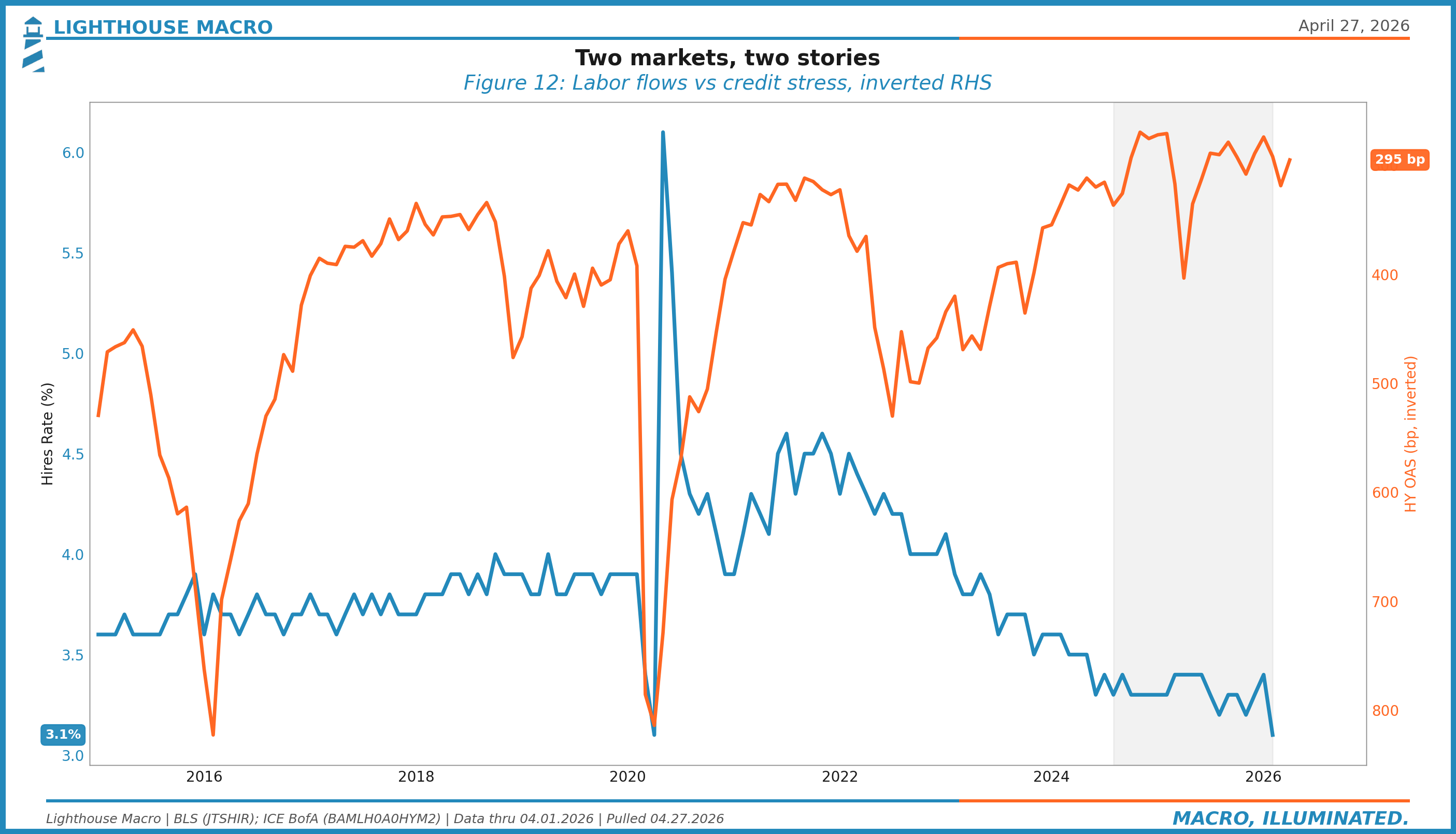
The hire rate, which measures how often workers are getting new jobs each month, sits at 3.1 percent. That is a level we have only seen at the worst moments of the global financial crisis and during the depths of the 2020 lockdown. It means the engine that absorbs displaced workers in normal recessions, the willingness of other employers to hire them, has slowed to crisis levels. Even though no one is being laid off in big numbers, the second half of the equation, the part that tells you how easy it is to find a new job, has effectively gone offline.
The quit rate tells the same story from the worker’s side. When workers feel confident, they quit jobs they do not like to find better ones. The quit rate at 1.9 percent has been sitting at or below 2.0 percent for eight straight months. Workers are staying put. They do not believe they could find a better job easily. That is not a level-of-employment story. That is a confidence story, and it tracks what would normally be the early warning signs of a turn.
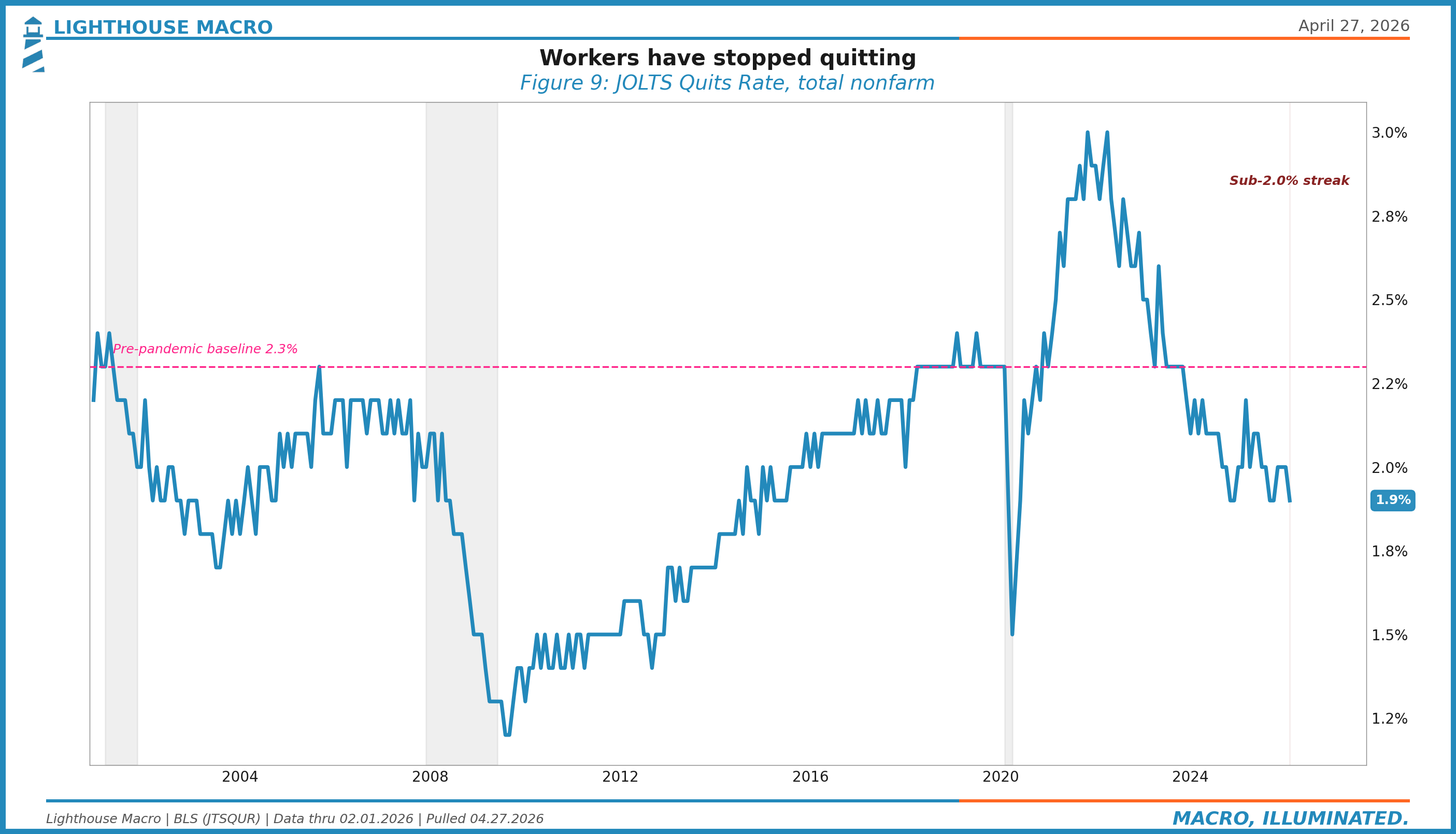
So why has the unemployment rate not moved? Because layoffs have not started. Initial jobless claims, the weekly read on layoffs, are sitting at completely benign levels. The labor market has settled into what one Fed official called a “low-hire, low-fire” equilibrium. Nobody is hiring much, but nobody is firing much either.
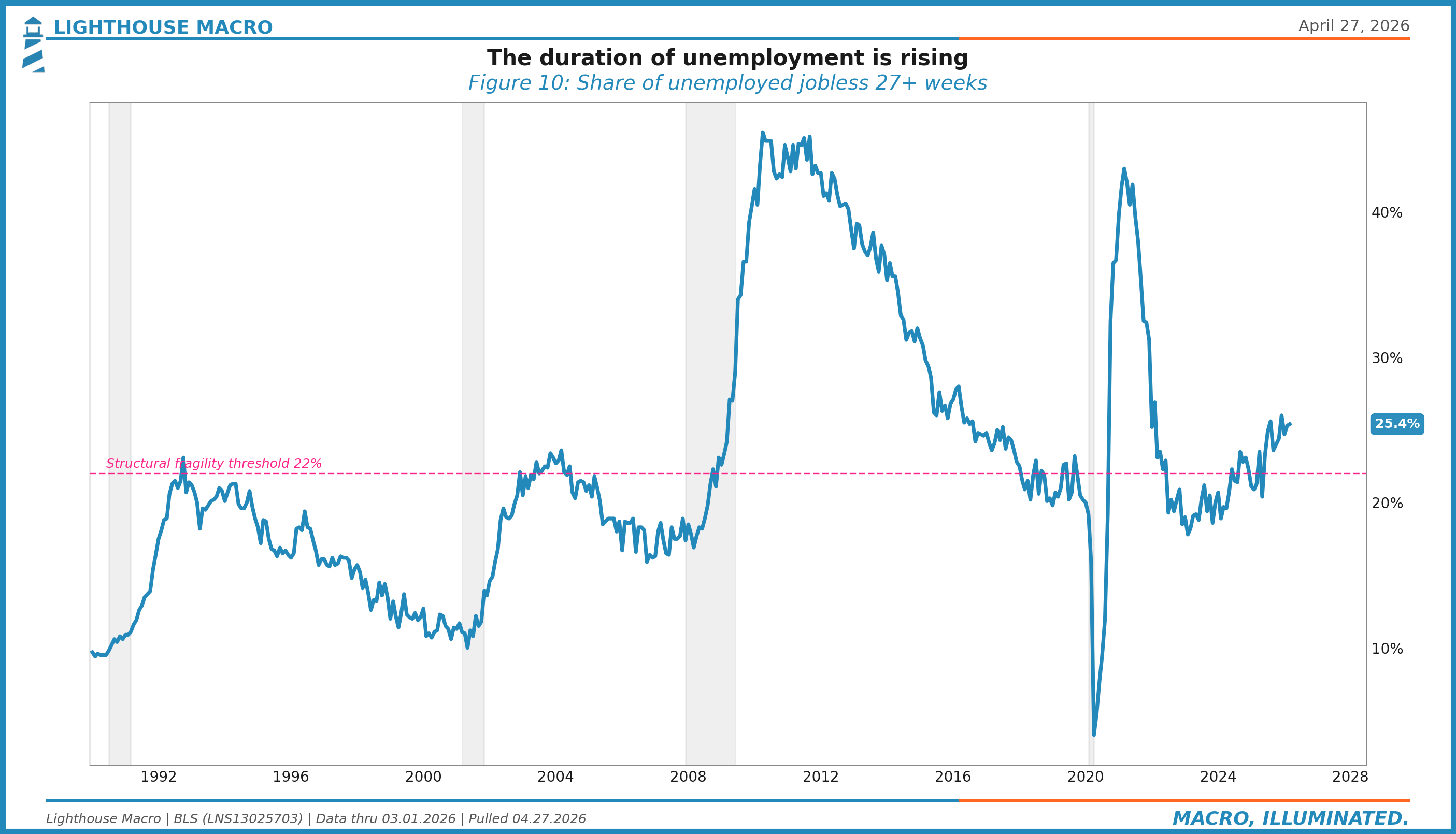
The reason the framework worries about this state is that it is structurally fragile. When employers eventually pivot from “we are not hiring” to “we are reducing headcount,” there is no second job market for displaced workers to absorb into. The hire rate that absorbs them in normal recessions is not there. We can already see the early signature of that fragility in another piece of data: how long the average unemployed person stays unemployed. The share of unemployed people who have been out of work for more than six months is rising even as the headline unemployment rate is not. Duration is the early signal.
The announced layoffs that have not yet shown up in jobless claims also tell a story. Challenger reported roughly 60,000 announced job cuts in March, with AI cited as the reason for a quarter of them, up from ten percent in February. Tech-sector cuts ran roughly 18,700 in March alone, with the first quarter total up forty percent year over year. None of that has reached the weekly claims data yet because severance windows and retention payments smooth the timing. It will.
This is what we mean when we say flows lead and stocks lag. The flow data has been saying the labor cycle has turned for six months. The level data has not said it yet. The credit market, which prices off the level data, has stayed calm. That gap is the thing the framework is built to read.
The credit-labor gap
Investment-grade corporate bond spreads (the extra yield investors demand to lend money to companies versus to the government) sit near 80 basis points, the tightest level in roughly thirty years. High-yield spreads, the version for riskier borrowers, sit near 285 basis points, inside levels we have seen only twice in the last twenty years: May 2007 and July 2021. Both prior episodes turned out to be peak complacency.
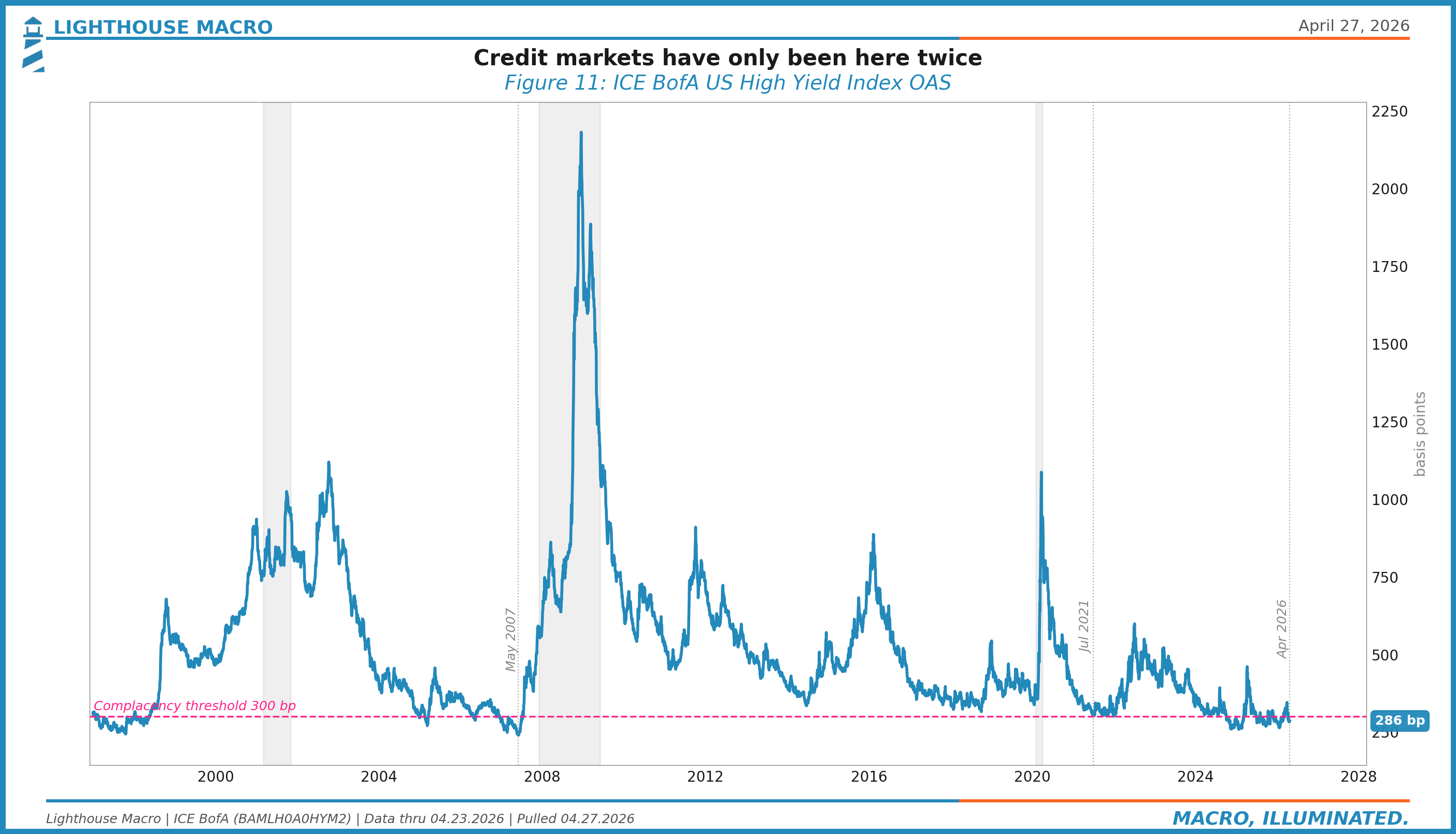
How can credit be this calm with labor flows this weak? The answer is mostly technical. Credit spreads do not need labor to be strong. They need defaults to be low. Companies refinanced most of their debt in 2024 and 2025 at lower rates, and corporate balance sheets are sitting on plenty of cash. Near-term defaults look benign, and credit is correctly pricing that.
What credit is not pricing is the cyclical risk that follows once labor turns. The two-month lag between when labor flows weaken and when defaults begin to rise is the gap we are watching. Right now, one market is reading the level signals (everything is fine), and our framework is reading the flow signals (this looks late-cycle). Both can be defensible at the same time. They cannot both stay defensible forever.
The thinning of the consumer’s savings cushion is the same gap, viewed from a different angle. The headline personal savings rate sits at four percent, down from five and a half a year ago. Our “Two Economies” piece on April 20 walked through the composition of that aggregate. The top decile of US households is saving roughly eighteen percent of income off appreciating asset bases. The bottom sixty percent is saving 1.2 percent and rolling balances on revolving credit. The four percent headline is camouflage. The household sector has been spending against a thinning buffer for a year, and the cushion is mostly gone for the people who do not own stocks.
The Treasury market is too quiet
There is a number called the term premium, which sounds technical but is not. It is the extra yield investors demand for the risk of lending the government money for ten years instead of rolling shorter-dated debt over and over. When the term premium is high, it means investors see real risk in long-duration government debt. When it is low, they do not. Right now it sits near 70 basis points, up from 40 a year ago, but our framework points to a level closer to 150 basis points as the honest one given how much the federal government is borrowing, the heavy reliance on short-term bills inside that mix, and the gradual fading of foreign demand. The trajectory is right. The pace is the question.
The next catalyst is a Treasury announcement on May 6, the week after this one. The market is watching for one specific change: whether Treasury drops the language that has been telling investors coupon auction sizes will not increase “for at least the next several quarters.” If that line gets removed, long-term yields rise immediately as investors price in more supply ahead. If it stays, the long end stays anchored.
Bond market volatility, captured by what is called the MOVE Index, sits more than forty percent below its year-ago level. That is a remarkable level of calm given how much risk the framework sees brewing underneath. Some of that calm is real, and some of it is technical: vol-targeting strategies and Fed forward guidance both suppress measured volatility. The absence of a wobble in the Treasury market should not be confused with the absence of risk in it.
The oil overlay
Oil deserves a paragraph and not the spine. The 2026 supply disruption tied to the Iran conflict pushed crude back near triple digits in late February and has kept it there, with a steady geopolitical premium baked into the curve. Gasoline near four dollars a gallon is the single biggest reason headline inflation lifted to 3.3 percent in March. The Fed’s posture, articulated by Powell at Harvard in March, is to look through it. Oil is not the framework. Oil is the noise that makes the framework harder to read in real time. The signals we want sit in the inflation data on Thursday and in the wage print. If those land soft, the oil shock is doing what supply shocks do: showing up in headlines and not in the structure underneath. That is the read we expect.
What would change our mind
Honesty requires laying out what would force us to revise the framework. Three scenarios.
The first is a clean hyperscaler capex blow-out on Wednesday night. If Amazon raises its 2026 spending guide aggressively, Alphabet does the same, and Meta tightens to the upper half of its envelope, the AI capital cycle extends another four to six quarters. That spending feeds through the industrial economy, lifts the breakeven rate of payroll growth, and arguably defers the labor-flow reckoning we have been tracking. The bullish read on business conditions becomes the dominant one. Equities rally. The credit-labor gap stops being a mispricing and becomes a recognition that the cycle just got extended.
The second is hot wages paired with soft inflation on Thursday morning. If the Employment Cost Index reaccelerates while inflation cools, the wage-shelter loop we have been tracking breaks in a benign direction. The Fed gets cover to cut on the inflation read while wages support the consumer. That is the cleanest soft-landing scenario, and we cannot rule it out.
The third is high-yield spreads tightening further into the print week. If the credit market absorbs hot inflation, hawkish Powell tone, and weak GDP without flinching, our read on the gap is wrong, and what we see as complacency is actually correct pricing of a low-default regime. We would have to revise our credit framework.
We do not expect any of those three to materialize cleanly this week. The most likely outcome by Friday’s close is some version of the muddle: data that confirms the framework directionally without forcing anyone to reposition urgently. The market continues to price the level signals. We continue to price the flow signals. The gap stays open.
What we will know by Friday
Four reads land between now and the weekend. Each carries asymmetric information.
The Fed and Powell’s tone tell us how close the central bank is to acknowledging the labor flow story. We expect minimal acknowledgment with optionality preserved.
The hyperscaler capex aggregate tells us whether the AI cycle is extending or showing first cracks. We expect extension at the headline level, with widening dispersion in capital efficiency that becomes a 2027 problem rather than a 2026 one.
The Thursday data triple tells us whether stagflation pressure is intensifying or easing at the margin. We expect easing on growth and wages, sticky on inflation.
The manufacturing survey on Friday is the cleanest soft-data read. We expect it to print near a level consistent with mild expansion, with the prices-paid component staying elevated.
The framework does not ask the data to prove a forecast. It asks the data whether the cycle map we have drawn matches the terrain in front of us. By Friday’s close we will know whether the labor flow signal is getting confirmation from earnings, whether the credit signal is starting to wake up, and whether the Fed is moving any closer to acknowledging the asymmetry between what the surface says and what the flows say.
Conclusion
The cleanest test of a framework is when the data converges to a single window. This week is that window. Our read going in is that the labor flow signal is real, the credit market is pricing the wrong cycle variable, the hyperscaler capex super-cycle is real but increasingly capital-inefficient, and the Fed is correctly stuck. None of those views is contrarian taken individually. The combination is.
The wager underneath the framework is that flows beat stocks at the turn. The stock data this week, meaning the headline earnings number, the GDP level, the inflation level, will be loud. The flow data, meaning the trajectory of capital spending, the hire rate the following Tuesday, the wage print, the composition of inflation underneath the headline, will be quieter. If we are right, the noise resolves into the signal we have been tracking all year. If we are wrong, we will know it because the AI capex prints come in flat, the wage data surprises hot, and credit tightens further into all of it. We do not expect that. We are watching for it anyway.
By next Sunday we will have the Fed decision, four mega-cap reports, GDP, the inflation print, the wage print, and the manufacturing survey on the desk. The framework will be either confirmed or strained. Strained is fine. Strained is information. We will report what the data did to the cycle map. The discipline is not the conviction. The discipline is the willingness to repaint the map when the terrain changes.
The terrain has not changed yet.
That’s our view from the Watch. We’ll keep the light on...
Bob Sheehan, CFA, CMT
Founder & Chief Investment Officer
Lighthouse Macro | Research | @LHMacro