

Caught Both Ways
The Beacon · July 6, 2026

The short version
For eighteen months the market argued about one thing, and only one thing. How many cuts, and how fast. The Warsh Fed settled that argument in June by flipping the dot plot to a hiking bias and raising its own 2026 core inflation forecast. The cuts everyone was waiting on are not coming.
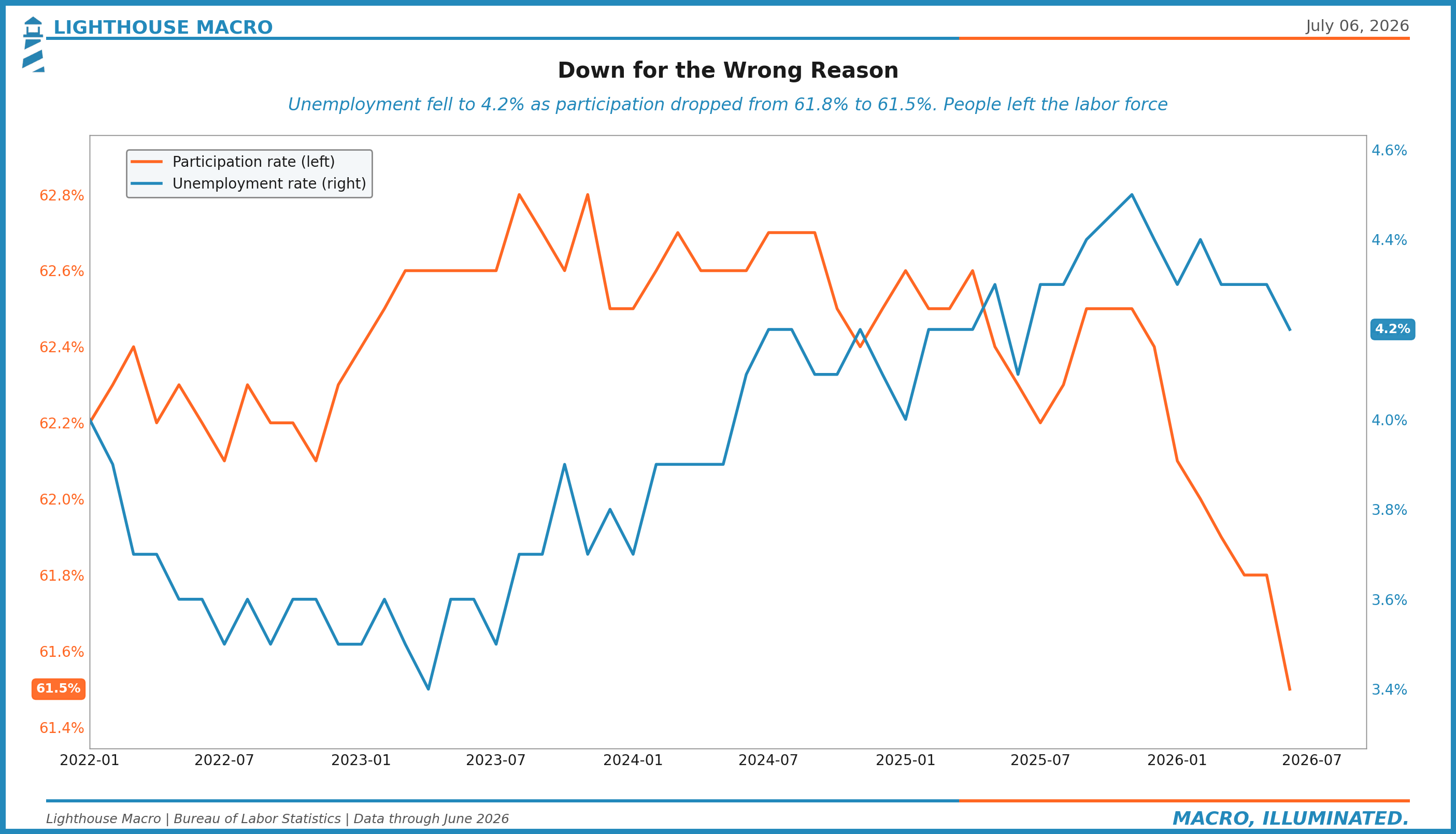
Then the June jobs report landed on July 2, and it opened the other side of the vise. Payrolls grew just 57,000, the weakest of the year. The unemployment rate fell to 4.2%, but it fell because people left the labor force, not because more of them found work. The labor market is starting to crack.
So here is the trap. Inflation at 3.4% core PCE says the Fed cannot cut. A labor market rolling over says it will eventually have to. One tool, two fires, pointed in opposite directions. That is a box, and the Fed is now standing in it.
Whichever way policy eventually breaks, it breaks late. And the household with no cushion left, funding today’s spending out of a 3% saving rate with sentiment at recessionary levels, is the one that absorbs the lag.
The tape has not priced any of this. The S&P sits near record highs, the VIX is back at 16, and high-yield spreads are 275bps, tighter than almost any point this cycle. The market is trading the box like it isn’t there. June CPI on July 15 and the FOMC on July 28 and 29 are the next two moments that force the issue.
The Setup
Go back to how the year was framed. Every desk, every strategist call, every rates model started from the same premise, and the premise was about timing. The Fed was going to cut. The only live questions were how many and how soon. That was the whole debate. Two cuts or three, July or September, twenty-five at a clip or a one-time fifty. The direction was settled in everyone’s mind. The economy would cool just enough, inflation would drift back toward two, and the cutting cycle that had been penciled in since 2024 would finally arrive.
The Fed spent June taking that premise apart.
At the June 16 and 17 meeting, the first with Kevin Warsh in the chair, the committee held the funds rate at 3.50 to 3.75% and then did something the market was not positioned for. The dot plot flipped. The median path for 2026 moved from an implied cut to an implied hike, the 2026 core PCE forecast got marked up to 3.3%, and 17 of the 18 officials said the risks to inflation were tilted to the upside. This was not a Fed looking for a reason to ease. This was a Fed telling you, as plainly as a dot plot can, that the next move was at least as likely to be up as down.
That should have been the story. Higher-for-longer, confirmed by the people who set the rate. The one axis the market had been trading all year, the pace of cuts, got closed. And for about ten days, that was the story.
Then the jobs report changed the shape of the problem.
The Second Blade
The June employment report came out early, pulled forward to July 2 because the Fourth fell on a Saturday and the desks went dark on Friday. It walked into a thin holiday tape, printed a headline that looked like relief, and then the whole market shut for three days to sit with it. Unemployment down to 4.2% from 4.3%. Low claims. One more month, the wires decided, of a labor market that keeps refusing to break.
Read one layer down and the relief dissolves. The other blade of the vise is coming out.
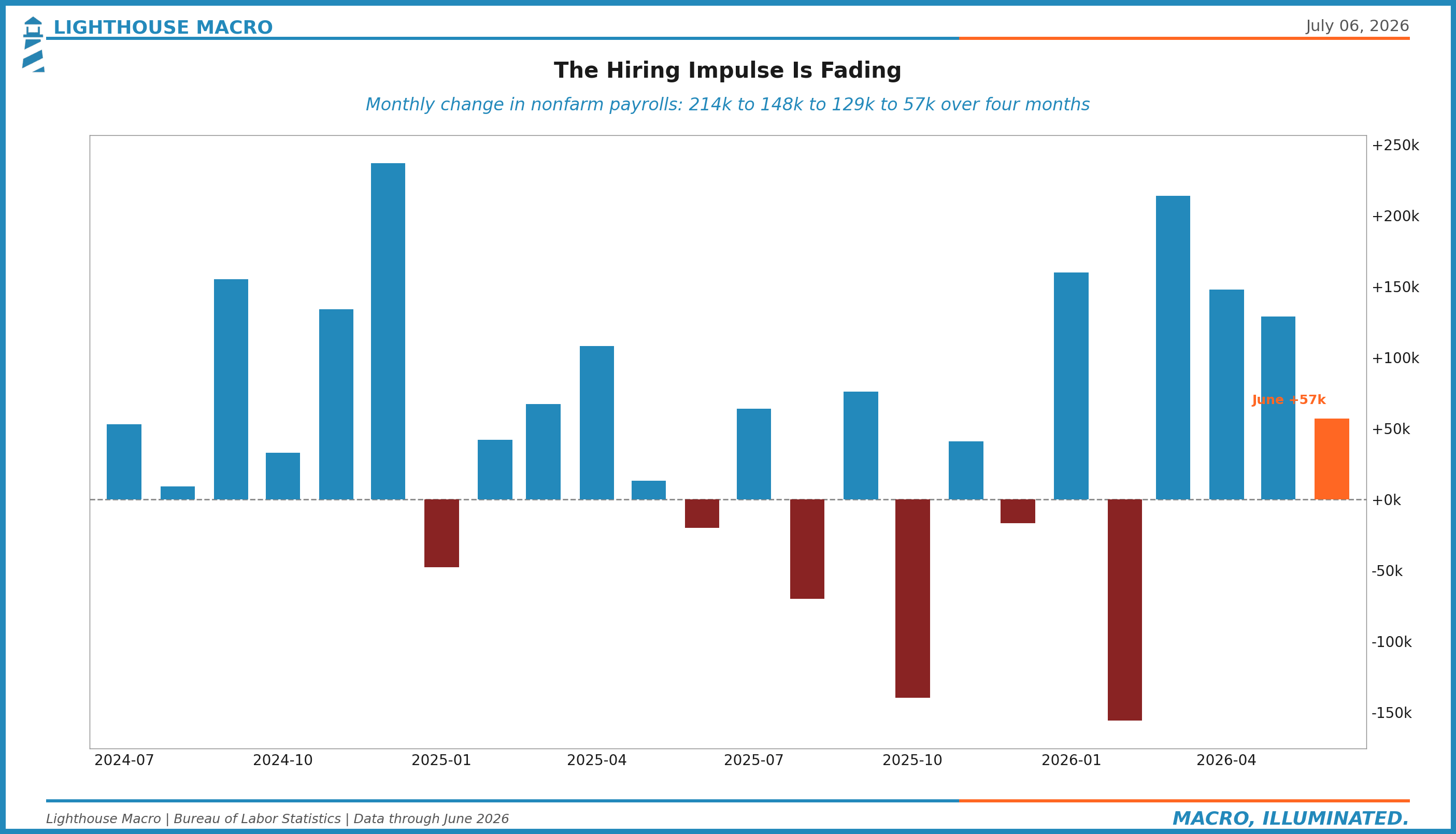
Start with the payroll number itself. The economy added 57,000 jobs in June. Put that next to the run that came before it, and the deceleration is the whole point. March added 214,000. April, 148,000. May, 129,000. June, 57,000. (Figure 1) That is a hiring impulse fading month after month, and the June print is the softest of the visible stretch. One weak month is noise. Four months walking downhill in a straight line is a trend.
Now the part that matters more than the payroll count, because it changes what the falling unemployment rate actually means.
Down for the Wrong Reason
An unemployment rate can fall for a good reason or a bad one. The good reason is that more people found jobs than joined the search. The bad reason is that people gave up looking, walked out of the labor force entirely, and stopped being counted as unemployed at all. The June rate fell for the bad reason.
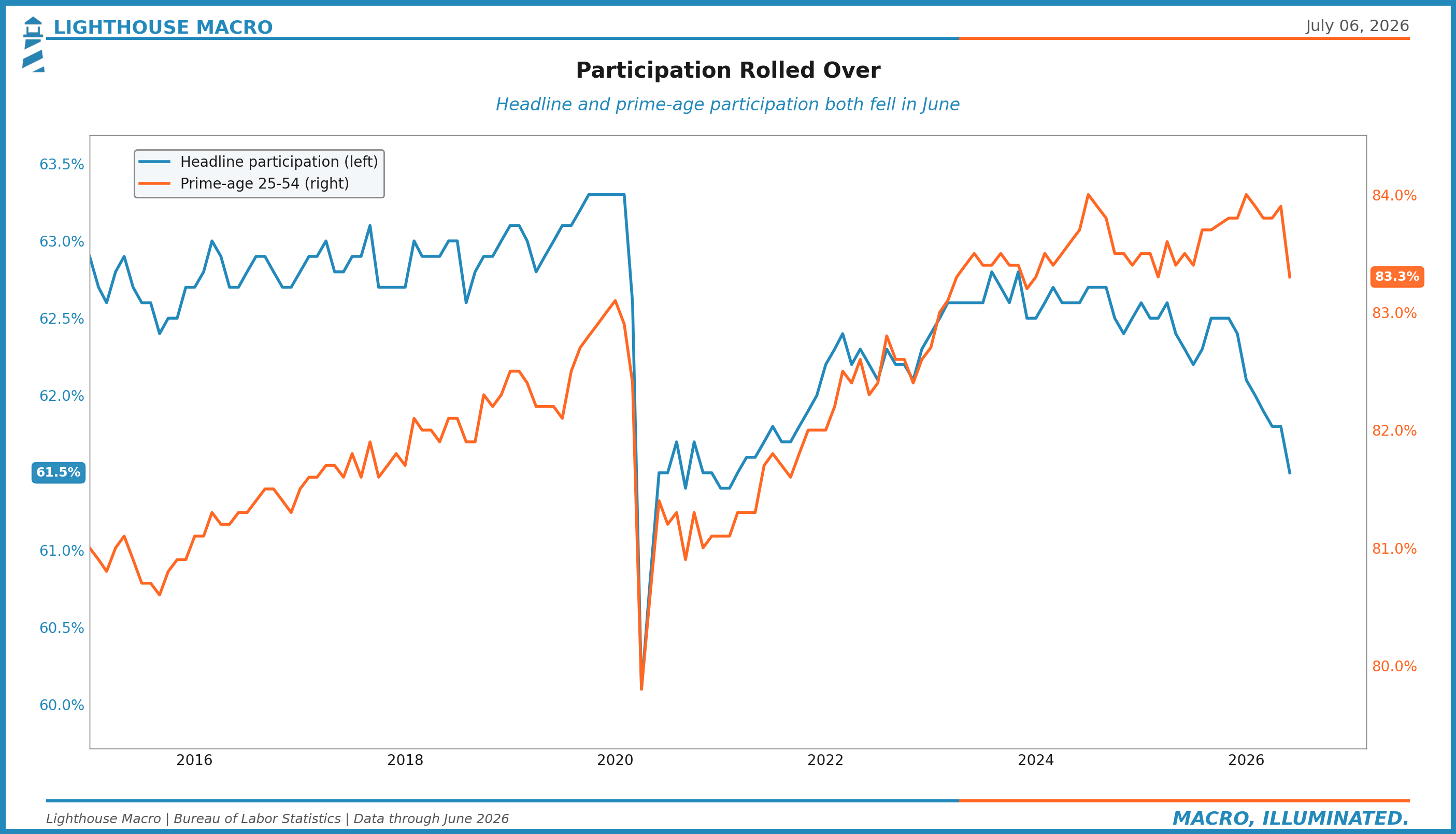
The labor force participation rate dropped from 61.8% to 61.5% in a single month. Prime-age participation, the twenty-five to fifty-four cohort that is supposed to be the sturdy core of the workforce, fell from 83.9% to 83.3%. (Figure 2) A 0.3-point drop in headline participation in a single month is people walking out the door. The unemployment rate improved because the denominator shrank, not because the numerator went to work. That is the one kind of improvement you never want to see, because it is what the early innings of a labor-market rollover look like from the inside.
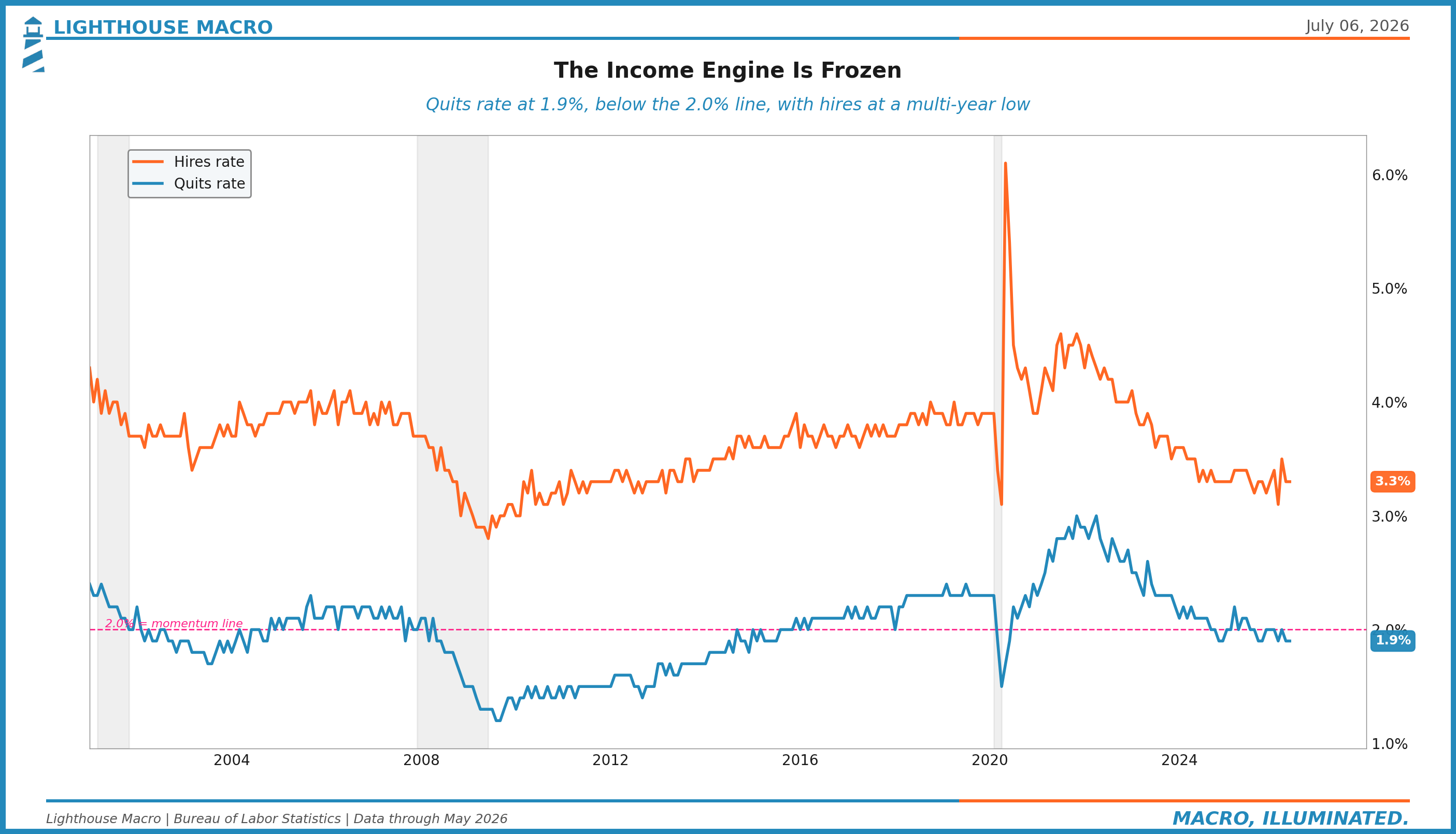
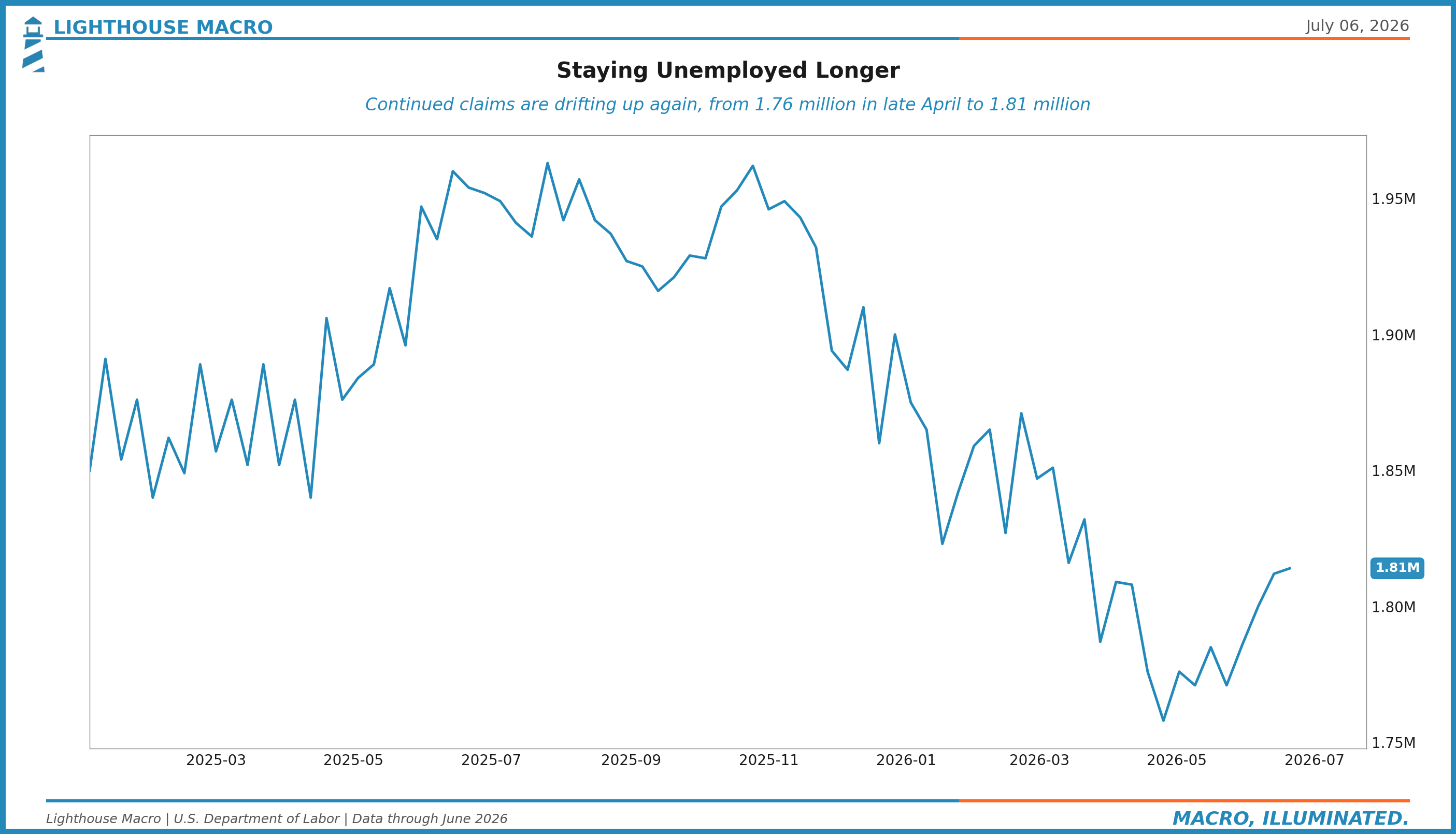
The internals say the same thing in a different language. The quits rate sat at 1.9% in the May JOLTS data, below the 2.0% line that has historically marked a labor market losing its forward momentum. (Figure 4) Quits are the truth serum of the labor market. People stop quitting when they stop believing a better job is one phone call away. The hires rate is down to 3.3%, a multi-year low, so the door in has narrowed at the same time the door out has stopped swinging. And continued jobless claims have drifted up to 1.81 million, which tells you the people who do lose a job are taking longer to find the next one. Firing has not started in size. But hiring has stalled, quitting for a raise has stopped, and the ones who fall out are staying out longer. That is a market losing its pulse, quietly, before it ever shows up in the layoff numbers.
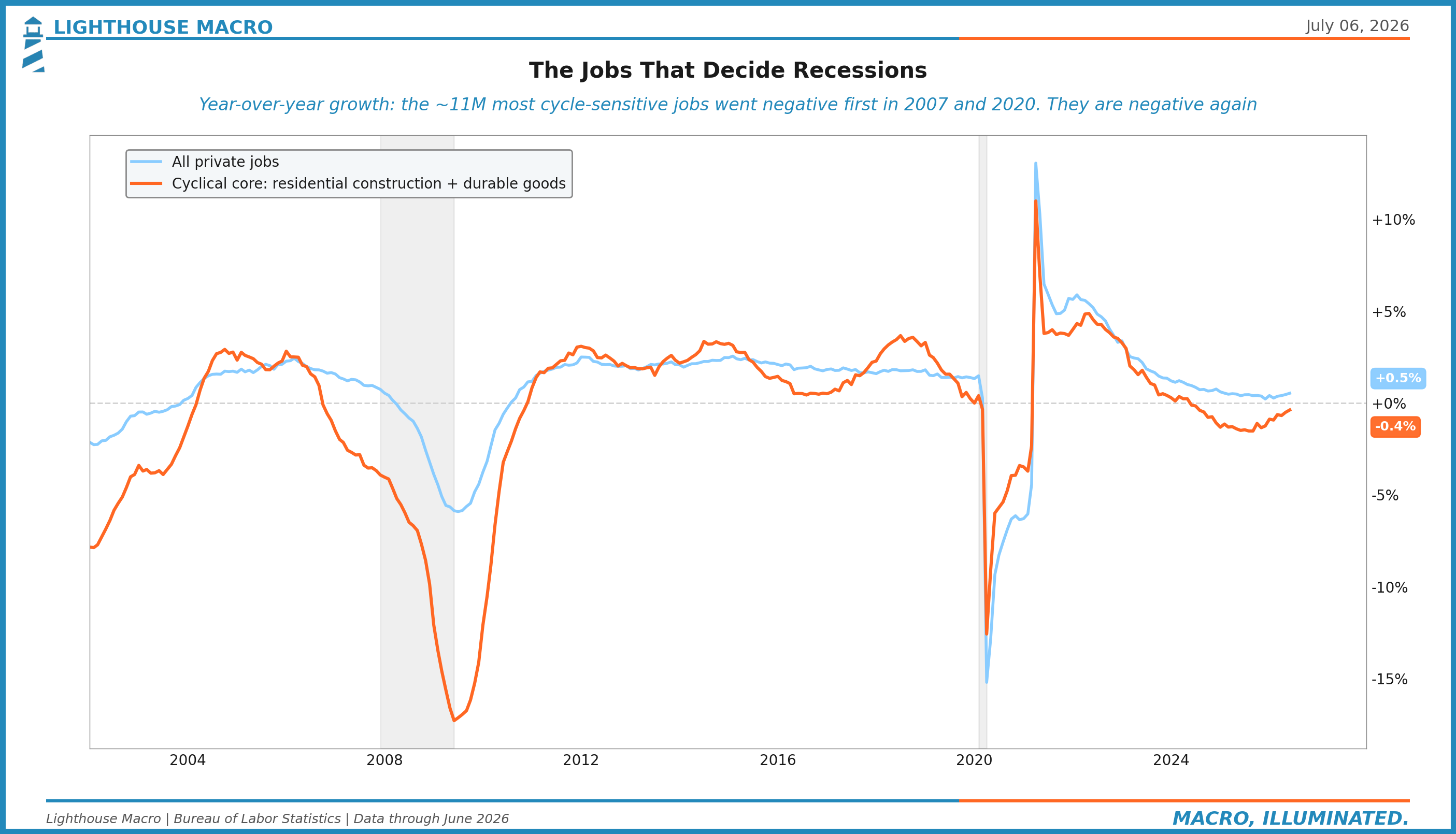
There is one more place to look, and it is the place recessions actually start. About 11 million jobs, residential construction and durable goods manufacturing, sit on the purchases people can delay. A grocery run can’t wait. A house and a car can. That slice went negative a full year before the 2008 recession while the headline stayed calm, and it is negative again now, shrinking since early 2024 while total payrolls set records. (Figure 6) The losses are still contained inside the cyclical core. Contained is doing a lot of work in that sentence.
So that is the second blade. The labor market that everyone keeps calling resilient is decelerating on hiring, thinning on participation, and freezing on the internal churn that used to hand workers raises. Collapsing would at least be obvious. This is quieter. It is rolling.
The Price Side Won’t Budge
Here is why the roll does not rescue anyone. In a normal cycle, a softening labor market is exactly what gives the Fed cover to cut. Growth cools, wage pressure eases, inflation follows the labor market down, and the committee rides that sequence lower on rates. That is the playbook the whole market was trading. It requires one thing to work. It requires inflation to cooperate.
Inflation is not cooperating.
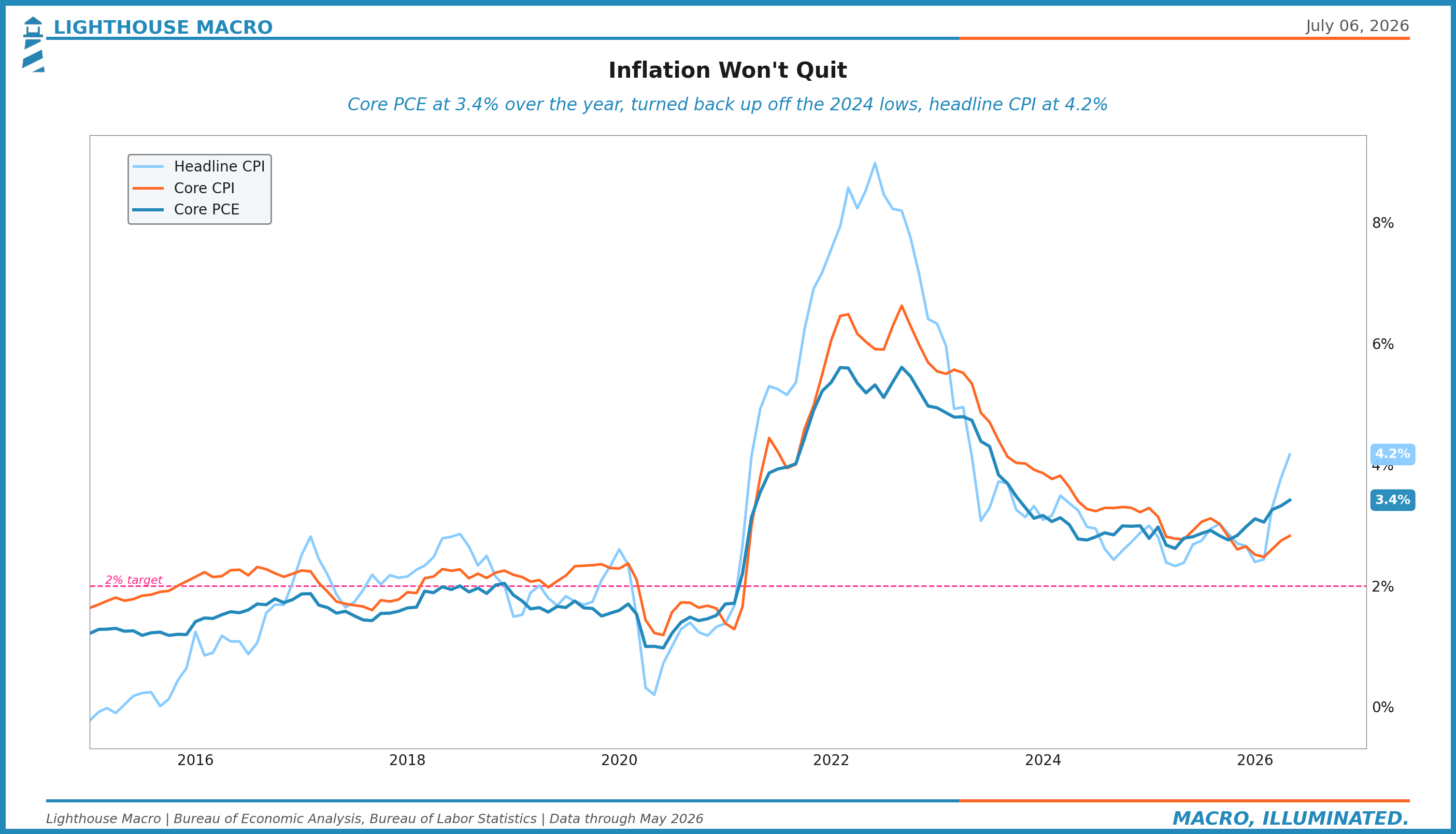
Core PCE, the measure the Fed actually targets, ran 3.4% over the year in May, and on a three-month annualized basis it is running 3.5%, which means the recent momentum is hotter than the trailing year, not cooler. (Figure 7) Headline CPI is 4.2%. Headline PCE is 4.1%. These are not numbers drifting gently back toward two. Core PCE has turned back up off its 2024 lows, and the Fed’s own June forecast, marked up to 3.3% for the year, says the committee sees it staying up. When the price data looks like this, a weakening labor market does not buy the Fed a cut. It just sharpens the conflict.
This is the read subscribers get every week. The cross-pillar synthesis, the mechanism, and what we are doing about it in the book.
Last call. The Fourth of July rate closes tonight. Through the end of today, Monday July 6, the annual plan is $400. That is 20% off the standard $500, and the rate locks for as long as you stay. After tonight, $500 is the floor from here, and the entry point only goes up. Subscribing inside the window also gets you this week’s full supplementary chart pack, linked at the end of this report, as well as the entire paid archive.
Two more things before the window closes. The mix of free and paid changes after tonight. Since January we have published the framework in the open, all twelve pillars, the full curriculum, because you cannot judge a process you have never seen. That phase is done. Starting with tomorrow’s Horizon, the forward-looking work goes behind the paywall, free pieces get less frequent, and previews get shorter. The syllabus was free. The course is not.
And if you have been to our main Lighthouse Macro site lately, you may have noticed the site is changing. There is a Reading Room collecting everything we have published, and behind it we are building Pharos, the Lighthouse Macro terminal. The build stands at 30 dashboards today: the 12 Pillars, 6 asset classes, 6 Main Street Monitors, and 6 Transmission Chain Trackers that pull the two dozen granular reads into the views we run the book from. Pharos is not open yet, and that is exactly why we are mentioning it tonight. Every paying subscriber is grandfathered into Pharos at their locked rate when it goes live. The $400 you lock tonight is the cheapest that door will ever be.
Don’t navigate in the dark.
